
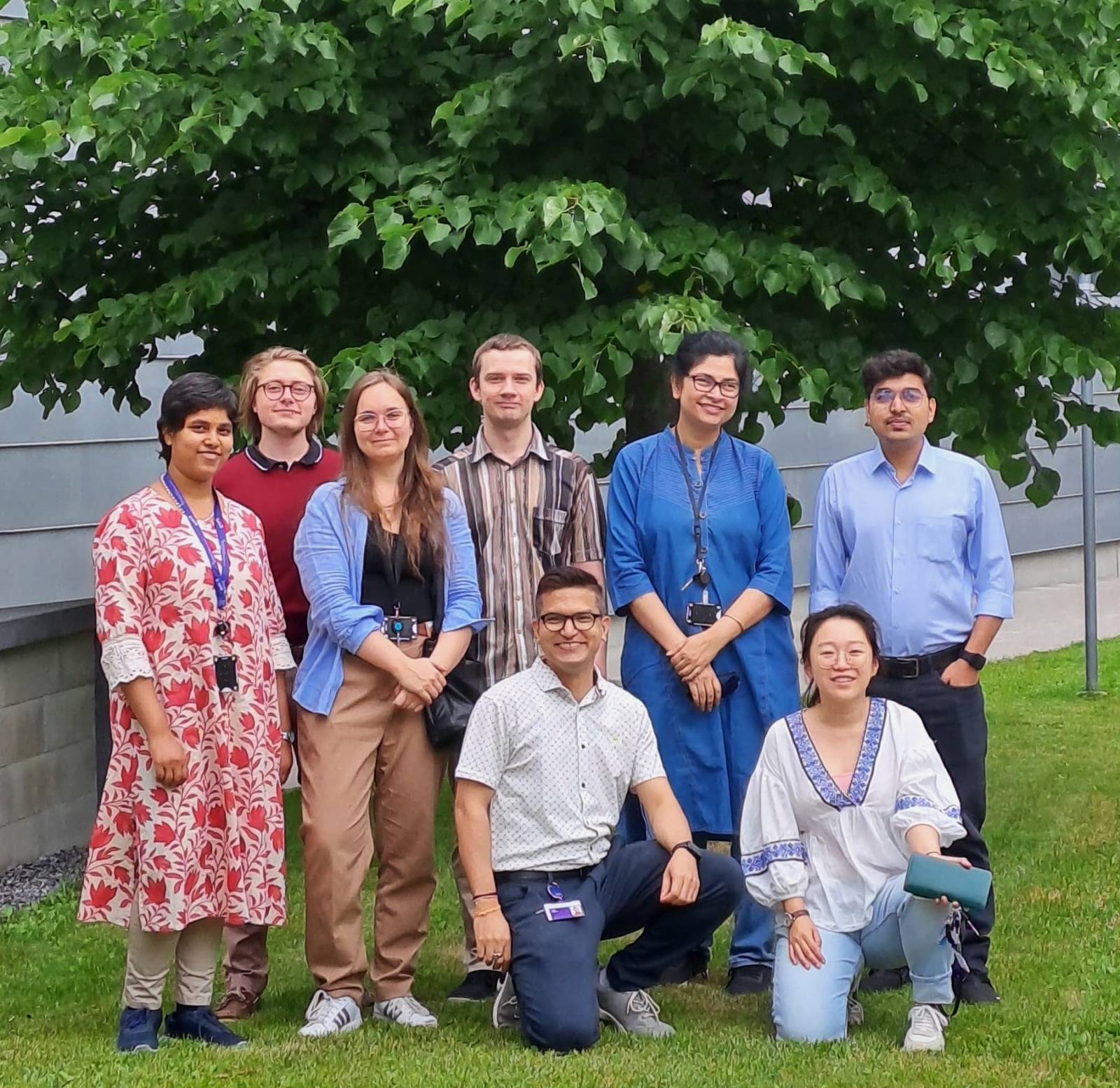
The CMOS and Beyond group currently consists of Principal Investigator (PI) Sayani Majumdar, 2 post doctoral fellows, 5 PhD students and two Masters student. Details on everyone’s expertise and research topics can be found below.
Principal Investigator
Sayani Majumdar
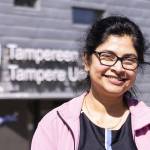
Dr. Sayani Majumdar is an Associate Professor of Electrical Engineering at the Faculty of Information Technologies and Communication Sciences at Tampere University, Finland. She also serves as a Steering committee member of the System-on-Chip (SoC) hub at Tampere University and as visiting professor at the Miin Wu School of Computing at National Cheng Kung University, Taiwan. Her career in semiconductor device research spans more than two decades where she worked in both academia and in close collaboration with the industry. She worked on several emerging technologies including spintronics and charge-based memories in world-leading organizations including MIT, USA and Max-Planck Institute, Germany. Her team’s current research focuses on the development of non-volatile memory and neuromorphic computing hardware using low-thermal budget ferroelectric materials and processes for their back-end-of-line integration with CMOS circuits, neuromorphic architectures and their application in extreme edge devices.
Post Doctoral Fellows
Sozaraj Rasappa

My roles and responsibilities in the CMOS and Beyond: Devices and Systems Research Group include leading fabrication efforts for developing 2D and 3D research device components integrated with CMOS backend. I focus on ferroelectric devices—such as ferroelectric capacitors, FeFETs, and ferroelectric tunnel junctions—for neuromorphic computing and sensing applications. I am responsible for maintaining KPIs related to both process and device performance, guided by data analysis and Lean Six Sigma principles. I collaborate with internal and external stakeholders throughout the end-to-end product development cycle, from design and fabrication to reliability testing.
Kapil Bhardwaj

I am a postdoctoral fellow in the CMOS and Beyond: Devices and Systems Research Group, where my current research focuses on developing neuromorphic architectures for multi-sensor fusion, aiming to improve decision-making in autonomous systems. By leveraging the inherent adaptability and fault-tolerant characteristics of neuromorphic circuits, I focus on designing energy-efficient and compact hardware solutions that can operate reliably under varying sensor conditions. Alongside this, I have gained substantial experience in SPICE modeling of emerging memory devices, peripheral circuits of in-memory computing systems, and various kinds of CMOS-based analog and mixed-signal circuits. This multidisciplinary expertise supports my broader vision of integrating novel memory and sensing paradigms into next-generation intelligent systems.
Ph. D. Students
Xinye Li
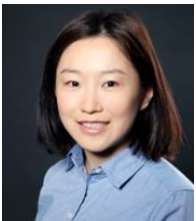
My PhD research focuses on “Low Thermal Budget Ferroelectric Memories and Sensors for Near and In-Sensor Computing.” The study centers on intelligent devices based on ferroelectric Hf₀.₅Zr₀.₅O₂ (HZO), which offer a scalable, back-end-of-line (BEOL)-compatible fabrication process and exhibit non-volatile remanent polarization. Utilizing Finland’s advanced atomic layer deposition (ALD) techniques, it is possible to develop energy-efficient, long-lifetime, wafer-level reliable superlattice HZO thin film. In my thesis, I will investigate integration of ferroelectric gate stacks with 2D semiconductor based transistors that is expected to further enhance their sensing capabilities and realize a sensing memory combined device platform.
Padma Srivari

My PhD research focuses on optimizing materials and device architectures to improve performance and energy efficiency in memory and neuromorphic circuits. A core aspect of this work involves the integration of AI-driven optimization techniques to systematically refine material compositions and process parameters, with the objective of enhancing device functionality while maintaining industrial relevance and sustainability. Specifically, my research centers on the development of low thermal budget ferroelectric HfZrO₂-based devices that are compatible with back-end-of-line (BEOL) CMOS fabrication. To address reliability and scalability challenges, I conduct comprehensive electrical and structural characterization at the wafer scale aiming to advance the realization of scalable, CMOS-compatible ferroelectric devices for next-generation memory and neuromorphic computing applications.
Ella Paasio

My research focuses on memory capability of ferroelectric HZO down to deep-cryogenic temperatures. From understanding the key physical operation and it’s limitations, to optimizing specialized fabrication conditions best suited for cryogenic applications. I specialize in device design, their thorough temperature-dependent characterization and physics based compact modelling. My work contributes toward development of cryogenic memory, that is essential for scaling up quantum computing, Space technologies, AI and high performance computing.
Farhan Siddique

In my doctoral research, I focus on fabrication and characterization optoelectronic synaptic devices based on 2D materials and ferroelectric structures. I am specializing on the fabrication of 2D semiconductor-based FET devices and studying their synaptic responses under light through electrical and optical measurements. My research will investigate key synaptic behaviors such as photonic memory and plasticity to evaluate their potential for neuromorphic computing applications. Ultimately, the photonic hardware will be integrated with software-based neural networks to enable efficient image classification and other complex tasks.
Anika Anu

My research focuses on the reliability aspects of ferroelectric memory devices by combining experimental measurements with machine learning based prediction models. My study concentrate on how various ferroelectric device parameters vary cycle-to-cycle, device-to-device, across wafer, and between manufacturing batches. I extract key features from the device characterization data and use machine learning models to identify patterns and predict how better device reliability can be achieved.
Master’s Thesis Students
Rikhard Ranta

I focus on researching HZO-based memristive FTJ devices for cryogenic applications, due to their high scalability, low operational power consumption and differences in operation depending on temperature. My goals include optimizing the FTJ operation in temperature regimes from industry standards down to deep-cryogenic temperatures, demonstrating cryogenic in-memory computing on hardware fabricated by our group as well as modelling the FTJ-device behaviour, with a final end goal of utilizing the FTJ crossbar arrays for quantum error correction using neural networks.
Ashfak Nehal

My research focuses on memristor based associative learning for multi sensor fusion in autonomous and ADAS systems. By codesigning ferroelectric devices with mixed signal circuits, I build hardware that learns useful correlations and remains robust to missing or unsynchronized inputs. My thesis spans device level modeling through breadboard and PCB prototypes to real-time embedded implementations on microcontrollers with various sensors, and develops a compact, low power, cloud independent neuromorphic preprocessing layer that enables millisecond scale actuation for safety critical behaviors.
Artur Toivonen (Former student)
Artur Toivonen worked (2024-2025) on cardiac arrythmia classification from Electrocardiogram (ECG) data using a ferroelectric neuron based Spiking Neural Network (SNN). Currently he is in the process of completing his masters thesis.