
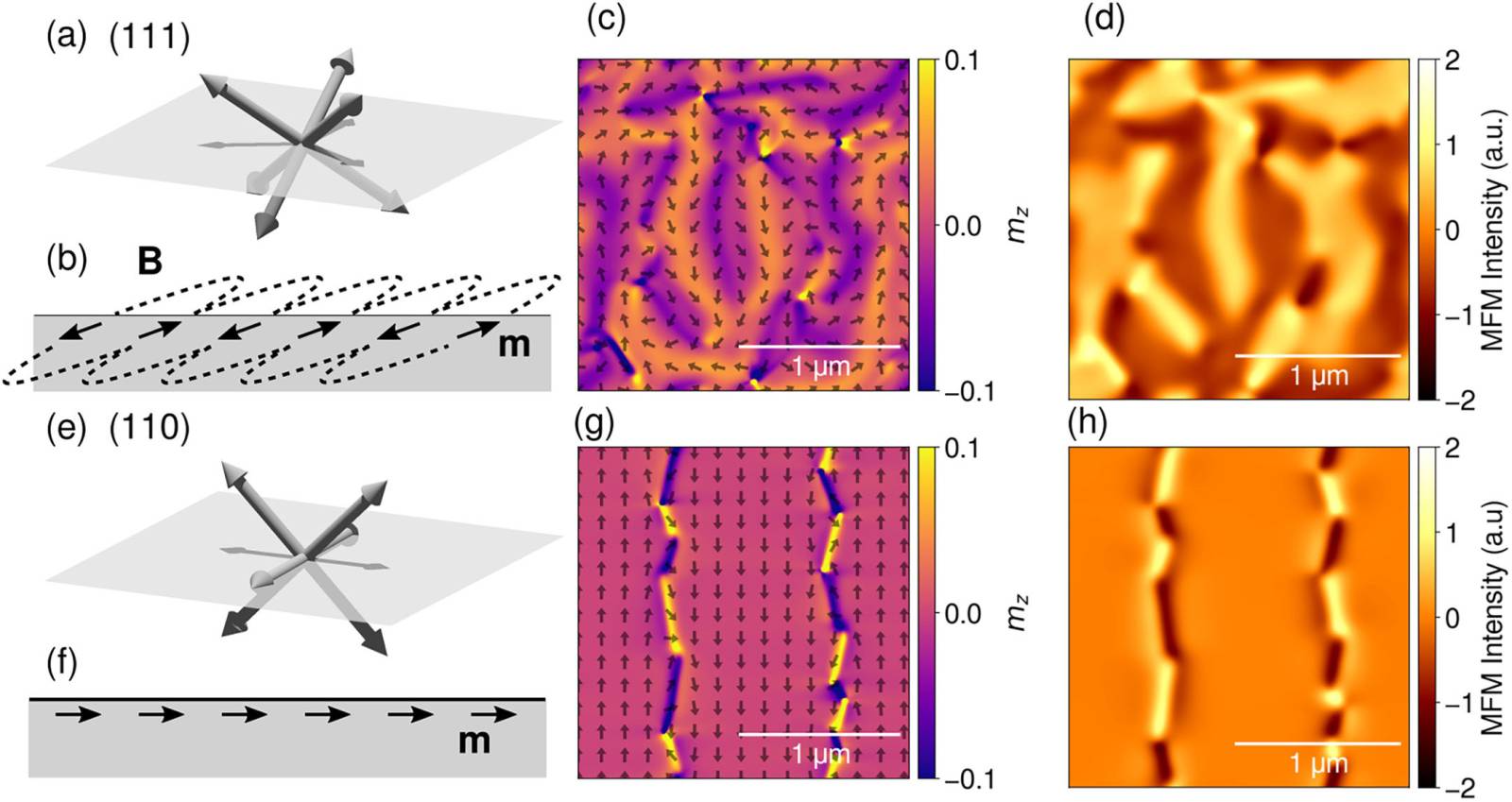
Abstract: Grains in ferritic steel oriented along the hard magnetization axis exhibit complex magnetic structures, often visualized as maze-like patterns using magnetic force microscopy. Although previously observed, their origin has remained unclear. Our study combines correlative structural analysis—including analytical electron microscopy, magnetic force microscopy, magneto-optical Kerr microscopy, and micromagnetic simulations—to reveal the origin of these patterns. Both experiments and simulations confirm that grains aligned with the hard axis show a maze-like domain structure, while other orientations display simpler configurations. Simulations demonstrate that the maze arises from slight out-of-plane magnetization components along the (111) surface, whereas magnetization remains in-plane on the (110) surface due to energy minimization. Notably, maze-like domains are absent when the surface orientation deviates more than 7° from the hard axis. We also identify a critical thickness range (120–256 nm) necessary for maze formation. Dynamic studies show that maze-like patterns disappear if the magnetic field in the vertical direction increases, while the actual domain walls move between pinning sites. Our comprehensive approach provides quantitative validation for a previously qualitative phenomenon, offering new insight into the magnetic behavior of ferritic steel and the measurable influence of crystallographic orientation and sample thickness on domain structure.
The paper is published as S. Santa-aho, J. Rozo Vasquez, S. Kaappa, M. Honkanen, L. Laurson, S. Strodick, F. Walther, and M. Vippola, Magnetic maze in steel resolved by correlative structural analysis, Mater. Des. 261, 115260 (2025).
Congrats to everyone involved!