

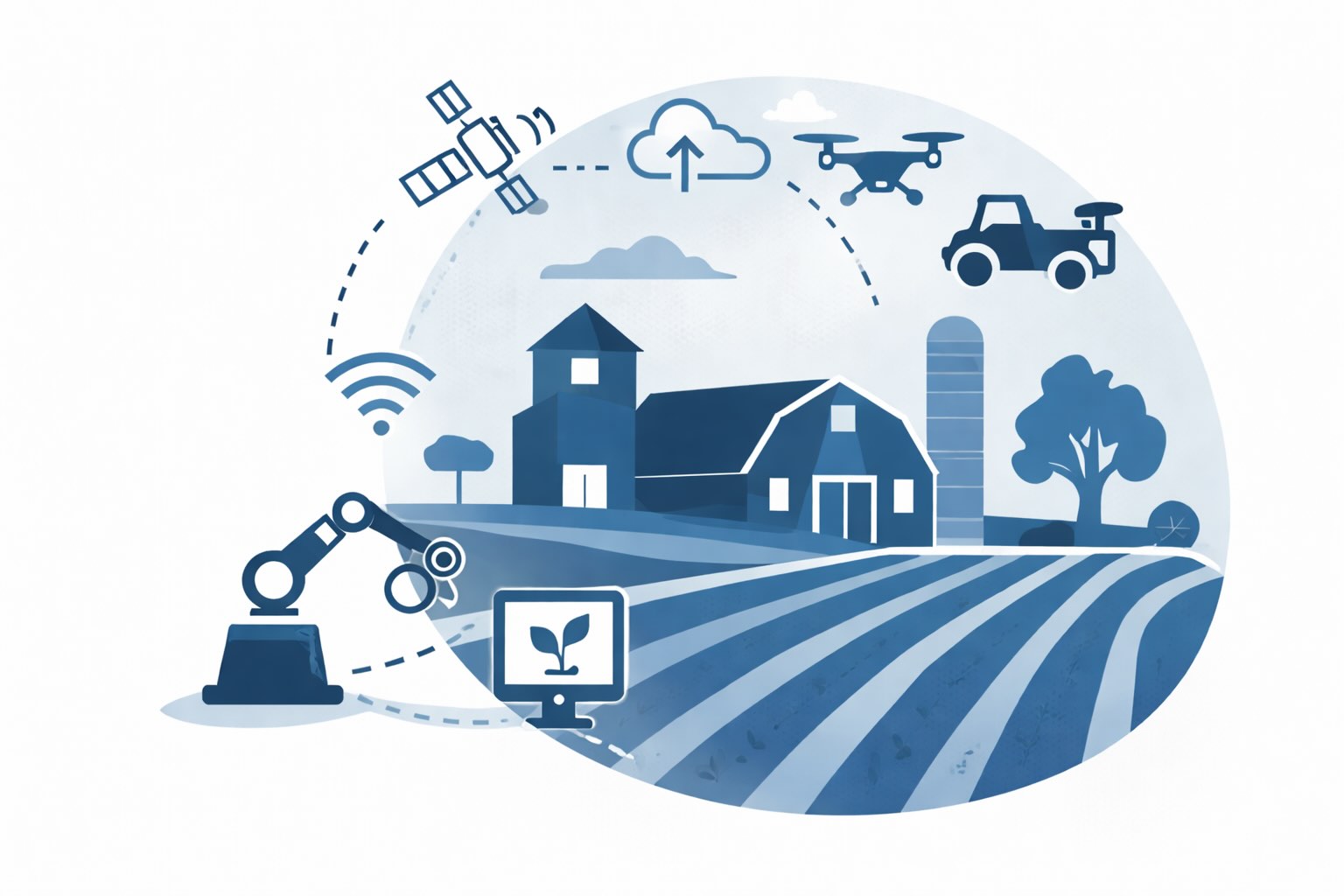
The Emerging Technologies Lab (ETL) at Tampere University is pleased to announce its participation in the FARMAR (Farmer-in-the-loop heritage-aware AI and Robotic Mechanisation for Agricultural Resilience) project, funded under the Marie Skłodowska-Curie Actions (MSCA) Staff Exchanges programme. The project will run from October 2026 to September 2030 and is coordinated by Durham University (UK).
FARMAR brings together an international consortium of academic, industry, and societal partners to explore how artificial intelligence, robotics, and data-driven technologies can support the transition toward more sustainable, resilient, and efficient agricultural systems. The project responds to major challenges in modern agriculture, including labour shortages, environmental pressures, and the need to translate technological advances into practical, scalable solutions.
A central feature of the project is international and intersectoral staff exchange, enabling researchers and professionals to collaborate across disciplines and organisational boundaries. Through these exchanges, FARMAR aims to bridge gaps between technological development, agricultural practice, and societal needs.
Within the project, ETL contributes its expertise in socio-technical systems, human–technology interaction, and digital transformation. The lab’s work focuses on understanding how advanced technologies reshape agricultural practices and decision-making, building on the idea that behaviour emerges from the interaction between individuals and their environments.
ETL’s contributions include:
- Analysing how farmers interact with and adopt AI-driven technologies.
- Translating real-world farming practices into forms usable by computational systems.
- Examining how technological change affects work, trust, and decision-making in agricultural contexts
By working closely with partners in robotics, agronomy, and industry, ETL helps ensure that FARMAR’s technological developments are grounded in real-world practices, and are not only technically robust but also usable, trustworthy, and socially sustainable.
FARMAR highlights the importance of interdisciplinary collaboration and knowledge exchange in addressing complex societal challenges and strengthens Tampere University’s role in European research at the intersection of technology and society.