
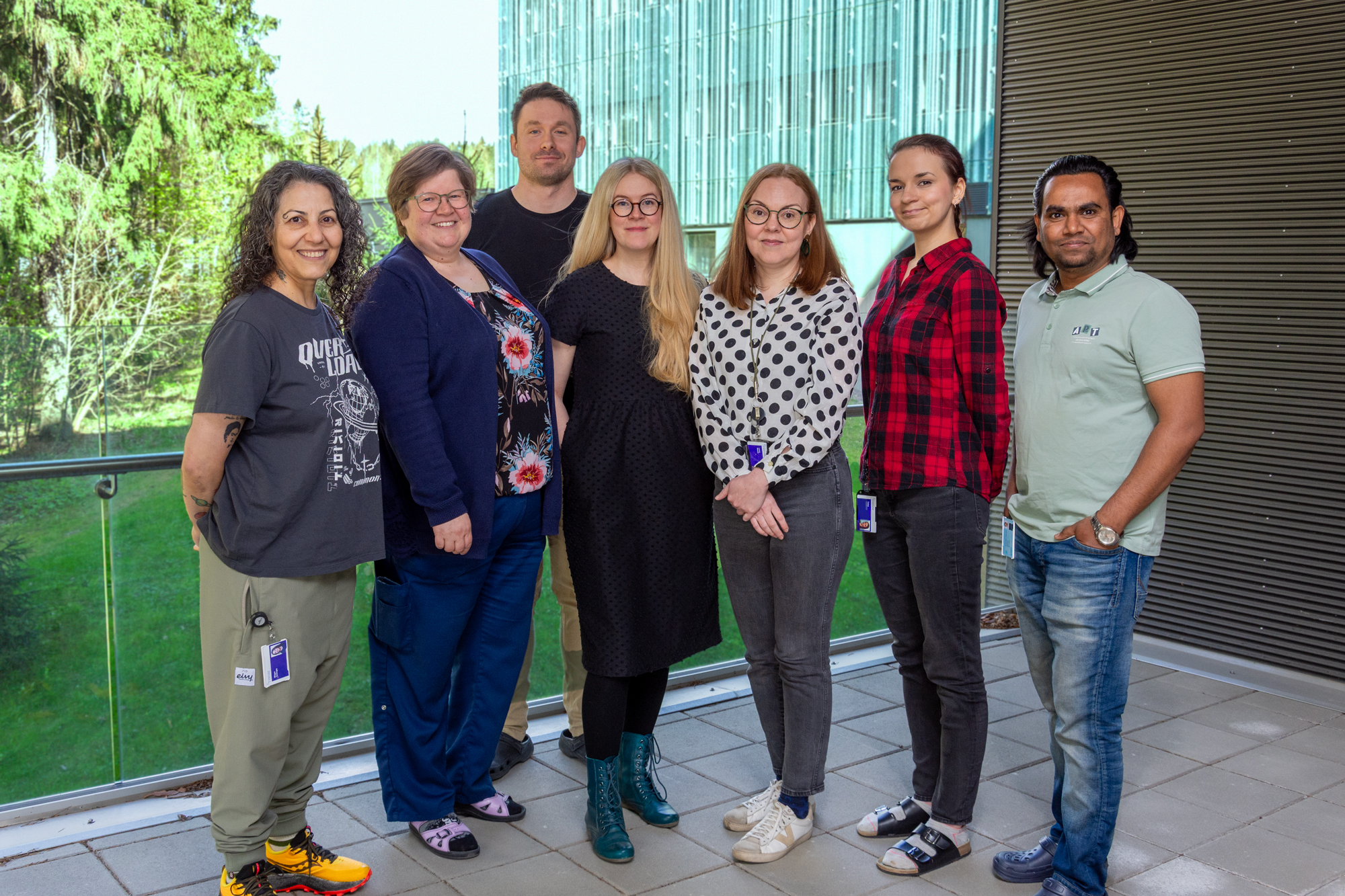
 Mitochondrial Immunometabolism research group (14.5.2025) from left to right Mügen Terzioglu, Tea Tuomela, Tilman Tietz, Tiina Salminen, Laura Vesala, Yuliya Basikhina and Kabir Mahmud.
We study the various roles that mitochondrial (dys)functions have on cellular and organismal physiology. Genetic variation leading to functional changes of mitochondria can originate from nuclear genes encoding for proteins transported to mitochondria, or from the small, circular mitochondrial genome (mtDNA). Environmental factors modulating mitochondrial functions include various pharmacological agents (such as antibiotics), toxins (such as pesticides), diet, temperature and infections.
We are interested in the effects of mitochondrial variation in the contexts of 1) mitochondrial pathologies, 2)innate immune responses and 3) cancer. Methods we use as readouts of the mitochondrial variation include transcriptomic and metabolomic profiling, respirometry, advanced fluorescent microscopy and flow cytometry. We have also developed new methodology to measure mitochondrial heat generation, and study the role of mitochondrial thermogenesis in various contexts at cellular and organismal level.
We utilize both in vitro and in vivo models to address our research questions comprehensively. Our in vitro models include patient derived cell lines as well as insect cell lines. As an in vivo model we have the genetic model species, fruit fly Drosophila melanogaster. Many of the disease genes and pathways are conserved between human and the fruit fly, and the highly sophisticated genetic toolbox generated for Drosophila enables us to modify target gene function in a temporal and tissue-specific manner.
This time-lapse video shows how human fibroblasts respond to the addition of mitochondrial inhibitor. Here, the network of mitochondria is stained with a chemical dye sensitive to changes in the mitochondrial temperature and the colder the mitochondria, the brighter the fluorescence (green). (Evident FV4000 LSCM microscope system, 60X silicon objective, zoom out). Mügen Terzioglu