
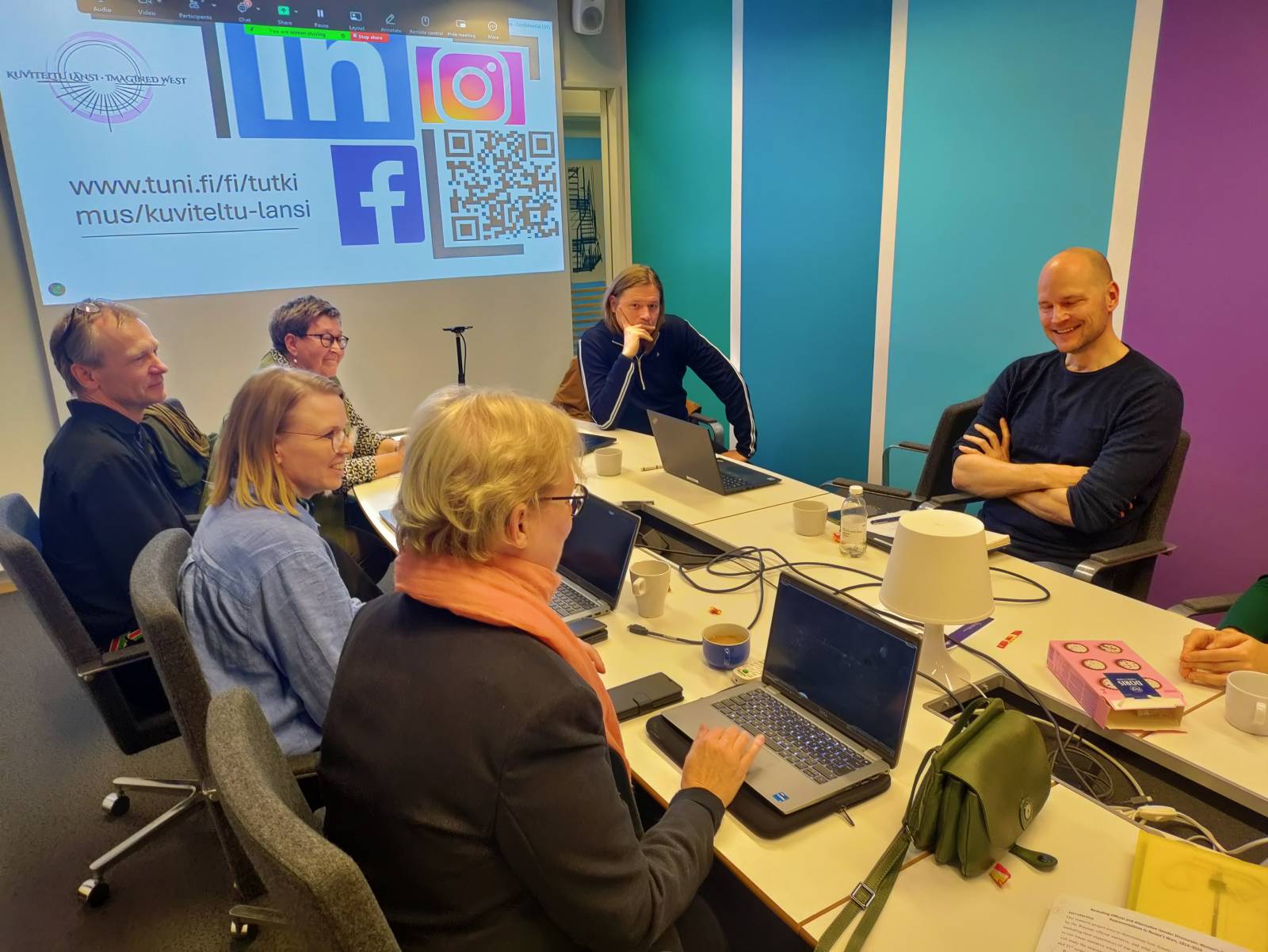
It has been over a year since we have had an opportunity to catch up face to face, so it was high time to gather again to hear the latest on what colleagues have been up to. It was decided that the meeting be an internal one amongst TaRC members and those doing research about themes that are of interest to TaRC.
We were pleasantly surprised to find how active the participants had been since our previous rendez-vous, and how diverse but yet interconnected their topics were. Not for the first time, a meeting like this showed the importance of an interdisciplinary approach to creating new ideas and generating new knowledge!
Apart from enjoying the company of good colleagues (and some coffee, tea and refreshments), we were treated to five interesting presentations:
- Elise Kraatila, Riikka Pirinen and Markus Laukkanen (Tampere University) discussed their new project on journalistic future narratives with a case study on Finnish media’s reporting about Finland, Russia, and NATO from the Russian invasion of Ukraine to August 2025.
- Mika Perkiömäki (Tampere University) presented his new project on different ways of climate obstruction in Russian pro-state media, with a focus on the years 2019-2024.
- Vera Zvereva (University of Jyväskylä) analysed Russian war propaganda on Telegram groups directed to Russians living in Finland as part of her bigger ongoing project focusing on the discourses of Russian political communication and cultural diplomacy in Finland.
- Tatu Laukkanen, Arja Rosenholm (both Tampere University) and Olga Simonova (University of Turku) presented their big new collaborative research project that investigates different mediated female (self-)representations in Russia’s wars from World War I to present day.
- Jukka Jouhki (Tampere University) talked about his ongoing project about the imagined West and different forms of Occidentalism, giving as a case study Finnish news media’s reporting on the war in Ukraine.
In the discussion following the presentations, the authors were given a number of useful tips for their respective studies. We hope they will help the presenters elaborate on their great ideas and research designs!
In addition, a number of ideas for further collaboration were put forward. Most were concerned with developing research methodology and increasing internal co-operation and communication between researchers and research groups. Some concrete invitations were already exchanged between scholars in different research groups to join each other’s meetings and symposia in the coming months. We will also keep you posted about these events on our pages.
We at TaRC hope such practices become an even more integral part of our work and continue to facilitate meetings for fruitful collisions across disciplinary and university boundaries in the future!