
Currently, the group is pursuing research in the following areas:
- Topology and Geometry of Structured Light
- Topological Light-Matter Interaction
- Quantum Optics of Epsilon-Near-Zero-Media
- First-Principle Approaches to Material Properties
Topology and Geometry of Structured Light
Structured light, i.e., electromagnetic waves with on-demand spatial and temporal structure and properties, has been a topic of intense research in the past decades, leading to many fascinating and groundbreaking applications, ranging from optical communications, microscopy, imaging, particle manipulation, and quantum information. Being able to predict how to control new and different degrees of freedom of light waves will then give a unique advantage in finding new forms of structured light, or new platforms for it, which will contribute in discovering new features of light, and novel exciting applications. For various of these studies, we collaborate with the group of Prof. Mark Dennis at the university of Birmingham, for complementary theoretical support, and the our colleagues from the Experimental Quantum Optics and Advanced Coherent Sources groups for experimental validation of our theories and models.
Geometry of Vector Beams
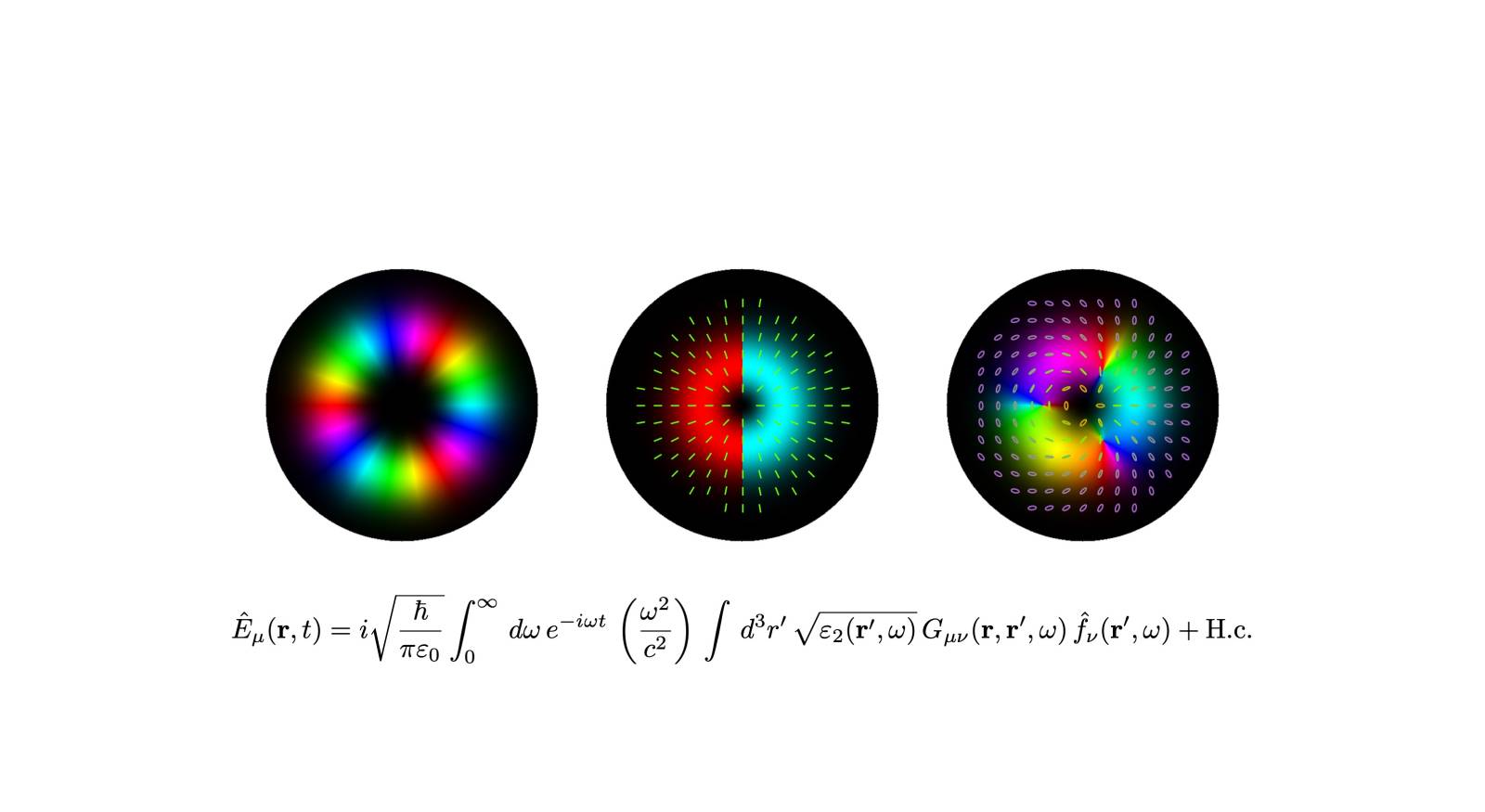
One important aspect of modern theoretical optics, especially when it comes to structured light, is to develop a common language capable of unifying the description of different kinds of light beams in a single framework. Having a single, coherent framework, in fact, allows for better design and control of the properties of light beams. In this context, fibre bundle theory offers a powerful geometric language to describe the properties of vector beams, linking local polarisation properties to global topological features. With it, we recently shown how this framework can be used to classify the various kinds of vector vortex beams in the paraxial regime. See Fig. 1 (and here for more details).
Currently, we are investigating, in collaboration with Prof. Mark Dennis, how this framework can be used to gain insight on the onset of non-Abelian geometric phases carried by vector beams, possibly leading to new guiding principles to create holonomiw classical and quantum gates for structured light.

igure 1. Classification of paraxial vector beams using fibre bundle theory
In the future, we would like to generalise this approach to embrace vector beams with arbitrary mode functions, and extend the formalism to also include non-paraxial light and spatiotemporal optical pulses, to create a comprehensive atlas of light fields based on their topological properties.
Optical Phase Singularities and Topological Field Theories
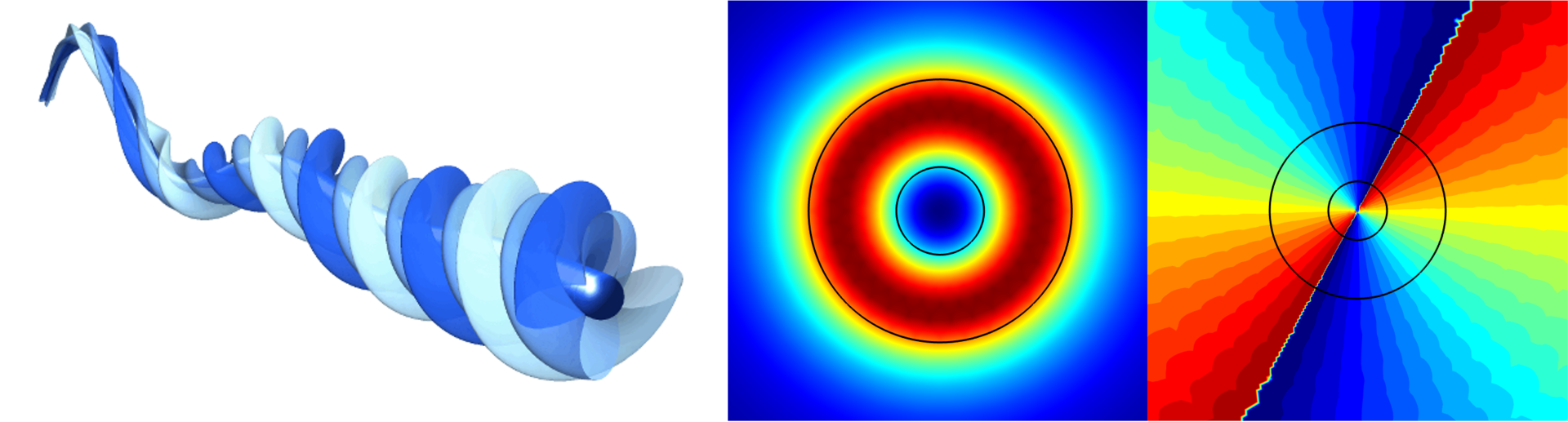
A light field may contain phase singularities, i.e., points in its phase front, where the phase is undefined. A prime example of that is an OAM beam, carrying a phase singularity at the centre of its phase front, which endows it with orbital angular momentum. These phase singularities are topological defects of the field and, as such, are resilient against perturbations and can be used as a skeleton to describe the topological properties of the field. In this project, we use topological field theory, a framework describing physical phenomena through their global geometric and topological structure, to study the dynamics of phase singularities during propagation. We are particularly interested in how these vortex lines (i.e., the trajectories described by phase singularities during propagation) intertwine with each other while the beam propagates, creating knotted and braided configurations (see Fig. 2). This could help us achieving a deeper understanding of their classical and quantum properties, and provide a comprehensive framework to control and engineer vortex lines in optical fields, a feature that could have promising applications in quantum information, sensing, and communications. Recently, we have studied, in collaboration with the Experimental Quantum Optics group, how constellations of phase singularities in OAM beams are changed upon reflection from a surface [click], and we are currently investigating the propagation properties of such constellations. Another interesting direction we are pursuing sees connecting the dynamics of phase singularities in optical beams with that of charged particles subject to a genuine 2D electromagnetic field, which could open the way for optical anyons.

Structured Light in Twisted, Ring-Code Optical Fibres
OAM beams, i.e., light fields carrying orbital angular momentum, have proven to be very important in various applications, ranging from microscopy and sensing, to optical communication and biophysics. Most commonly, these beams are generated in free space with the help of computer generated holograms. Being able to generate such light fields in optical fibres in a controllable manner, however, could open the way for application of OAM beams in high-power physics, since optical fibres are a well-established framework for high-power applications. Amongst the plethora of available geometries, twisted fibres, i.e., optical fibres whose core rotates around the optical axis in a helical fashion, are a very interesting platform for OAM beams, since twisting introduces a new set of selection rules on the allowed optical modes supported by the fibre, which favours, by symmetry, OAM modes over others. The aim of this research topic is then to model the propagation of OAM beams in twisted, ring-core fibres, understand their properties and provide a comprehensive platform to design and engineer OAM modes in optical fibres for high-power applications.
Topological Light-Matter Interaction
Another interesting research direction is to look at the interplay between topological properties of light and matter, by combining vector beams with topological insulators. In this way, it is possible to control and engineer the topological properties of matter by patterning topological insulators with suitably designed vector beams, so that the inhomogeneous polarisation pattern possessed by the vector beams can induce a similar pattern in the spin texture of electrons in the material, thus unlocking new dynamics and properties of matter. Currently, in collaboration with the Theory of Quantum Matter and Information group, we are working on coupling optical skyrmion beams to simple, two band topological insulators to establish the basic model for topological light-matter interaction. In the future, we would like to use this framework to find new ways to control the flow of light and electron-photon interactions in all-topological systems.

Quantum Optics of Epsilon-Near-Zero-Media
Epsilon-Near-Zero (ENZ) media are exotic materials, whose permittivity has a real part that formally goes to zero at a specific frequency (the ENZ frequency). When this condition is met, electromagnetic waves propagating in such media experience unusual properties, due to the fact that the refractive index is smaller than one, i.e., than the refractive index in vacuum. However, these materials typically experience non-negligible losses around the ENZ frequency, making them intrinsically lossy and dispersive media. To study the quantum properties of such materials, therefore, the traditional approach of Quantum Optics is not viable anymore, since usually the lossless medium assumptions is made. To properly describe quantum effects in ENZ media, therefore, we use the rigorous dyadic Green’s tensor quantisation scheme, where polaritons (i.e., dressed light-matter excitations), rather than photons, are the primary quantum objects of the theory. With this at hand, we try to describe quantum nonlinear effects, in ENZ nanostructure excited by quantum states of light. Our current research, done in collaboration with the Nanomaterials & Nanostructure Optics group led by Prof. Luca Dal Negro (Boston University), is focused on quantum nonlinear optics effects, such as Kerr effect, third-harmonic generation, and cross-phase modulation. Our aim is to investigate the feasibility of ENZ-based single-photon devices for quantum sensing and establish a robust benchmark for quantum nonlinear optics in nanophotonic structures.
First-Principle Approaches to Material Properties
Understanding the origin of the various physical properties of matter is very important, as it enables a better level of design and engineering of optical technologies based on such materials. Our research focuses on the use of quantum field theory inspired methods, such as path integrals and macroscopic quantum electrodynamics (QED), to investigate the interaction of light with matter at the microscopic level and connect these microscopic dynamics with the macroscopic effective models of linear and nonlinear classical and quantum optics. In doing so, we construct a unique bridge between the microscopic and macroscopic world, which allows us to obtain a better understanding of many-body effects in light-matter interaction phenomena.
Currently, we have two parallel, but complementary, research directions on this topic: one, in collaboration with the Electronic Structure Theory group of Emeritus Prof. Tapio Rantala, aims at using Path Integral Monte Carlo (PIMC) methods to study the linear and nonlinear response of quantum plasma to have a better understanding of the optical response of ENZ materials from a first principle perspective. The other approach, in collaboration with the Quantum Optics of Macroscopic Systems group led by Prof. Stefan Scheel (University of Rostock), aims at investigating the quantum nonlinear properties of ENZ materials starting from the microscopic Huttner-Barnett model of lossy, dispersive materials, and constructing, using path integrals, a macroscopic theory of quantum nonlinear optics in such media. Recently, for example, we have extended the Huttner-Barnett model to encompass third-order nonlinear optical response and derived an analytical expression for the third-order optical susceptibility of dispersive, lossy media [click]. In the future, we intend to generalise our model, encompassing thermal and magnetic effects, as well as electron-electron interactions.