
The T-Winning Spaces study aimed to increase understanding about the environmental and social impacts and challenges of digital remote work, and provide winning spatial solutions and strategy, policy and management recommendations for different types of organizations and individuals to empower them to support the double twin transition of digital/green and virtual/physical. WP3, led by the Urban Physics Research Group, developed methods to calculate the Greenhouse Gas emissions and health implications of different remote work scenarios for the population of the Helsinki Metropolitan Area. Our new (beta) interactive tool enables on-the-fly calculations of how spatial patterns may change spatial patterns in commuting-related GHG emissions, daytime population levels, and traffic flows, while also providing a population-level estimate of the potential health impact from reduced physical activity that would otherwise occur during commuting. The tool was developed by Researcher Petr Anashin and Postdoctoral Researcher Alonso Espinosa. Try the new tool here – we are happy to receive feedback!
Interactive tool on emissions and health impacts of remote work
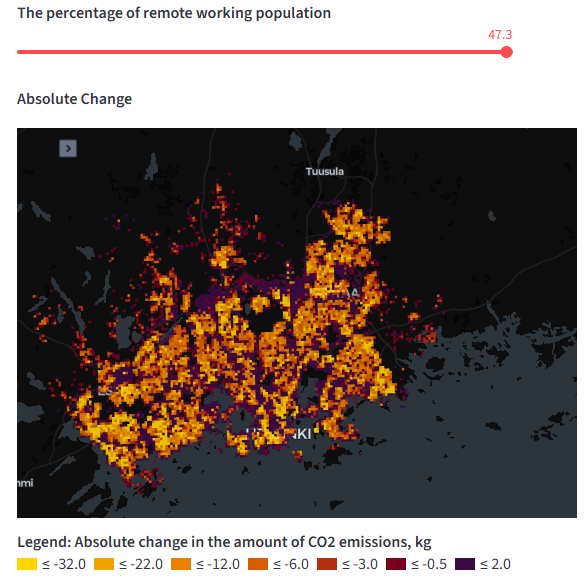
Remote work may reduce emissions, but also physical activity levels