
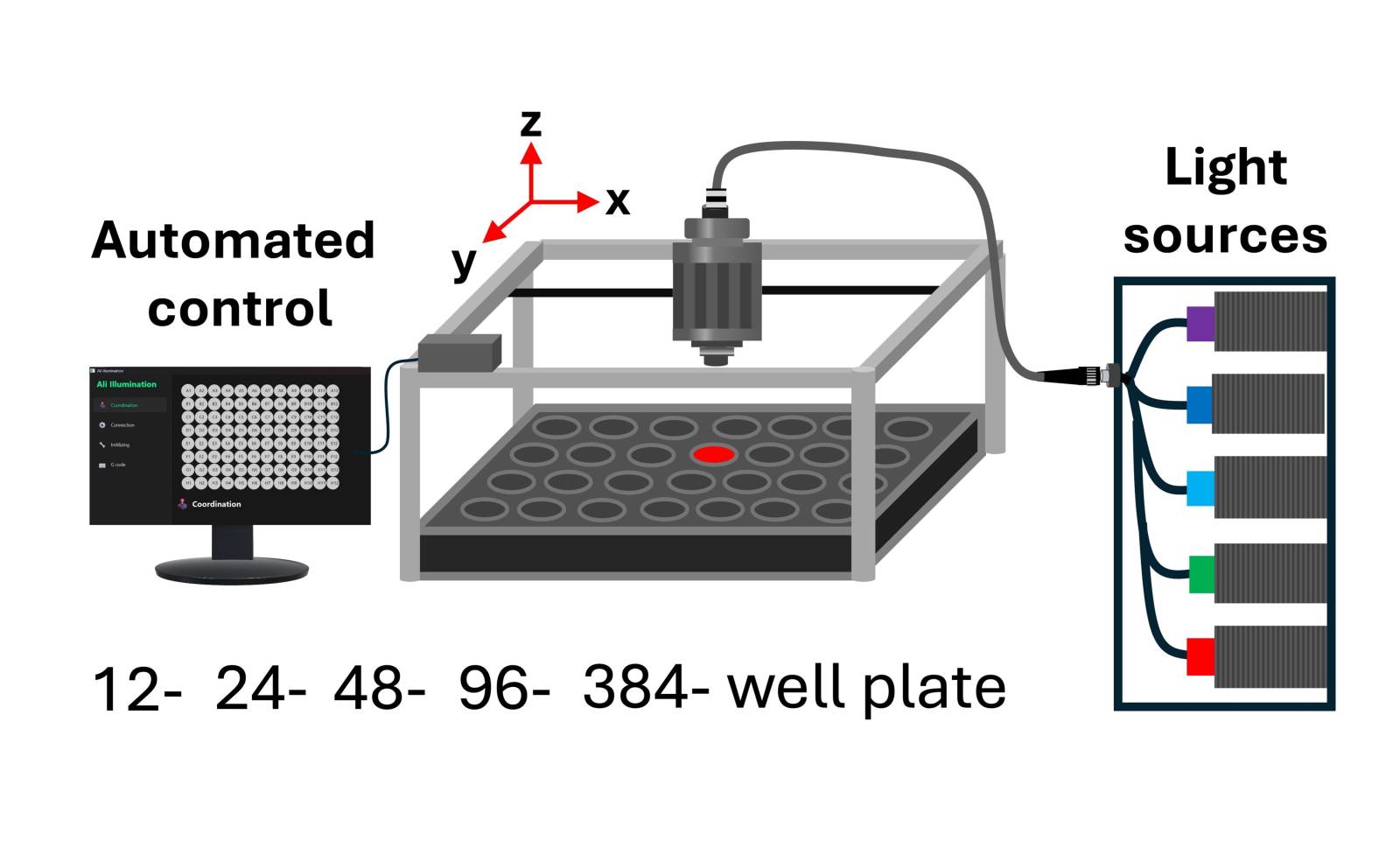
Researchers from Tampere University developed and validated a cost-effective, customizable illumination platform designed specifically for high-throughput in vitro studies of photoresponsive systems. The work was published in RSC Analyst journal.
The platform is easy to fabricate, flexible in design, and enables rapid screening of multiple experimental parameters. To demonstrate its performance, we conducted a comparative study using reactive oxygen species (ROS)-sensitive liposomes loaded with two structurally identical phthalocyanines differing only in their central metal: zinc and palladium.
Using the system, we were able to efficiently optimize key variables relevant for light-triggered drug delivery, including dye loading, power density, total light dosage, and oxygen conditions (aerobic vs. anaerobic). Under optimized conditions (690 nm irradiation, 10 J cm⁻²), Pd(II) phthalocyanine-loaded liposomes achieved up to 100% calcein release, whereas Zn(II) phthalocyanine-loaded liposomes reached 50% release under identical conditions.
Importantly, under anaerobic conditions, calcein release was significantly reduced for both systems, confirming the ROS-dependent mechanism of membrane destabilization. Throughout the experiments, the illumination platform demonstrated stable and reliable performance.
This work highlights how accessible, well-designed hardware can accelerate the development and optimization of light-triggered drug delivery systems and other photoactivated biomedical technologies.