
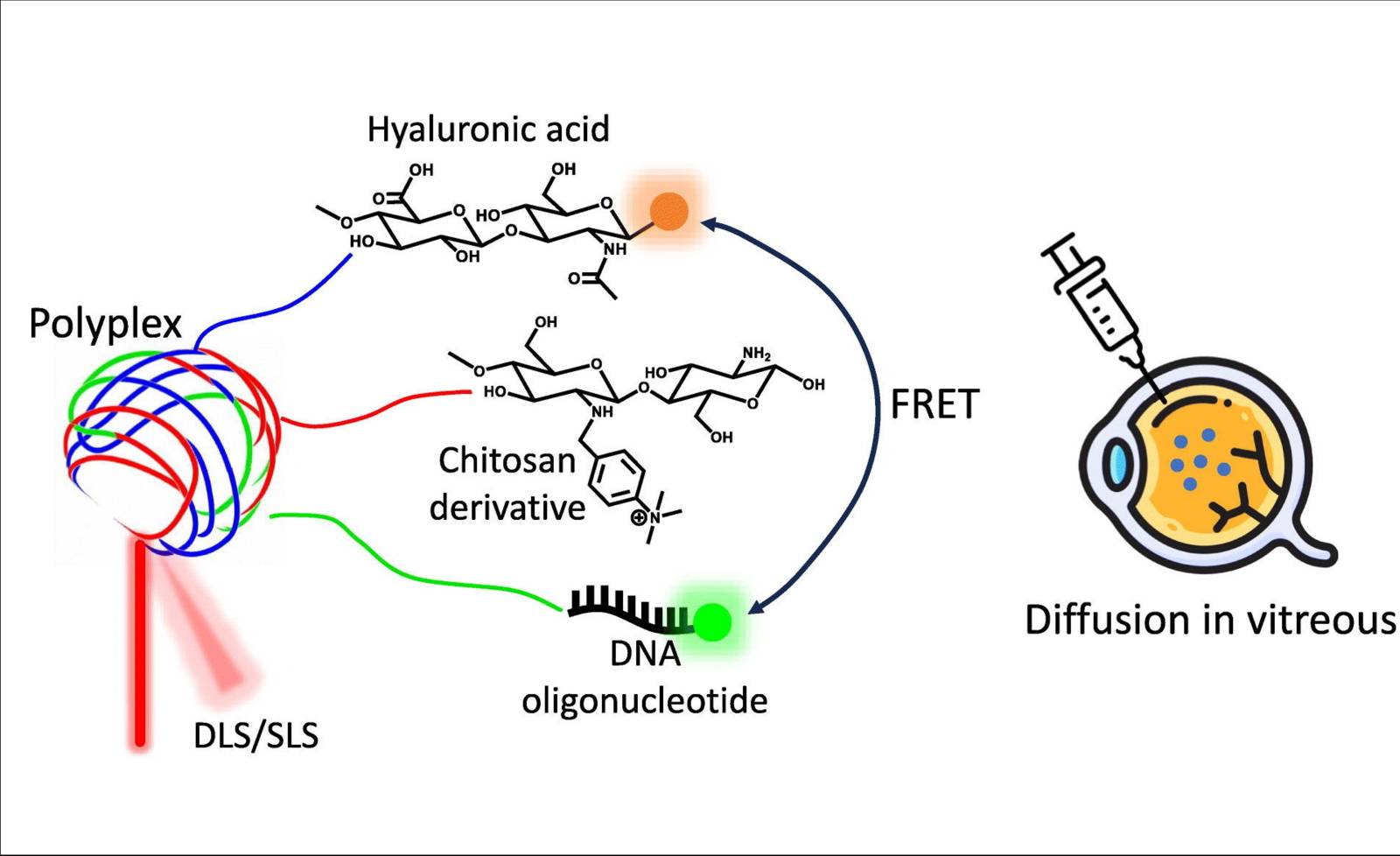
Researchers from University of Helsinki in collaboration with Tampere University have taken an important step toward improving retinal gene therapies by uncovering how DNA-polymer complexes behave in environments that closely mimic the human eye.
Current retinal treatments often rely on repeated intravitreal injections to deliver DNA- and RNA-based nanomedicines. However, once injected, these nanocarriers interact with the vitreous humor, a complex biological matrix that can significantly influence their mobility and therapeutic efficiency. A deeper understanding of these interactions is essential for designing more effective delivery systems.
In this study, polysaccharide-based polyplexes were investigated as potential DNA delivery vehicles. Using advanced analytical techniques, the team examined the structure and formation mechanism of N-[4-(trimethylammonium)benzyl]-chitosan:DNA:hyaluronate complexes.
The results revealed that DNA oligonucleotides form star-shaped particles when combined with the cationic chitosan derivative. Interestingly, when hyaluronate was introduced, it did not simply coat the surface of the complex. Instead, hyaluronate molecules intercalated into the internal structure of the polyplex, fundamentally influencing its architecture.
To evaluate their translational potential, the polyplexes were tested ex vivo for mobility in porcine vitreous. Both cationic and anionic formulations demonstrated promising diffusion properties, comparable to neutral and anionic liposomes, suggesting their suitability for intravitreal delivery.
These findings provide valuable insight into structure-function relationships in DNA-polymer complexes and support the development of more efficient and predictable retinal gene delivery systems.