
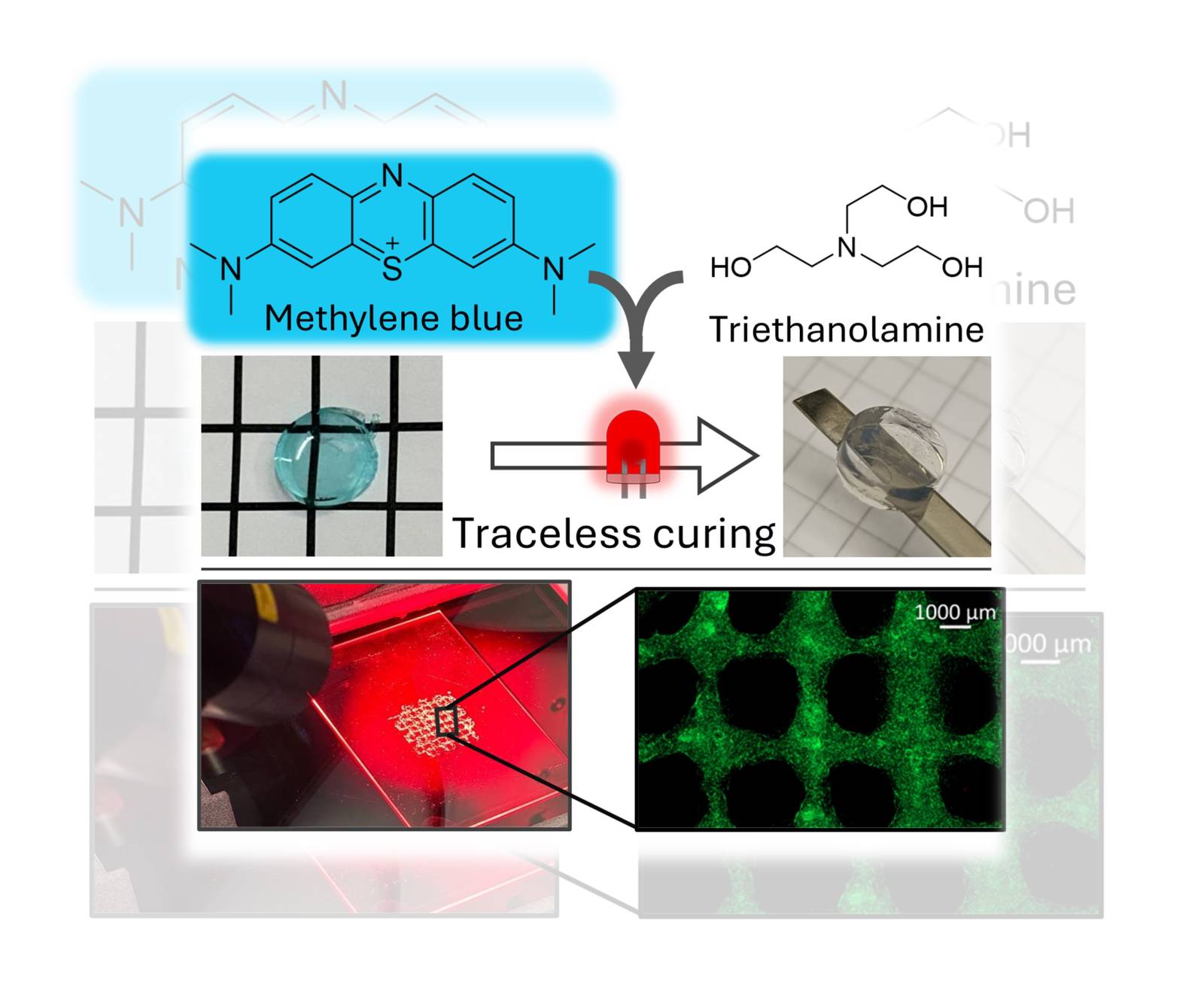
Researchers from Tampere University in collaboration with University of Helsinki and Turku University of Applied Sciences have developed a “traceless” red-light photopolymerization system that enables the fabrication of fully transparent, biocompatible hydrogels overcoming key limitations of conventional UV-based crosslinking methods. The work was recently published in Advanced Materials.
Photocrosslinking with non-pulsed red light offers clear advantages over UV light, including deeper tissue penetration and improved biocompatibility. However, most red-light systems rely on photoinitiators that leave residual color in the material and may raise cytotoxicity concerns, limiting their use in sensitive biomedical applications.
In this study, the team introduced a photoinitiating system composed of FDA-approved methylene blue and cytocompatible triethanolamine. Upon 625 nm irradiation, the system efficiently induces polymerization and remarkably, leaves no visible trace of the methylene blue afterward. The result is a permanently colorless hydrogel with tunable mechanical properties controlled by light exposure.
Using this approach, gelatin methacrylate (GelMA) hydrogels were successfully polymerized under ambient conditions. The system was further applied in extrusion-based 3D bioprinting with NIH-3T3 fibroblasts. After photocuring, the cell-laden constructs supported cell adhesion and proliferation, demonstrating strong potential for tissue engineering applications.
Importantly, red-light excitation enabled polymerization through at least 5 mm of biological tissue, highlighting the possibility of transdermal photopolymerization for minimally invasive implantation strategies.
This work represents a significant step toward safer, transparent, and clinically relevant hydrogel systems for biomedical engineering, biosensing, wound care, and regenerative medicine.
Read the full article here:
https://advanced.onlinelibrary.wiley.com/doi/10.1002/adma.202502386