
Teacher education plays a crucial role in preparing future educators to understand and address the complex dimensions of climate change and climate justice across diverse contexts. Teachers hold a unique and powerful position as key agents of change, nurturing the next generation’s understanding, values, and actions.
This is a guest blog post reflecting on the outcomes of a DigiSus seed funded project “Arts-based climate change education through digitalization (DIGI-CLIMART)”.
Participatory workshops on climate change education
To address climate change and climate justice in education from a holistic perspective, particularly within teacher education programs, three cross-locational and cross-national online workshops linking the Global South and Global North were planned and implemented between April and August 2025.
The aims of organizing these three participatory workshops were:
- to foster cross-cultural and cross-locational understanding and to co-create educational initiatives focused on climate change education and climate justice,
- to test and pilot digital methods for exchanging knowledge and experiences on integrating climate change and climate justice into teaching, curriculum and teacher education program, fostering dynamic dialogue and mutual learning, and
- to test and pilot various pedagogical approaches including art-based methos, narrative and photovoice approaches to facilitate active and more inclusive engagement among participants in an online atmosphere.
Accordingly, three online workshops were implemented through Zoom for different target groups: schoolteachers, teacher students and students in educational technology, as well as teacher educators and early childhood teachers.
Workshop 1: Teaching Climate Change (3 May, 2025)
This participatory workshop created a shared space for 25 schoolteachers from Finland, Greece, and two schools in two different islands in Indonesia to come together, exchange experiences, reflect on practice, and explore different ways of approaching climate change in the classroom.
The workshop focused on interdisciplinarity and narrative approaches for climate change education. Accordingly, a comprehensive and interactive lecture was delivered. Teachers engaged in group activity and exchanged ideas for designing a lesson plan while integrating climate change into the different teaching subjects. Participants also practiced simple digital and artistic tools (photos, stories, videos, Canva, PowerPoint, etc.).
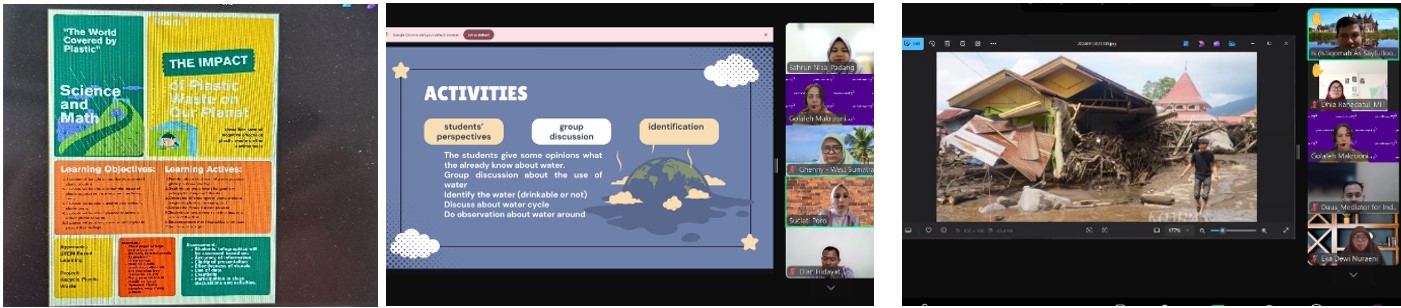
The workshops provided a valuable opportunity to exchange local narratives on how climate change affects education and the daily lives of people in different geographical locations. They also offered a deeper, more authentic, and empathetic understanding of the impacts of climate change, as well as the mitigation and adaptation strategies employed by teachers across diverse contexts.
“This workshop has equipped me positively with Climate Change phenomenon. It has helped me to see different ways to think especially about the climate change and how we (as a teacher) integrated it through our teaching.”
“The workshop would likely highlight the connections between different aspects of climate change all over the world. Different places, same problem, I guess…”
Workshop 2: Art & Digital Tools for Climate Education and Climate Justice (16 May, 2025)
The 38 workshop participants included teacher students at Tampere University and teacher students and students from educational technology from two Indonesian universities: Universitas Pendidikan Indonesia, and Universitas Negeri Padang.
This participatory workshop focused on introduction on empathy and climate justice, using art-based methods, the usage of digital tools and digital art in climate change education. Speakers from Finland and Indonesia delivered the presentations on these topics.
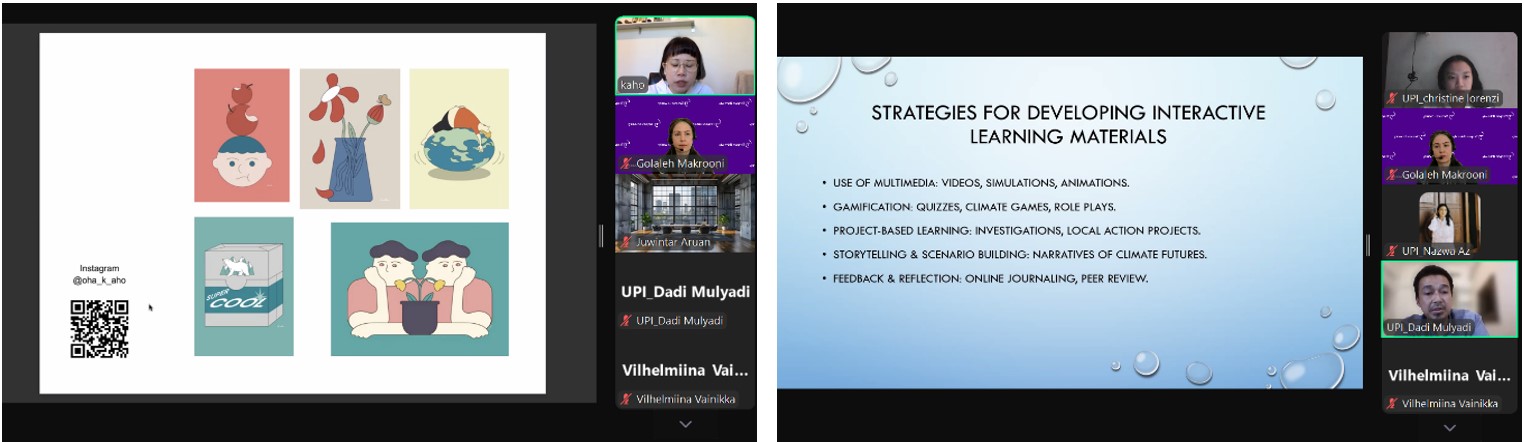
Participants were involved in group activities, exploring simple digital and artistic tools (photos, stories, video media, Canva, PowerPoint, etc.) to reflect on and express climate change and climate justice through creating the short instructive story while using art and digital tools.
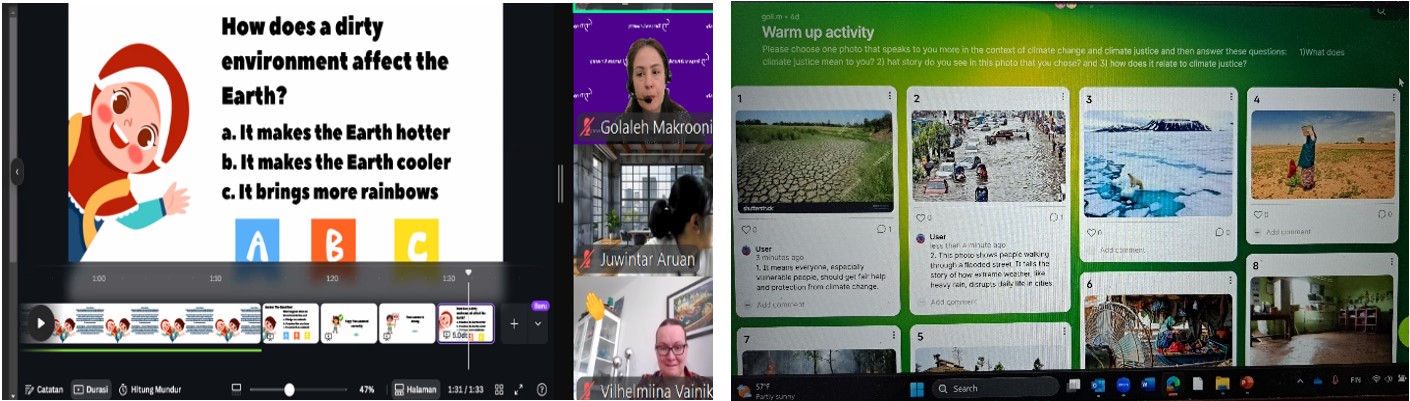
The participants’ feedback conveys increasing understanding and skills, for example:
“This workshop is very interesting because I learned how to educate students about climate change using the tools and methods taught.”
“I gained a better understanding of how to create more engaging and interactive learning materials.”
“In this era, digital tools is really important to organizing such a workshop. As we use online meeting visual art and digital is a way that we can use it easily.”
Workshop 3: Integrating Climate Change Education and Climate Justice into Teacher Education Program (19 August, 2025)
This workshop offered a shared space for about 40 teacher educators and early childhood educators from Finland and universities in the Global South, particularly from Indonesia, to come together, exchange experiences, reflect on good practices, and explore various perspectives of approaching climate change and climate justice—both conceptually and pedagogically—that can be meaningfully integrated into teacher education programs and curricula.
The workshop aimed to go beyond the previous ones by focusing on decolonizing and empathic pedagogical, interdisciplinary, arts-based and creative, dialogical ways to include climate justice and climate change into curriculum. Speakers from Indonesia and Finland delivered presentations on the findings of previous research and practices on climate justice and climate education including:
- “Climate Change as a curricular challenge in education” by Professor Eero Ropo,
- “Empathic and decolonizing pedagogies for climate justice – suggestions for teacher education” by Dr. Vilhelmiina Vainikka,
- “Climate change education in Indonesia” by M.Ed. Nur Rofika AYU Shinta Amalia,
- “The way forward: Inductive, Culturally Rooted Climate Justice Pedagogy” by Dr. Khairil Azhar, and
- “Navigating Climate Change in Education: Lessons from Practice” by Dr. Golaleh Makrooni.
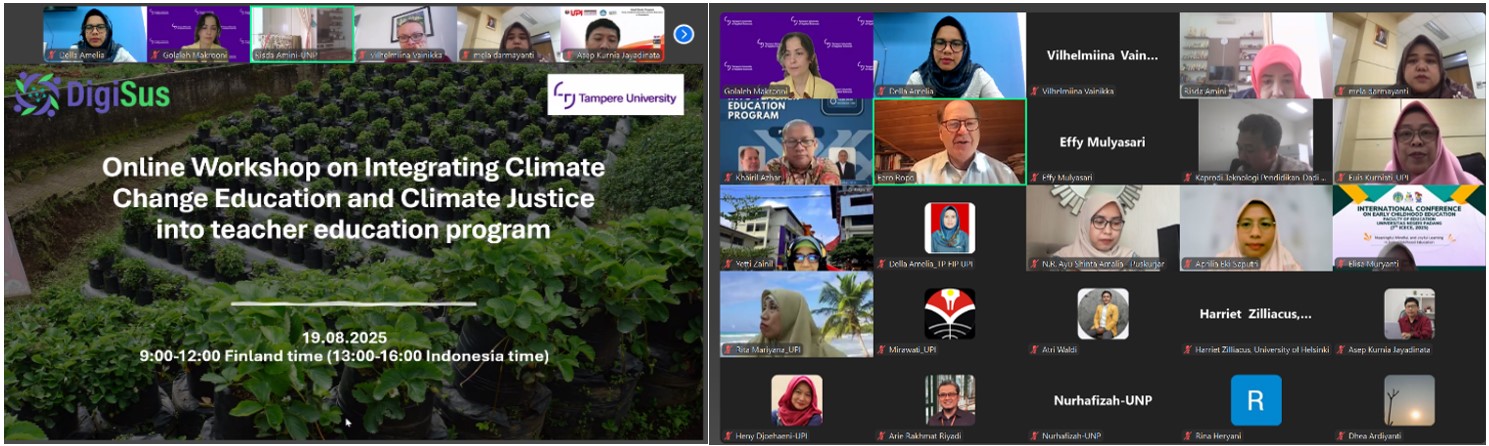
Participants engaged in discussions to share experiences, perspectives, challenges, and opportunities, while also reflecting on the importance of fostering critical thinking and a sense of global responsibility in future teachers. In the group discussion, most participants agreed that developing a relevant and meaningful curriculum is essential—one that not only addresses the scientific aspects of climate change but also its social and ethical dimensions.
Secondly, there was recognition of the need to create more space for enhancing critical thinking among teacher students, supported and encouraged by teacher educators. This raised important considerations on how to better engage teacher students—who will become future teachers—from both theoretical and pedagogical perspectives.
“As a teacher educator, my role is not only to teach about climate change but also to foster students’ care and responsibility for the planet. I integrate these issues through discussions, projects, and creative activities, while encouraging simple yet meaningful actions in schools and communities. By modeling sustainable living, I hope to inspire future teachers who are knowledgeable, empathetic, and committed to building a more just and sustainable world.”
“The workshop was very insightful and engaging. I appreciated how the material was presented clearly and connected well to real-life issues. It gave me a better understanding of climate education and justice, and I felt encouraged to reflect on my own role in contributing to positive change. Overall, it was an enriching experience.”
Reflections: Benefits and challenges in organizing and implementing cross-locational online workshops
Benefits
- Space for recognition and visibility of local experiences and narratives. Participants shared community practices and local adaptation strategies shaped by their specific contexts. For example, participants from Indonesia noted changes in the timing of rainy and dry seasons, as well as the increasing unpredictability of weather patterns compared to the past. They shared concrete examples of how climate change affects their daily lives and teaching—such as extreme heat making classrooms uncomfortable, and heavy rainstorms causing delays or interruptions to be schooling. These experiences stand in clear contrast to those of participants from Finland.
- Space for creating dialogue and empathy. Organizing online workshops offers significant benefits, especially when it comes to involving participants from diverse geographical and cultural locations. This broad participation creates rich opportunities for dialogue, experience exchange, and deepening our understanding of climate change as a complex, multifaceted phenomenon. By hearing how people from different contexts experience and respond to climate change, participants develop more holistic and critical perspectives. Such engagement fosters sustainable and meaningful empathy, which can inspire more effective climate action both locally and globally.
- Creating more inclusive space for dialogue. Although all workshops were held in English, mediators from Indonesia and Greece were present to enhance inclusion and reduce language barriers, ensuring active engagement from participants with limited English proficiency. The mediators also assisted in disseminating the flyer and supporting participant registration in their respective locations. However, since participants came from two to three different countries and not all had strong English skills, having more mediators could help make the workshops more inclusive and accessible.
Challenges
- Usage of digitalization. Digital tools open up great opportunities for collaboration and learning, but they also come with challenges. Not everyone feels equally comfortable with technology, and complex programs can easily create barriers instead of bridges. That’s why keeping tasks simple is key. Rather than offering just a one-off workshop, organizing a series of shorter sessions can make a big difference. This way, participants have time to practice, experiment, and gradually grow their confidence in digital spaces.
- Usage of arts-based methods. Another important takeaway is that many participants find it challenging to understand how arts-based methods can actually be applied in practice. This is why creating more opportunities to test and try them out in workshops is so valuable. Exploring how these approaches can be adapted for digital spaces—and used in more collaborative ways—is something that still needs much more practice and experimentation.
- Expanding access: Arts-based methods for diverse voices. As organizers, we also found ourselves reflecting on the backgrounds of participants in these workshop series—most of whom came from the education sector in schools and universities. This led us to an important question: what about people from other sectors, especially those with less social and cultural capital or from marginalized groups? How can their voices and experiences be meaningfully included in conversations about climate change and climate justice? Arts-based methods in digital spaces may hold potential here, but more exploration is needed to ensure they truly create space for diverse perspectives.
- Participation challenges and institutional support. Despite the advantages of these workshops, we faced challenges in attracting enough participants from Finland, both teachers and teacher students. In contrast, many participants from Indonesia were eager and enthusiastic to join. Scheduling conflicts and overlapping commitments partly explain the lower Finnish participation, but we believe the issue also points to a need for greater attention at the university and administrative levels. To maximize the impact of international online workshops, it is crucial that they receive more visibility and stronger institutional support within Finland.
Impact and Next Steps
The insights gained from these workshops will:
- Support the development of research proposals for future calls in collaboration with partners from the Global South.
- Promote awareness and foster global perspectives on climate change and climate justice in teaching, curriculum design, and teacher education programs.
- Strengthen the agency of teachers, teacher students, and teacher educators to integrate climate change and climate justice in more engaging and meaningful ways, using innovative pedagogical approaches such as art-based and narrative methods.
- Encourage innovative uses of digital tools to connect learners and educators worldwide, enabling the sharing of local perspectives and the co-construction of global understandings.
- Support sustainable and impactful responses to climate change at both local and global levels.
Writers:
Golaleh Makrooni, Postdoctoral Research Fellow, Faculty of Education and Culture
Vilhelmiina Vainikka, Postdoctoral Research Fellow, Faculty of Education and Culture
***
Photo credits: Golaleh Makrooni.