

Authors: Praju Adhikari, Bidhya Acharya Adhikari and Tarja Kinnunen, Unit of Health Sciences, Faculty of Social Sciences, Tampere University. This is a guest blog post reflecting on the aims and outcomes of a DigiSus funded Societal Impact project “Digitalizing Dietary Assessment for Sustainable Nutrition Research in Nepal”.
The importance of accurate dietary data
Accurate dietary intake data is essential for nutrition research, public health policy, and dietary recommendations. However, in Nepal, dietary assessment is usually done either manually or with the help of expensive international software with foreign database. This increases the risk of errors, and limits quality and usability of data.
Without a country-specific digital calculation tool, process of dietary intake calculation is time consuming and often inconsistent, making it difficult to conduct large scale or high-quality dietary studies and nutrition research.
From manual calculations to a digital solution
To address this challenge, the Strengthening Nutrition Education and Research Capacity in Universities in Nepal (NERC) project at Tampere University is developing a digital Nepalese food composition database with an integrated Excel-based dietary intake calculation tool. The rationale behind this initiative of developing Excel-based intake calculation tool is to make dietary assessment easier, faster, and more reliable while maintaining its usability in rural settings with limited internet connectivity which is very crucial in Nepal.
The database that the intake calculation tool uses is developed by NERC project and it currently includes around 1,000 food items and 40 nutrients. The nutrient values of food items in the database are compiled and calculated in compliance to international standards. This ensures scientific validity and allows Nepalese dietary data to be compared with datasets from other countries.
Automating dietary intake calculation with VBA
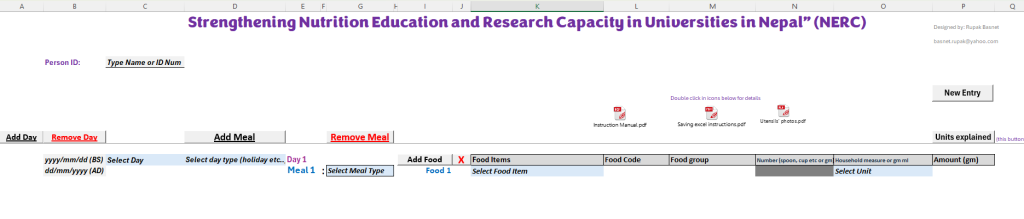
A key feature of the project is the Excel-based intake calculator, designed to work fully offline. Using Visual Basic for Applications (VBA), automated features have been incorporated into the tool, significantly reducing manual data entry and calculation errors. VBA-driven automation enables efficient workflow, automatic nutrient calculation, and a more user-friendly interface.
For the purpose of intake calculation, the calculator is built with a hierarchical structure: days, meals within days, and food items within meals. Users can input data for multiple days and meals per individual. There are three sections for user input, everything else is automated. Once a food item is selected, the tool automatically fills in the food group and code. Users can enter either the actual weight in grams or use household measures with a multiplier. User manuals are also embedded in the sheet for easy guidance.
Once dietary data either from a 24-hour recall or a food diary is entered into our intake calculation tool, it generates report in two sheets: a summary and a detailed food diary. The diary sheet shows the amount of each food consumed, and a detailed breakdown of nutrient intake per food item. To enhance usability, the total daily intake is highlighted in green. The summary sheet is tailored for researchers. It presents nutrient totals by day in a clean format that can be directly imported into statistical software for analysis.
With support from DigiSus, the calculator’s layout and functionality have been further refined, improving usability and efficiency. By digitalizing dietary calculations, researchers can spend less time on manual work and more time analyzing data and generating meaningful insights for nutrition policy and practice.
Strengthening nutrition education and research capacity
Beyond tool development, the project also strengthens education. Partner universities in Nepal have revised course content on dietary assessment, food security, and sustainable food systems, with updated courses being implemented from May 2025. In May 2026, additional training will be provided for nutrition teachers, dietitians, and nutritionists across Nepal to support wider adoption of the database and calculator.
By combining freely accessible digital tool, offline functionality, and capacity building, the NERC project demonstrates how relatively simple digital innovations such as an Excel tool enhanced with VBA automation can significantly strengthen nutrition research in low-resource settings.
About the Authors
Tarja Kinnunen is a university lecturer from the Unit of Health Sciences, Faculty of Social Sciences, Tampere University. She leads the NERC-project in which this dietary intake calculator was developed. Praju Adhikari and Bidhya Acharya Adhikari work as researchers in the NERC project.