

Games and Learning
Interactive Play, Insightful Learning
About the Research Group
The Games & Learning Group investigates how games and playful interactions shape learning, motivation, emotion, and engagement across a wide range of educational contexts—including mathematics, digital and graph literacy, critical reading, leadership, and special‑education settings.
We view games both as instructional interventions and as research platforms, using them to probe educational and psychological phenomena and to serve as authentic assessment tools. Our work spans single‑player and multiplayer environments, and we apply learning‑analytics and multimodal process data to trace cognitive, affective, and behavioral dynamics throughout gameplay and game‑driven learning experiences.
A rapidly expanding focus is the integration of generative AI. We explore AI‑supported “learning‑by‑designing games,” where learners co‑create educational games with AI partners, thereby deepening knowledge, skill acquisition, and creativity while revealing how AI‑mediated design influences learning processes.
Finally, we develop adaptive, personalized learning solutions that respond to diverse learner needs. By combining field studies, laboratory experiments, and advanced computational analyses of multimodal data from individuals and teams, we generate nuanced insights that drive new theories and technologies for game‑based learning.
Key Highlights
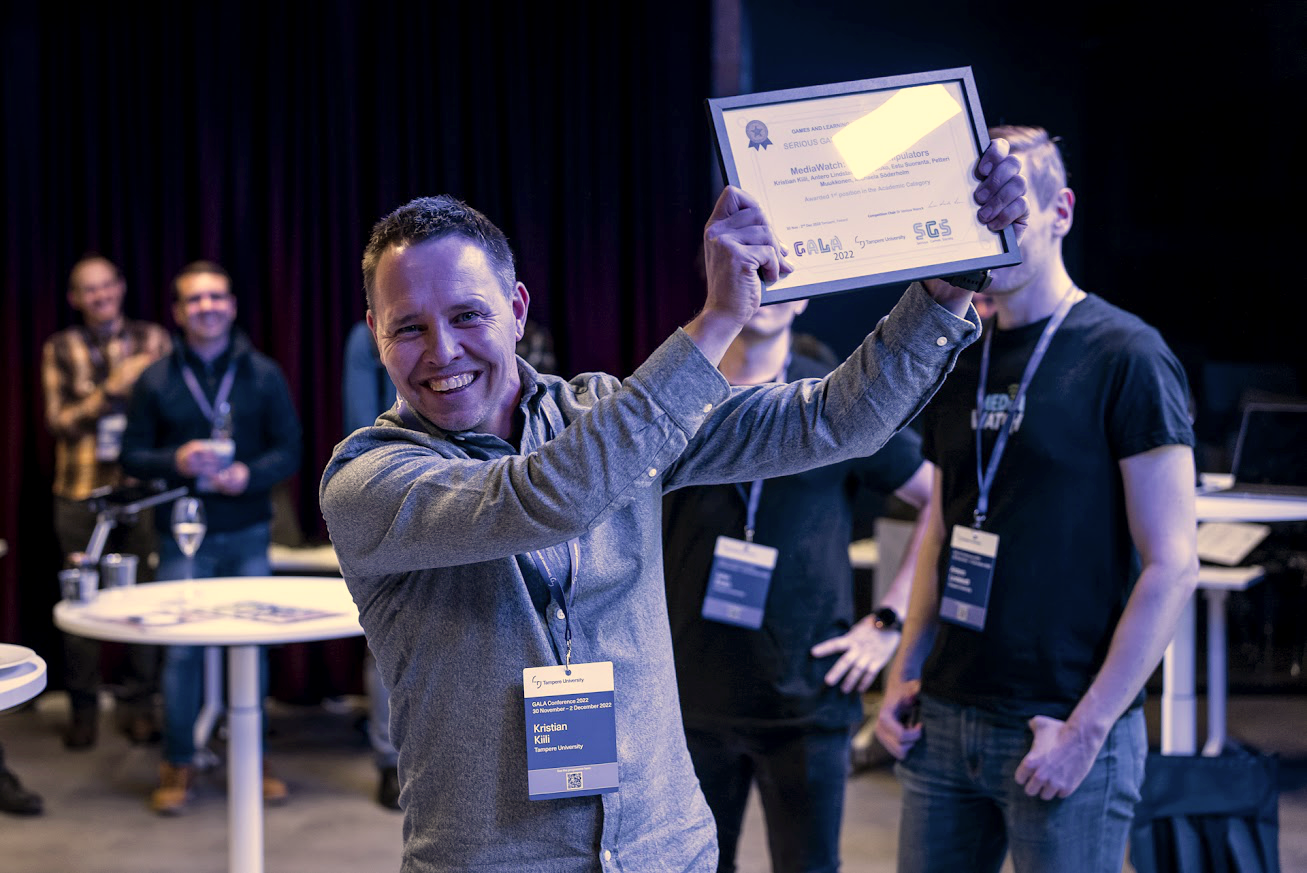
Our MediaWatch graph‑reading game was honored as the Best Serious Game (Academic Category) at the GALA 2022 Serious Games Competition, hosted by the Serious Games Society.
Examples of Our Work
Cultivating mathematical flexibility in a game-based learning environment: Scaffolding for learning and engagement (SCAFFLEX)
Timeline: 2024-2028
Digital game-based learning environments can support the development of mathematical flexibility, a highly sought-after but difficult-to-achieve goal of mathematical curricula worldwide, including in Finland. This project includes three studies aimed at furthering our understanding of the specific features of digital game-based learning environments that can best support the development of mathematical flexibility and engage learners. The main features examined are different task types and the design of scaffolds that help learners when they face difficulties in the game. These studies will further advance theories and practices in designing game-based learning environments that support mathematical flexibility and consider the learners’ needs.
Funded by Research Council of Finland.
Technological and Societal Innovations to Cultivate Critical Reading in the Internet Era (CRITICAL)
One of the main challenges of our times is the spread of misinformation and disinformation on the Internet. The exposure to false information, in conjunction with poor critical reading skills, may endanger citizen’s decision-making on important issues. The CRITICAL project aims to develop technological and societal innovations to support adolescents critical reading skills required in the Internet era. The project increases understanding of development of critical reading skills and factors affecting development of these skills. Based on the project’s assessment and intervention studies, CRITICAL has developed gamified and adaptive learning solutions to support, for example, graph literacy, critical reading skills, perspective-taking and understanding of AI ethics. Overall, CRITICAL aims to have a broad impact by preparing adolescents to deal with misinformation and disinformation, and by informing the work of curriculum developers, educators, and policymakers.
Funded by Strategic Research Council (SRC).
Our People
Kristian Kiili

Group Leader
Professor
Kristian Kiili is a Professor of Game-Based Learning in the Faculty of Education and Culture at Tampere University, Finland. He leads the Games and Learning Research Group, which explores how game elements influence learning, motivation, emotion, and engagement across diverse educational contexts. His current research focuses on designing and empirically evaluating interactive digital learning and assessment environments —particularly game-based environments that foster numerical skills, graph literacy, critical reading, perspective-taking, and learner engagement. By examining how cognition, emotions, and behavior unfold during gameplay, his work informs the creation of adaptive, personalized learning environments and contributes to modeling game-based learning processes.
✉️ kristian.kiili@tuni.fi
🔗 TUNI ● ORCID ● Google Scholar
Muhterem Dindar
Assistant Professor
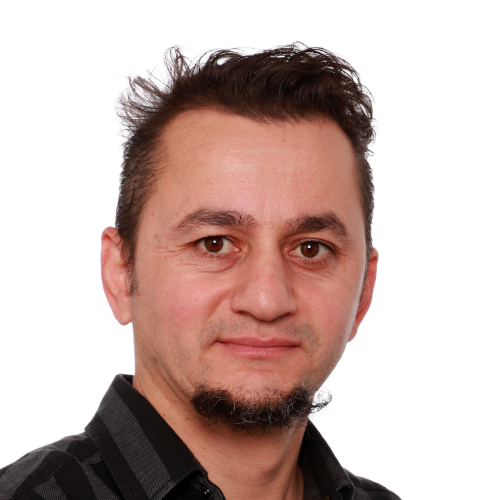
Muhterem is a tenure‑track Assistant Professor of Game‑Based Learning at Tampere University (Faculty of Education and Culture) and a Docent in Multimodal Methods, where he uses experimental designs and multimodal data—such as electrodermal activity, heart‑rate, facial expressions, and video—to investigate social cognition, contagion, and human‑AI collaboration in collaborative, technology‑enhanced learning environments. Muhterem is the leader of GATE-project, which explores the degree to which gamified teamwork can foster emergent leadership and successful team performance.
✉️ muhterem.dindar@tuni.fi
🔗 TUNI ● ORCID ● Google Scholar
Antti Koskinen

Post-Doctoral Researcher
Antti is a Postdoctoral Researcher at Tampere University, Finland. His research focuses on digital game-based learning, AI ethics, adaptive instructional support, and the role of emotional design in fostering student motivation and engagement.
Tomi Jaakkola

Associate Professor
Tomi researches simulation-, game- and multimedia-based learning and teaching in STEM education, with a focus on learning, interest and self-efficacy.
Carita Kiili

Associate Professor
Carita is a researcher specializing in digital reading and online credibility evaluation. For example, she created engaging assessments and learning materials—such as the “Funky Facts Detective School” video series, workbook and teacher’s manual—to help early adolescents develop effective strategies for judging online information.
✉️ carita.kiili@tuni.fi
🔗 Google Scholar ● ORCID ● LinkedIn
Antero Lindstedt

Doctoral Researcher
Antero is a doctoral researcher with a focus on developing learning games and other tools for data collection.
Elvis Ortega-Ochoa

Post-Doctoral Researcher
Elvis is the Chief Executive Officer and founder of EduAIA, and a post-doctoral researcher focused on empathic pedagogical conversational agents.
Eemeli Eiste

Doctoral Researcher
Eemeli is a doctoral researcher investigating how AI can promote critical and responsible learning within game‑based environments. His dissertation examines students’ AI use during educational game‑design tasks, aiming to inform the creation of learning activities that enhance, rather than replace, learners’ own thinking and effort.
✉️ eemeli.eiste@tuni.fi
🔗 ORCID
Lok "Natalie" Lam

Doctoral Researcher
Natalie is a researcher on the GATE project who uses machine‑learning and multimodal analytics (video, audio, physiological signals) to study emotional, physiological, and behavioral contagion in game‑based collaborative learning. Natalie develops influence scores that predict emergent leadership and providing practical tools for educators and organizations.
✉️ lok.lam@tuni.fi
🔗 LinkedIn
Helka Hirvonen

Doctoral Researcher
Helka is a political‑science scholar now pursuing a doctorate in Education and Culture. She researches graph literacy and critical graph reading, and game‑based learning. She aims to empower citizens with strong visual data‑interpretation skills.
✉️ helka.hirvonen@tuni.fi
🔗 LinkedIn ● ORCID
Riikka Anttonen

Doctoral Researcher
Riikka is a Doctoral Researcher, who studies self‑efficacy, online reading, and epistemic emotions to understand how motivational and emotional factors influence students’ assessments of online information credibility. Her work supports the CRITICAL project, where she contributes to evidence‑based interventions that enhance critical reading skills in children and adolescents.