Towards professional class tutoring and a motivating school community (MOTI)
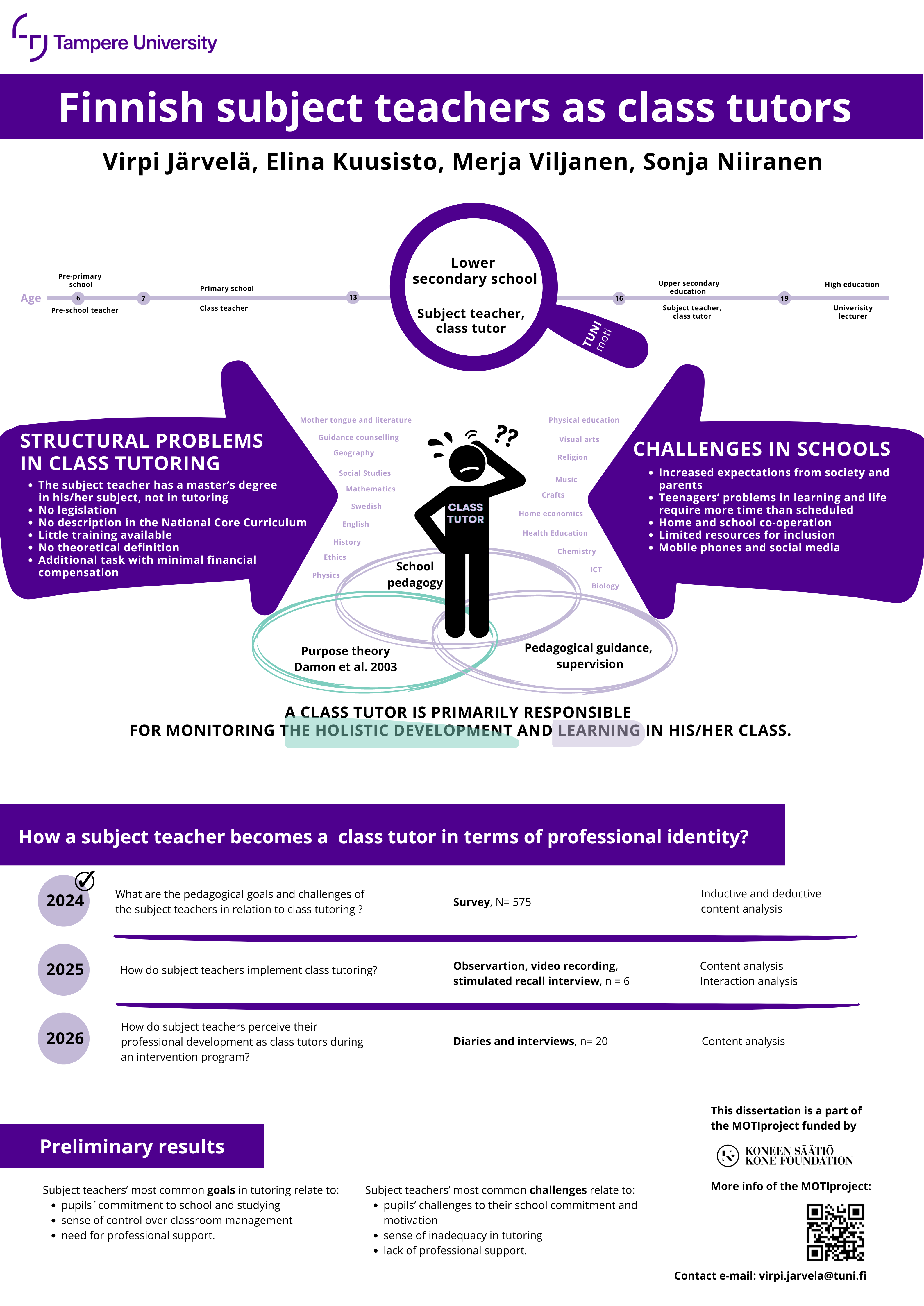
In Finnish society, subject teachers face heightened expectations and responsibilities as class tutors in secondary education. Surprisingly, class tutoring remains undefined in legislation, the national core curriculum, and research. This study pioneers in establishing a theoretical and pedagogical basis for class tutoring. This interdisciplinary and mixed-method research provides important theoretical, educational, and societal implications to strengthen class tutors’ professionality and support positive youth development among adolescents.
The first MOTI-article has been published on June 13, 2025:
Making the invisible visible – lower secondary school teachers’ needs as class tutors in student welfare support
The study examines the needs of lower secondary school teachers (N=487) who serve as class tutors supporting student welfare. Research on class tutors (also known as homeroom teachers, form tutors) is scarce, and their work is not covered by legislation or the basic education curriculum. However, class tutors play an important role in supporting the growth of lower secondary school students. The teachers’ replies on their support needs were analyzed using inductive content analysis. The main categories identified were providing student-specific support, performing metawork, building a collaborative class and school culture, and developing class tutoring. The help that the respondents needed the most was in providing individual support to address challenges in school engagement. Metawork is used in the study to refer to the essential, supportive work that takes place in the background but is crucial for supporting the student, such as interacting with the guardians, coordinating the student welfare support networks, and managing the student records. The results of the study indicated that class tutoring requires basic structures: time, pay, materials, and clear task definitions. The results can be used in teacher education programs for subject teachers to ensure that class tutoring is implemented professionally. Smooth and seamless cooperation in student welfare multiprofessional teams requires that all parties involved understand the role of class tutors in supporting young people in their educational journeys.
Reference: Kuusisto, E., Koskela, T., Viljanen, M., & Järvelä, V. (2025). Making the invisible visible – lower secondary school teachers’ needs as class tutors in student welfare support. The Finnish Journal of Education, 56 (3), 327–345.
Below our poster that was presented at Earli Sig 11&13 conference at Oxford on August 13, 2024.