

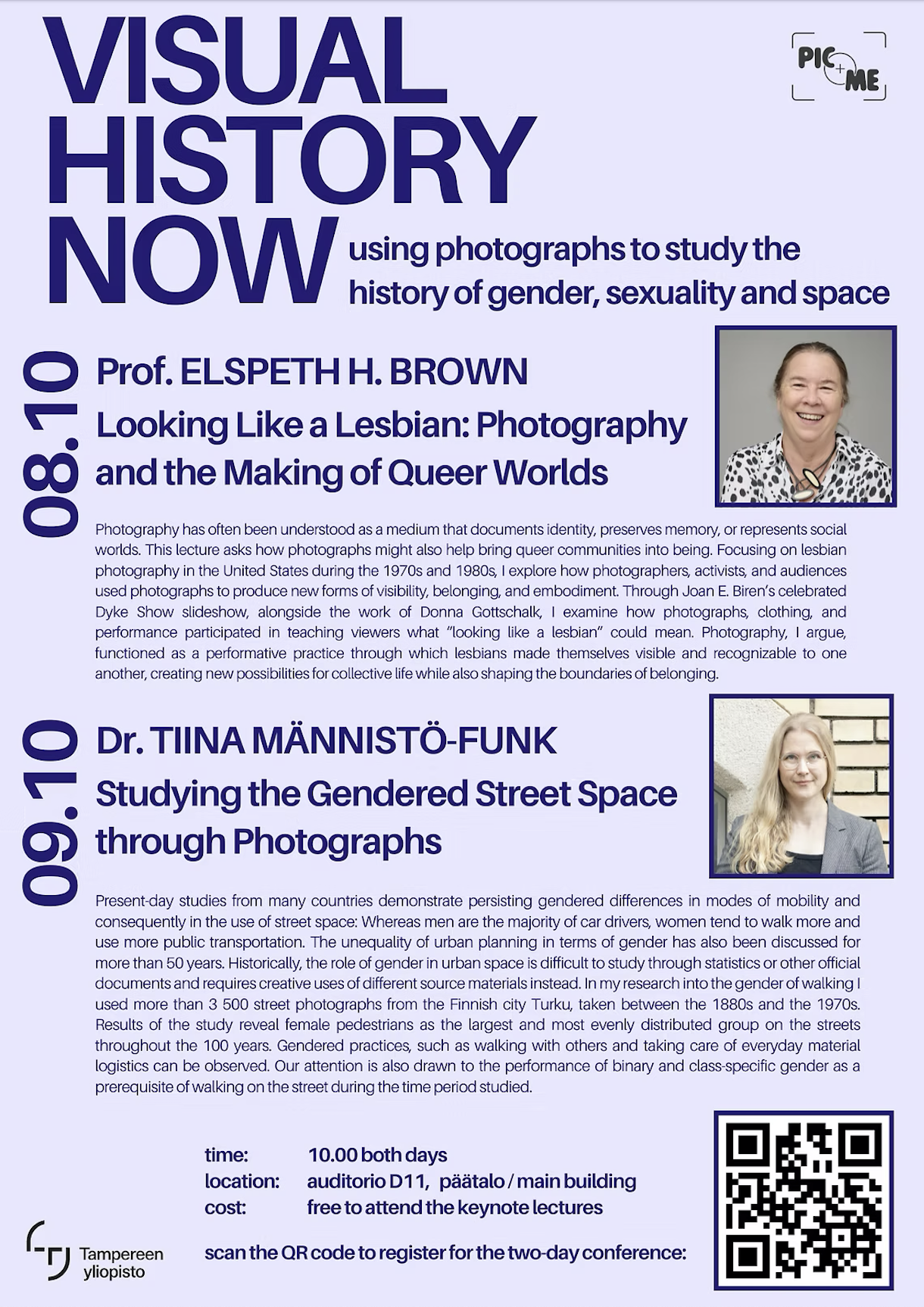
Dates: 8th and 9th October, 2026 (with pre-conference evening event on 7th October)
Location: Tampere University, Finland
Keynotes:
- Professor Elspeth H. Brown (University of Toronto), “Looking Like a Lesbian: Photography and the Making of Queer Worlds”
- Dr. Tiina Männistö-Funk (University of Turku), “Studying the Gendered Street Space through Photographs”
You may also view a version of the programme, with some elements removed, here: https://drive.google.com/file/d/1P30TFVK2COg26kNrQD6JUkqOX3jCIedD/view?usp=sharing
Register for the conference by 22nd September: https://www.lyyti.in/visualhistorynow2026
Conference theme:
Much like historical texts, historical photographs need particular tools, competences, and methods for analysis to unfold their making, uses, and reception. And just like texts, photographs can be used in multiple ways to answer diverse questions. If we want to think beyond textual sources, what are the means to analyse this form of visuality? How can we make sense of historical photographs and interpret their content for historical analysis?
Visual History Now brings together scholars using historical photographs in their research on gender, sexuality, and space. The conference presentations share research projects and perspectives that:
– use innovative methods to approach historical archives, combining photographs and other sources
– queer the methods of analysis of gender and sexuality in historical photographs
– scrutinize, by which means we can extract information from, photographs
– provide a novel take in approaching materiality in the photographs
– incorporate affect-based approaches in photographic analysis
– propose inventive uses of photography for public history
– offer other inspiring perspectives that ignite new paths to study visual history.
Learn more about the Picture Me project via our website at www.picmeproject.net