
We are thrilled to announce that CLIMETA: Meta-engagement in Metaverse has been funded as an Academy Project by the Research Council of Finland (2026–2030).
The project involves new methods and perspectives to answer whether engaging with a virtual world can help us become wiser, more reflective citizens?
The Problem We’re Trying to Solve
Climate change is, in many ways, a cognitive challenge as much as a scientific or political one. Even when individuals have access to accurate information, barriers such as climate anxiety, echo chambers, short-term thinking, or in-group biases can get in the way of untangling its complexity and engaging in meaningful action. We thus focus on metacognitive development, which targets our capacity to recognize and affect our own thoughts and feelings. This requires approaches that go beyond informational education and nudging towards experience-based, holistic methods.
CLIMETA starts from the premise that what we need is meta-engagement: the ability to examine and regulate our own thinking processes, emotional responses, and inclinations toward action. It is thus focused on not just knowing about climate change, but becoming aware of how we think about it — and developing the skills to do it better. In a media landscape that too often amplifies cognitive shortcuts and emotional polarisation, the ability to examine one’s own thinking is a necessary skill for a functioning democracy. CLIMETA aims to understand how we can cultivate it, and make those tools openly available to educators, policymakers, and the public.
Why Virtual Reality?
Existing approaches, however well-designed, often struggle to produce lasting change in how individuals behave and make decisions. This is partly because access to information and knowledge alone does not necessarily shape our meaning-making and the lived, embodied experience of being in the world.
VR is uniquely positioned to tackle this. Drawing on the 4E cognition framework — which understands cognition as Embodied, Embedded, Enacted, and Extended — CLIMETA will harness the distinctive affordances of immersive technologies for consequential development of metacognition. The goal is to build genuine metacognitive capacities: awareness of biases, understanding of one’s emotional responses, and a stronger sense of agency and self-efficacy.
The Team
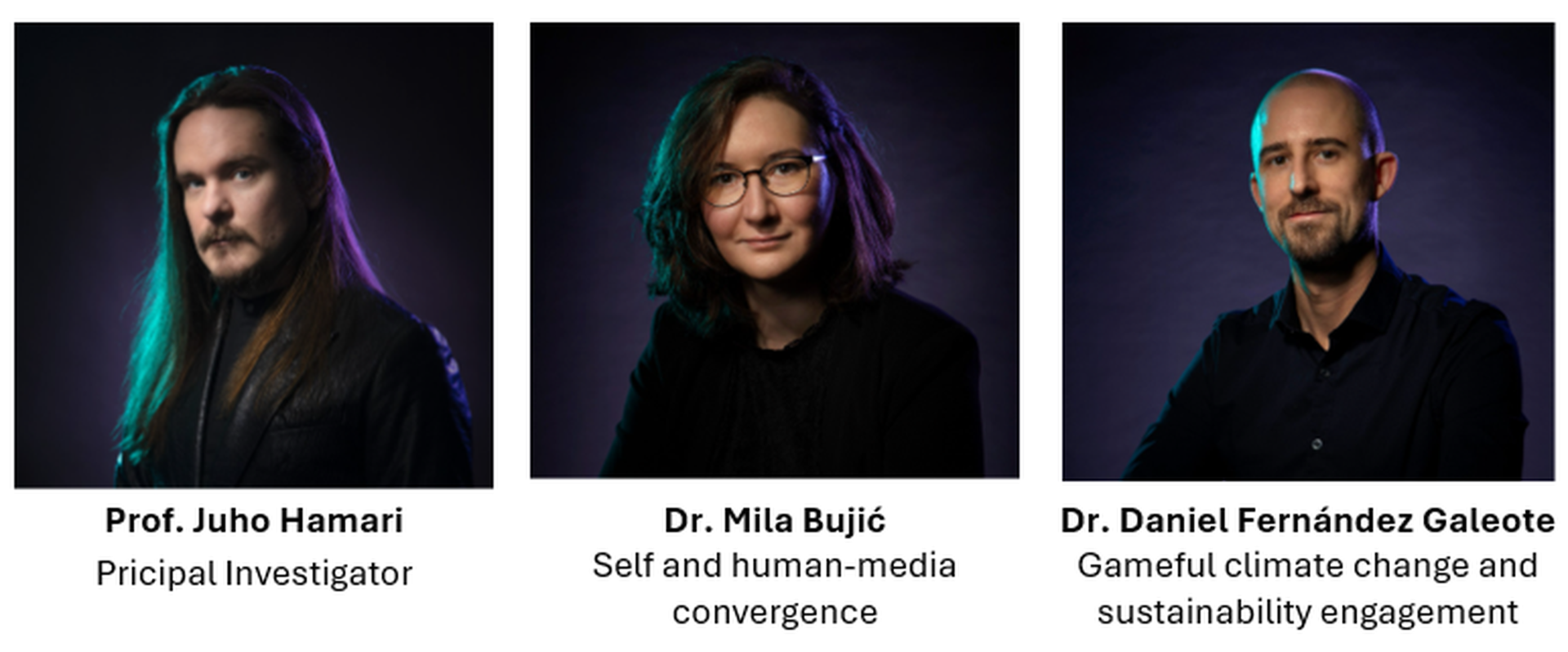
We are also hiring! We welcome applicants with background in, for example, human-computer interaction, psychology, media and communications, and/or cognitive science; see more:
- Doctoral Researcher (Gamification / Games / XR / GenAI / Emerging Media for Engagement with Sustainable Futures), 1-3 positions
- Postdoctoral Research Fellow (Gamification / Games / XR / GenAI / Emerging Media for Engagement with Sustainable Futures), 1-3 positions
The deadline for applications is 15.10.2026.
——————————————–
If you are interested in following along, collaborating, or learning more about the project, feel free to get in touch:
Professor Juho Hamari, juho.hamari@tuni.fi
Senior Research Fellow Mila Bujić, mila.bujic@tuni.fi
Postdoctoral Research Fellow Daniel Fernández Galeote, daniel.fernandezgaleote@tuni.fi
——————————————–
CLIMETA (2026–2030) is funded by the Research Council of Finland as an Academy Project (decision no. 377217). The project is based at the Gamification Group, Research Centre of Gameful Realities, Tampere University. Finland.