

Fire performance of cross-laminated timber (CLT) under natural fire exposure including the cooling phase
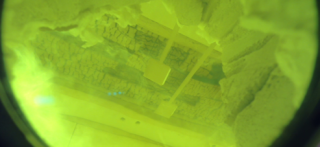
The recently published second-generation Eurocode for timber structures (EN 1995-1-2:2025) introduces new fire design methods for cross-laminated timber (CLT) structures, assuming that the adhesive bond lines remain intact during fire exposure. However, many commercially available CLT products use adhesive systems that may soften at elevated temperatures, resulting in fire-induced delamination and modified charring behaviour. This project examines the effects of adhesive performance, mechanical loading, and fire exposure conditions on the thermal degradation of CLT structures under both standard and natural fire scenarios, with a particular focus on panels where bond line integrity is compromised.
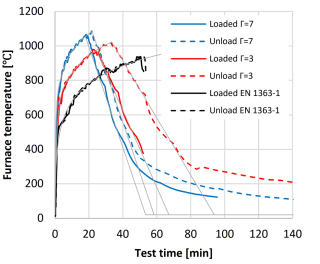
The research combines experimental furnace testing and numerical modelling to study heat transfer, charring behaviour, fire-induced delamination (char layer fall-off), and the reduction of load-bearing capacity in CLT elements. Particular attention is given to the behaviour of CLT during the cooling phase of natural fires and to the effectiveness of fire-protection board systems in limiting damage. The results will support the development of safer and more reliable fire design methods for modern timber structures.
Publications related to the research:
- Experimental study on cross-laminated timber panels exposed to parametric fires, SiF 2026 Proceedings, pp. 613-621, https://sif2026.smithengineering.queensu.ca/elementor-1296/
- Kantavien puuurakenteiden oletettuun palonkehitykseen perustuva palomitoitus (Performance-based Fire Design of Load-Bearing Timber Structures), https://urn.fi/URN:ISBN:978-952-03-4755-0
Fire performance of adhesives used in CLT structures (MODIFIRE 1.2.2025-30.6.2027)
The project will generate research-based knowledge on the effects of high temperatures on adhesive finger joints and adhesive bonds in CLT structures, and will assess the suitability of different methods for testing adhesive joints. The research activities will comprise small-scale heat-resistance tests on adhesive joints, as well as fire tests conducted in accordance with the Eurocode standard EN 1995-1-2:2025. Compared with full-scale fire tests, small-scale tests provide significantly faster and more cost-effective means of evaluating adhesive performance under elevated temperatures.
The tests will compare the fire behaviour of samples manufactured using different adhesives, bonding parameters and lamella thicknesses, as well as the temperature resistance of the adhesives themselves. Based on the test results, the objective is to identify a testing methodology that can strengthen RDI activities within the wood products industry by enabling more reliable prediction of the charring behaviour of laminated wood products. Furthemore, the research aims to assess the suitability of faster fire-testing approaches for evaluating the performance of finger-jointed sawn timber and CLT structures.
The project is co-funded by the European Union, with the grant awarded by the South Savo Regional Council.
https://www.tuni.fi/en/tau/research/modifire




For more information, please contact:
Prof. Mikko Malaska, mikko.malaska@tuni.fi
Fire performance of steel-timber hybrid floor systems
Despite their growing popularity and significant potential, the fire performance of steel-timber hybrid beam systems remains insufficiently understood, and only limited research and design guidance is currently available to support their safe and efficient application.
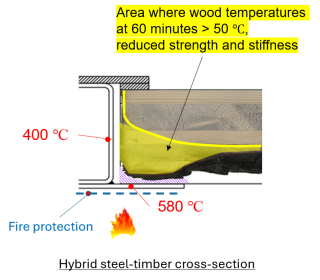
This research combines furnace testing and numerical simulations to investigate the fire performance of CLT panels at the beam support region of a steel-timber hybrid floor system, as well as the thermal behaviour of the steel beam and CLT slabs. The study aims to improve understanding of temperature development and charring within the hybrid beam cross-section when exposed to standard fire conditions. In addition, the effects of intumescent fire protection on temperature distribution and charring behaviour are investigated. Two-dimensional thermal simulations are performed using the SAFIR software for both unprotected and protected configurations.
Publications related to the research:
- Fire Performance of Steel-Timber Hybrid Beam Section, https://doi.org/10.1007/s10694-023-01471-y
For more information, please contact:
Prof. Mikko Malaska, mikko.malaska@tuni.fi
Sustainable Hybrid Structures (HybridS 1.5.2026 – 31.12.2028)
This research is part of a broader consortium that brings together a selected group of research and development organisations and industrial partners to address the challenges of modern and future machinery and transportation systems, particularly in the maritime sector, including ships and yachts.
Due to limitations in current regulations, the identification of deviated prescriptive functional requirements and their associated performance criteria may not form a sufficient basis for evaluating the safety of ship designs incorporating hybrid structures. Because hybrid structures can affect fire safety in multiple ways, some of which are not covered by existing prescriptive requirements, additional investigations are needed to assess their implications for the overall level of fire safety.
The research aims to develop procedures for demonstrating compliance with fire safety standards for non-steel structures and combustible hybrid and composite components used in marine applications. New fire testing methodologies will be developed to evaluate the fire performance of complex composite and hybrid structures and their protective coatings. In addition, the research seeks to improve numerical methods for analysing the fire behaviour and fire resistance of composite structures and to validate these methods using experimental data.
The project is funded by Business Finland under the Co-Innovation funding programme.
https://www.tuni.fi/en/tau/research/sustainable-hybrid-structures
For more information, please contact:
Prof. Mikko Malaska, mikko.malaska@tuni.fi,
Doctoral researcher Hassan Naveed, hassan.naveed@tuni.fi
Experimental fire resistance testing
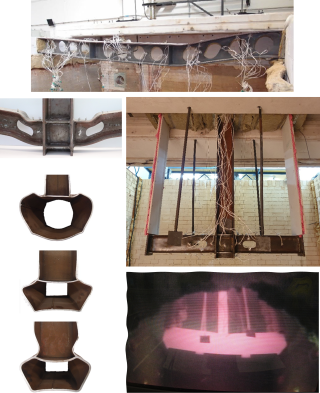
The accredited state-of-the-art fire testing facilities, including large-scale vertical and horizontal test furnaces, allow for a variety of test arrangements and provide excellent opportunities for the development of a new generation of fire-safe materials and structures.
- Experimental and numerical analysis of stainless steel cellular beams in fire, https://doi.org/10.1016/j.firesaf.2021.103277
- Performance of structural stainless steel following a fire, https://doi.org/10.1016/j.engstruct.2021.112001
- Resistance of Axially Loaded Square Hollow Section T-Joints at Elevated Temperatures, https://trepo.tuni.fi/handle/10024/133904
- Behaviour of reduced web section connections in fire – an experimental and numerical study, https://doi.org/10.1016/j.jcsr.2025.109938
- Scope of accreditation: https://research.tuni.fi/fire/fire-testing/
Various timber construction projects
Several projects on industrial timber construction are presented in the Industrial timber construction Graduate School website.
Contact person: Prof. Sami Pajunen, sami.pajunen@tuni.fi
Direct design method for high strength steel tubular structures (2019-2022)
In this research project, the aim is to apply the recently developed direct design method on tubular structures made of high strength (and regular) steel. The idea of the direct design method is to employ a system-level safety factor for the entire structure to verify its resistance instead of performing design separately for each member. The system factor is obtained by reliability analysis on a class of structures.
The project is funded by the Doctoral School of Industry Innovation, with SSAB Europe as the industrial partner.
Contact person: Asst. Prof. Kristo Mela, kristo.mela@tuni.fi
Doctoral researcher: Lauri Jaamala
Shear resistance of sandwich panels (2021-2024)
Sandwich panels with thin steel faces and thick insulation core are widely used as cladding structures in various buildings. In this research project, the current methods of testing and calculating the shear resistance of sandwich panels are examined. The goal is to provide updated testing procedures and expressions for the shear resistance to be used in design. The project includes an extensive testign campaign accompanied with thorough computational analysis.
The project is funded by the Doctoral School of Industry Innovation, with Ruukki Construction as the industrial partner.
Contact person: Asst. Prof. Kristo Mela, kristo.mela@tuni.fi
Doctoral researcher: Shekhar Silwal
Steel cladding systems for stabilization of steel buildings in fire, RFCS-STABFI (2017-2020)
Steel cladding structures -namely trapezoidal sheeting and sandwich panels- can efficiently be used to provide additional stability to individual structural members and entire building frames. While a wide set of guidance is provided for design in room temperature, knowledge on the stabilising effect of cladding structures in a fire situation is still lacking. The primary objective of the project STABFI was to produce enough data on the stabilising behaviour of trapezoidal sheeting and sandwich panels in a fire such that the stabilising effect could be taken into account in design. The research included an extensive testing campaign, numerical studies, and derivation of applicable structural models.
The STABFI consortium consisted of the following partners:
Tampere University (Coordinator)
Czech Technical University in Prague
City, University of London
Budapest University of Technology and Economics
Brandenburg University of Technology
HAMK University of Applied Sciences
Ruukki Construction
Kingspan
SFS Intec
The project was funded by the Research Fund for Coal and Steel (EU).
Contact person: Asst. Prof. Kristo Mela, kristo.mela@tuni.fi
In the project, researchers from City, University of London created a software for the design calculations of a steel member supported by sandwich panels at elevated temperatures. The standalone software package can be downloaded here. A user manual can be downloaded here.