

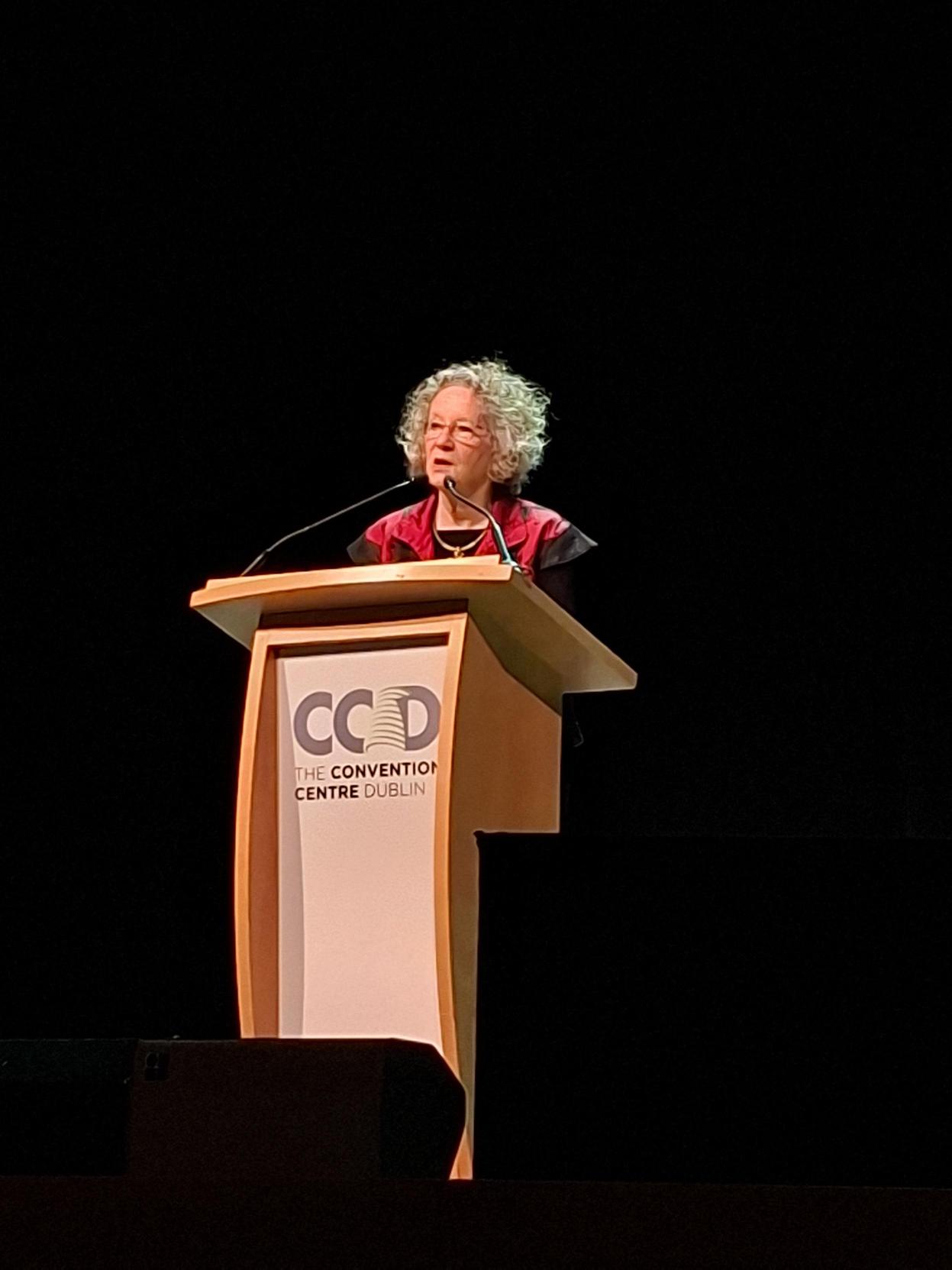
Professori Carol Ryffin keynote-puhe
Oli upeaa kuulla 75-vuotiaan legendan puhe, jossa hän esitteli elämäntyötään. Carol Ryff on yhdysvaltalainen tutkija, jonka vuonna 1989 julkaisema tutkimus ”Happiness is everything, or is it? Explorations on the meaning of psychological well-being” on yksi hyvintointitutkimuksen klassikoita. Elämänpäämäärä on tutkitusti keskeisin tekijä ihmisen hyvinvoinnille. Ryffin Midlife in the US (MIDUS) -projektin keräämät aineistot ovat avoimesti saatavilla. MOTIprojektissakin olemme käyttäneet Ryffin Purpose in Life -mittarin väittämiä, kun olemme tutkineet elämänpäämäärään sitoutumista eli Damonin määritelmän mukaista, toimintaa kuvaavaa dimensiota. Puheen päätteeksi Carol Ryffiä kunnioitettiin antamalla aplodit seisten – tämä oli jotain mitä Elina ei ole aikaisemmin kokenut tieteellisissä konferensseissa.
 Professori Carol Ryff
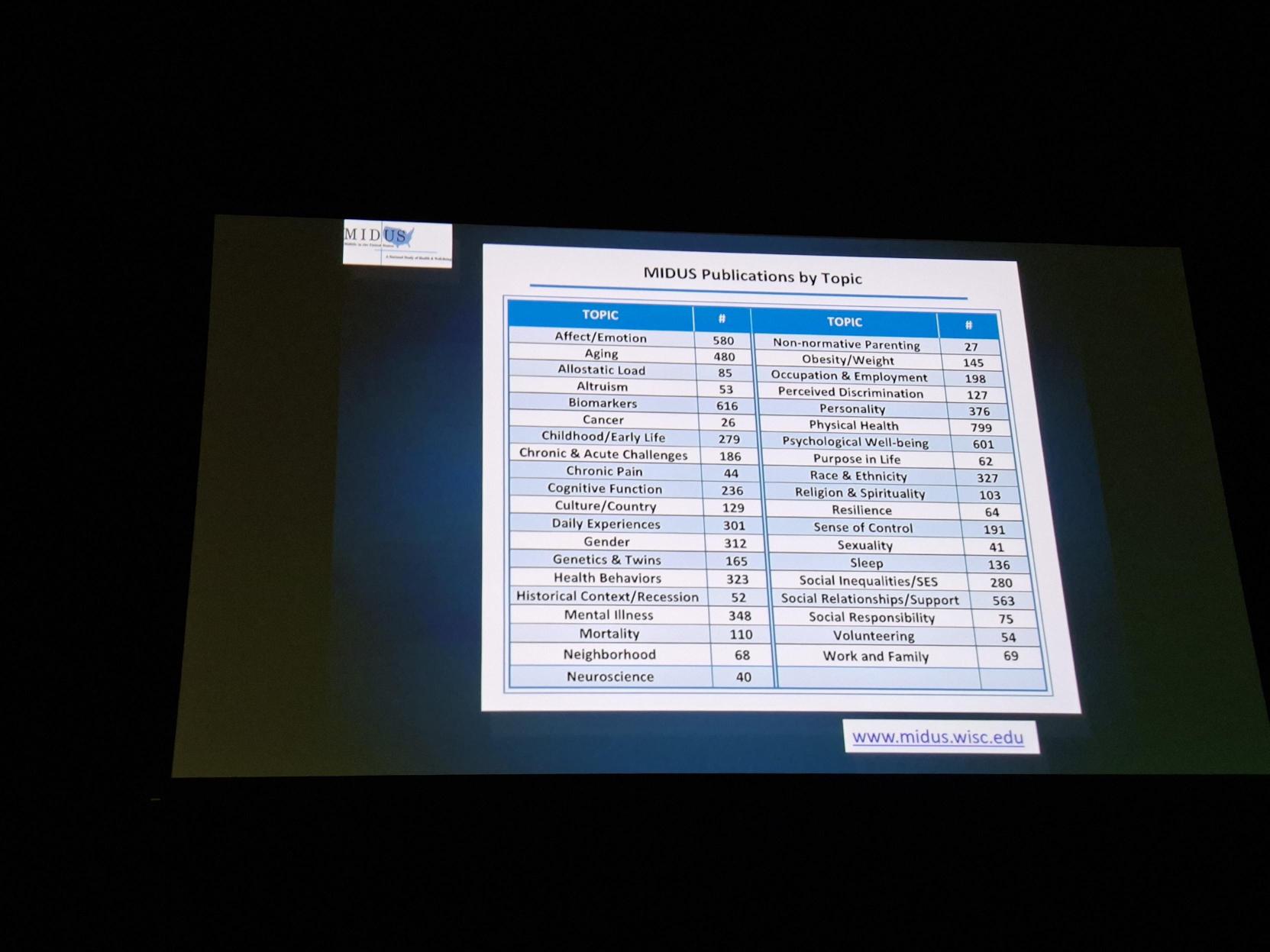 Ryffin MIDUS-projektin tutkimusaineistoista tehtyjä tutkimuksia
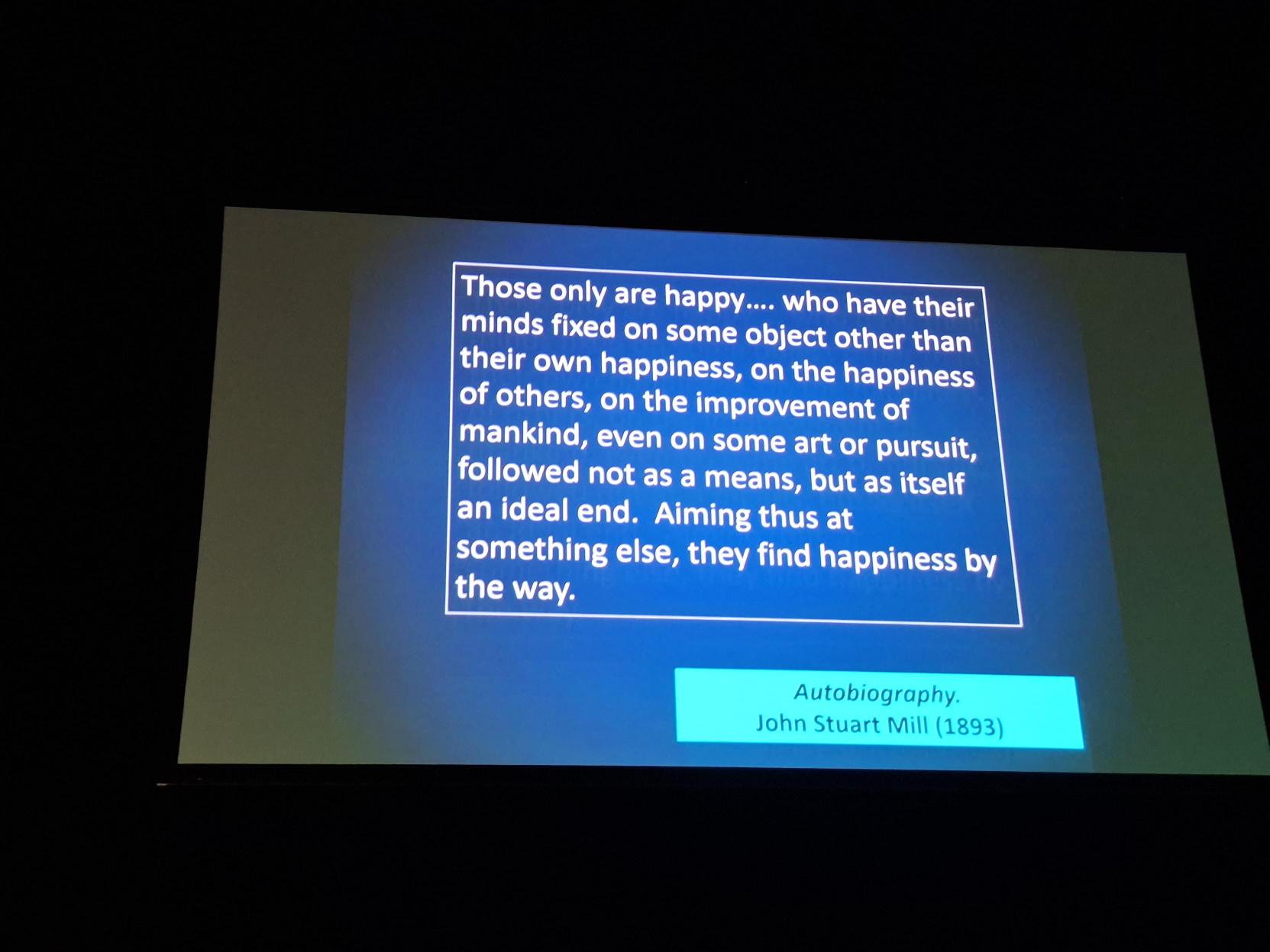
Ryff siteerasi John Stuart Millin viisaista sanoja.
Apulaisprofessori Frank Martelan puhe
Suomalaista Frank Martelaa saapui kuuntelemaan täysi sali konferenssivieraita. Tunnelma oli kuin rock-konsertissa. Martelan pääviesti kiteytyy tyyneysrukoukseen. Elina oppi uuden käsitteen meliorismi: hyväksy asiat joita et voi muuttaa, ja vaikuta siihen, mitä voit muuttaa. Martela korosti, että melioristista asennetta tarvitaan erityisesti vaikeina aikoina:
- suhde menneeseen – hyväksy mennyt, sillä sitä ei voi enää muuttaa
- suhde tulevaan – keskity siihen, mihin voit vaikutaa
- suhde nykyhetkeen – muista arvostaa jokapäiväisen elämän kauneutta
Meliorismin esimerkkeinä toimivat mm. Suomen entisten presidenttien sanonnat:
Kaiken viisauden alku on tosiasioiden tunnistaminen – J.K. Paasikivi 6.12.1944
Olen aina pyrkinyt parhaani ja ymmärrykseni mukaan palvelemaan maatani… Maan palveluksessa ei paikka ratkaise, vaan tahto. Se voi yhtä hyvin olla vankilassa kuin presidentin linnassa. – Risto Ryti 2.2.1946
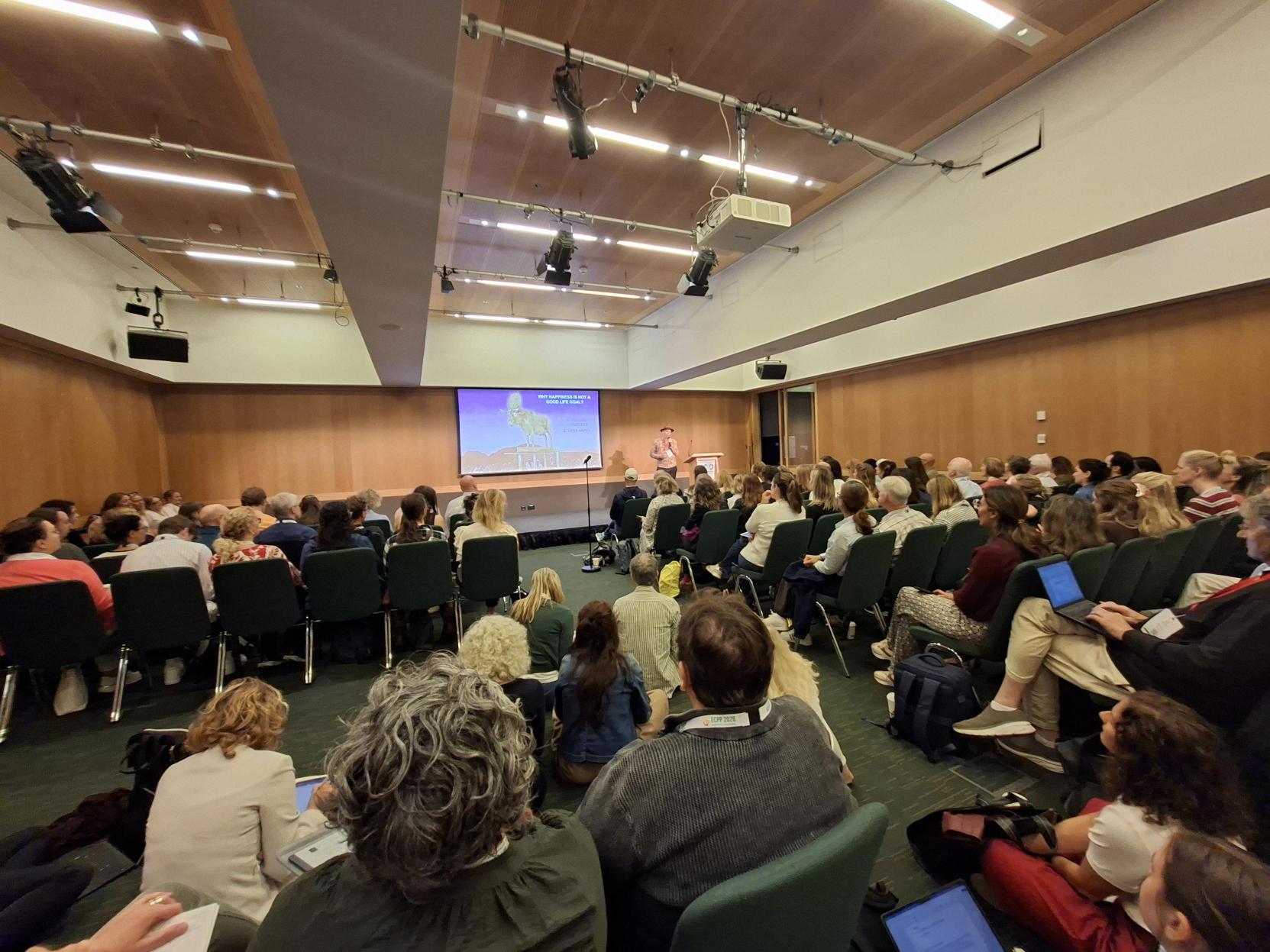
Frank Martelan luennolla oli tupa täynnä kuulijoita.
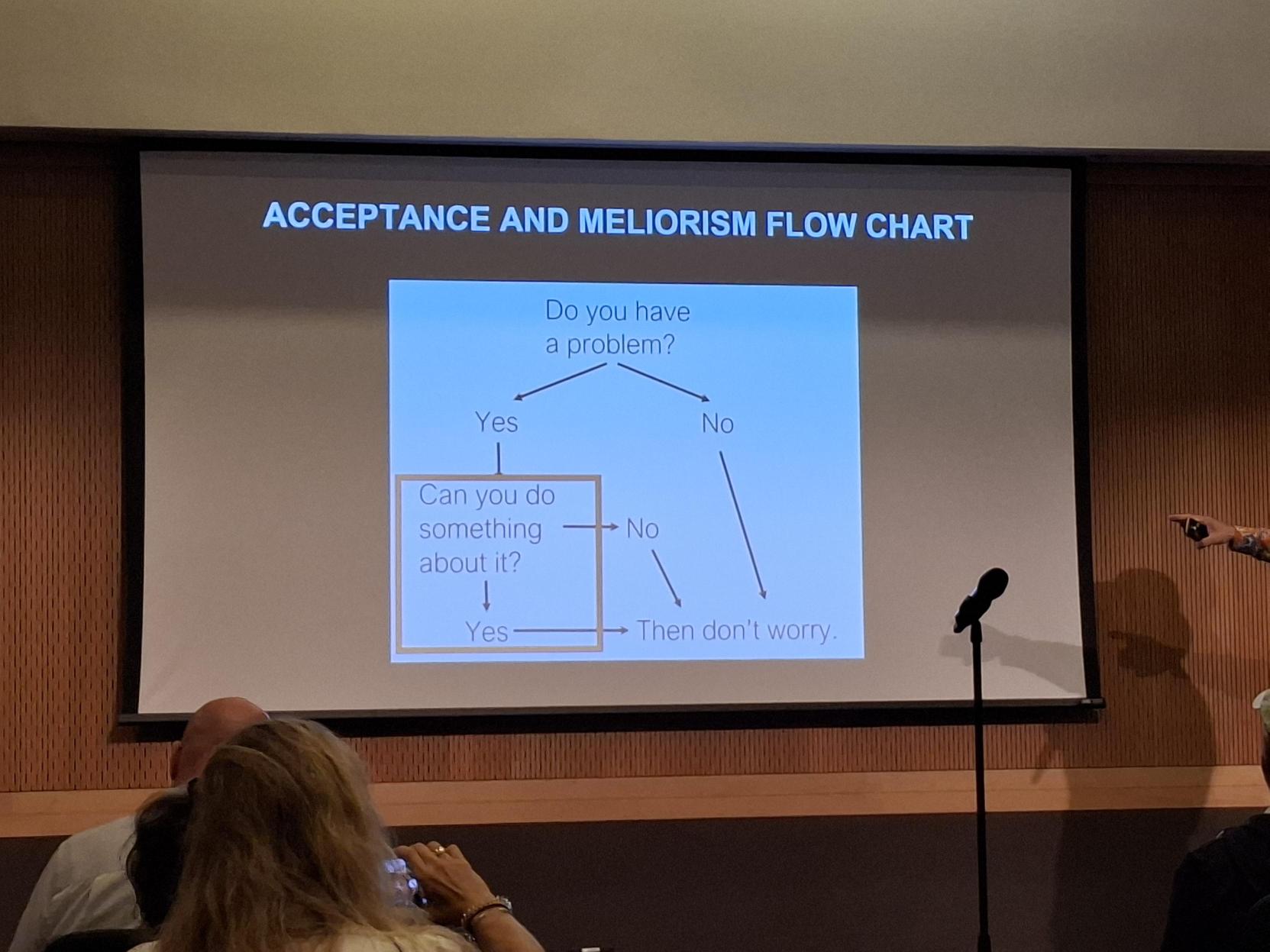
Meliorismin vuokaavio
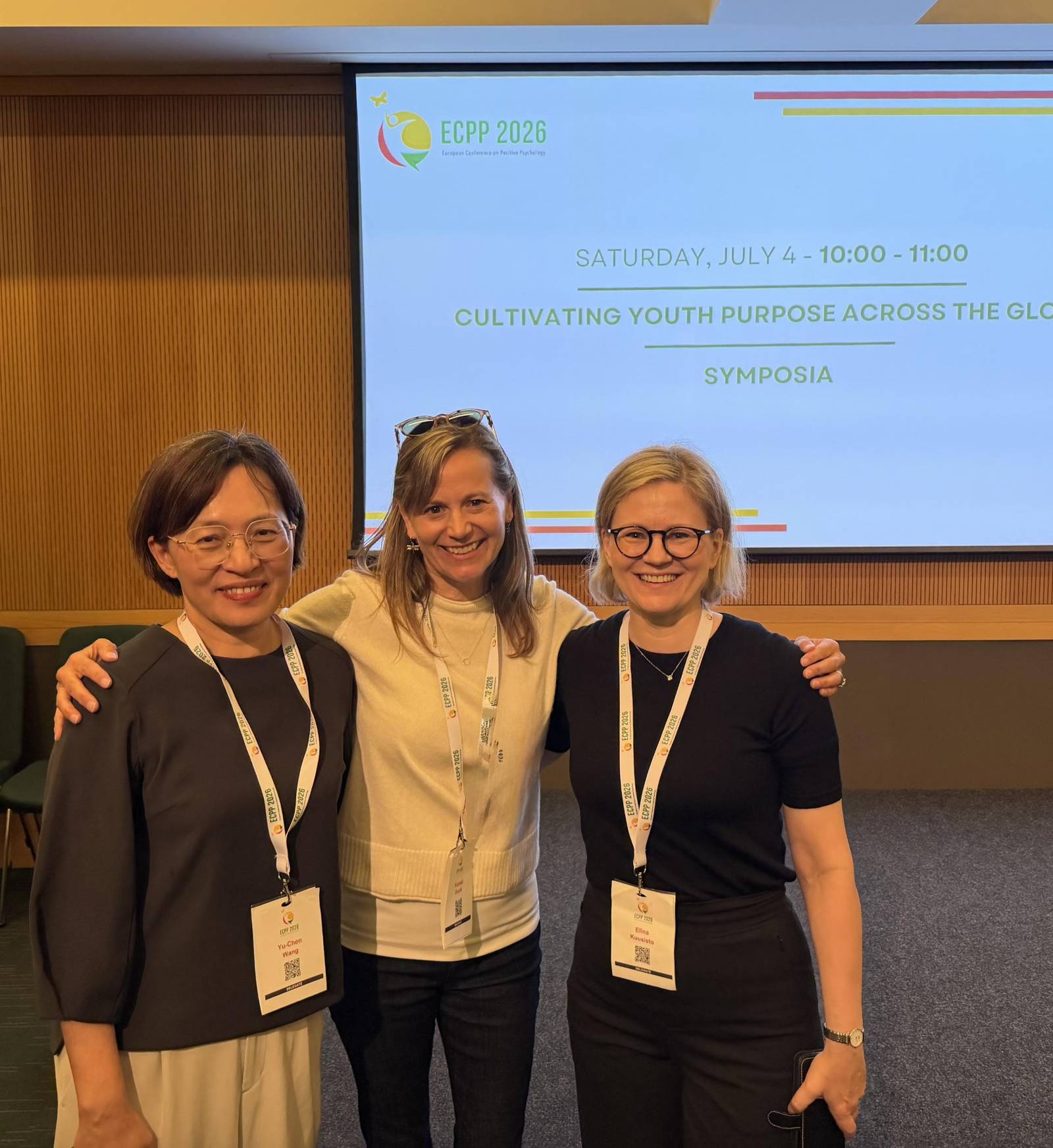
Cultivating Youth Purpose across the Globe -symposium 4.7.2026
Oli upeaa pitää puhe Kendall Cotton Bronkin järjestämässä symposiumissa. Symposiumin aluksi Kendall esitteli havainnointitutkimusta, jossa oli tutkittu monikulttuurisen, haastavalla alueella sijaitsevan ja erinomaisista oppimistuloksista tunnetun koulun. He siis laajensivat exemplar-tutkimusta organisaation tasolle ja tutkivat, miten tässä koulussa tuetaan nuorten päämääriä: Kaikki ovat sisäistäneet koulun arvot. Opettajat ovat työstäneet omia elämänpäämääriään, tietävät, mikä on heidän päämääränsä ja heille on luontevaa puhua elämänpäämääristä. Lisäksi oppilaille oli paljon mahdollisuuksia tehdä vapaaehtoistyötä ja antaa oma panoksensa toisten hyväksi.
Taiwanilainen professori Ye-Chen kertoi career purpose -tutkimuksesta, jossa oli tutkittu siirtymää lukiosta yliopistoon ja miten ammattiin liittyvät päämäärät kehittyvät.
Elina kokosi ja summasi puheessaan yli vuosikymmenen ajalta tehtyvä suomalaista elämänpäämäärä-tutkimusta. Keskeisin havainto on: kun eri-ikäiset suomalaiset kuvaavat kirjoittaen elämänpäämääriään, niissä korostuu itseen suuntautuminen – mitä haluan itselleni. Itsen ulkopuolelle suuntautuminen on verrattain harvinaista, sillä elämänpäämäärissä se näyttäytyy alle 5 %:lla yläkoululaisista, 15 %:lla toisen asteen opiskelijoista sekä noin 35 %:lla korkeakouluopiskelijoista ja opettajista. Seuraava tärkeä kysymys on, miten itsen ulkopuolelle suuntautumista voitaisiin vahvistaa kasvatuksen ja opetuksen keinoin.
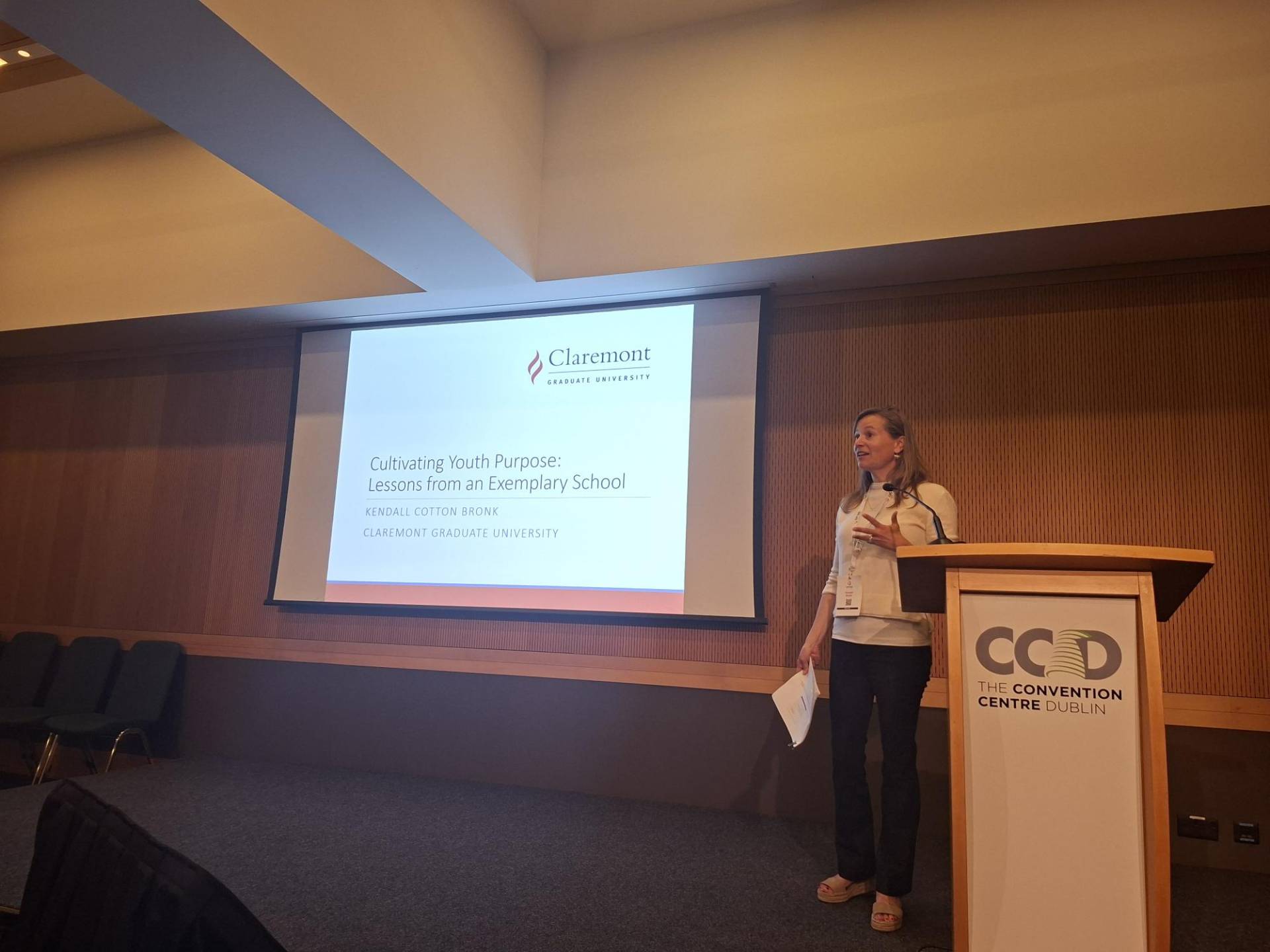
Kendall Cotton Bronk
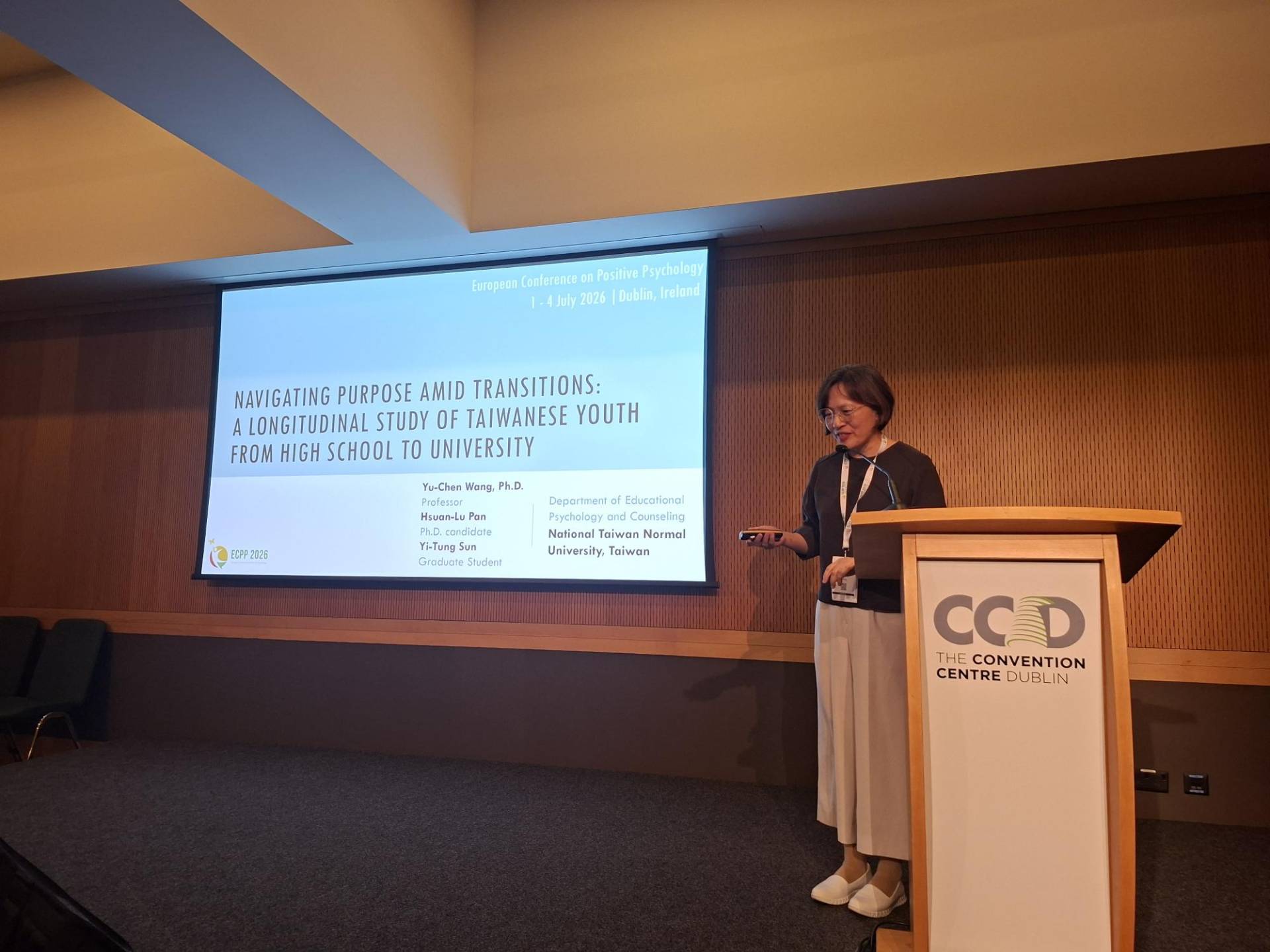
Yo-Chen Wang
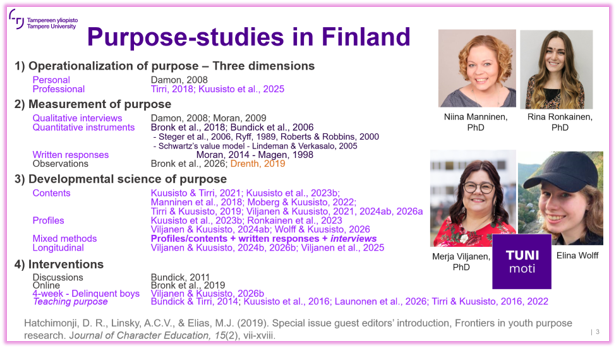
Ote Elinan esitysmateriaalista: MOTIprojekti vahvasti mukana suomalaisessa elämänpäämäärä-tutkimuksessa

Hulppea konferenssikeskus Dublinin keskustassa

Cultivating Youth Purpose across the Globe -symposiumin yleiskuvaus ja esitelmien abstraktit
When young people identify and pursue a long-term aim that enables them to contribute to the broader world in personally meaningful aims, they thrive (Bronk et al., 2009; Clarke et al., 2023). Compared to others, youth with purpose are more likely to display indicators of academic achievement and well-being (Hill et al., 2014; Sharma et al., 2023); however, despite the benefits of leading lives of purpose, many young people struggle to do so (Damon, 2008; Gallup & Bates College, 2018). Accordingly, scholars and practitioners have grown increasingly interested in supporting the development of youth purpose, especially in school settings. This proposed symposium will feature findings from three studies designed to cultivate youth purpose in the US, Europe, and Asia. In addition to outlining culturally specific strategies for cultivating purpose, or a stable and enduring aim that is at once personally meaningful and at the same time enables individuals to contribute to the world beyond the self (Damon et al., 2003), we will also highlight purpose nurturing strategies that appear to be effective across cultural contexts.
Dr. Bronk will share findings from a large-scale study of youth purpose in the United States. Generously funded by the Walton Family Foundation and in conjunction with co-Principal Investigator Belle Liang at Boston College, this study featured an in-depth case study of a high school nominated by purpose researchers and practitioners as being an exemplar of youth purpose cultivation. In addition to carrying out observations at the school, members of the research team also conducted roughly 60 minute, semi-structured interviews with teachers and staff (N=30) and 90 minute focus groups (N=8) with students (N=44). Taken together, findings shed important light on how administrators at the high school have managed to help its diverse student body lead lives of purpose. Findings highlight the important role that purposeful educators and mentors play in supporting youth purpose. Young people internalize the language of purpose and envision what leading a life of purpose might look like by interacting with purposeful teachers and counselors on campus. In addition, according to students and educators, a school culture that prioritizes inclusiveness and student belonging is also key to the development of youth purpose. Activities and discussions designed to help support identity development, which is closely related to purpose formation, also aided in the growth of purpose among students. Finally, students need opportunities to contribute to the world beyond themselves in personally meaningful ways. Curricular materials that emphasize student responsibility and opportunities to actively engage in supporting families and communities are core to the development of youth purpose. In addition to outlining these and other findings from this study, this presentation will also address implications for other schools and school leaders interested in supporting the development of youth purpose.
Drs. Wang and Lu will share findings from their study entitled Navigating Purpose Amid Transitions: A Longitudinal Study of Taiwanese Youth from High School to University. The study examines how career purpose is developed and recalibrated among Taiwanese adolescents during the critical transition from the final year of high school to the first year of university—a period heavily shaped by family expectations, academic performance, and socioeconomic considerations in East Asian contexts. Twenty-four participants (8 male, 16 female) identified as having career purpose, defined by meaning, prosocial intentions, long-term goals, and purposeful action, were followed longitudinally through two in-depth interviews. The first occurred during the final year of high school (mean age = 16.83), and the second one year later. At follow-up, one participant was preparing for re-examination, while the others had entered university across a range of majors. Data were analyzed using a grounded theory approach. Findings indicate that participants’ career goals were not fixed. Instead, they represented evolving constructions shaped by ongoing negotiation between idealistic aspirations and practical constraints. Initially grounded in intrinsic interests and a desire to contribute to others, career purpose provided participants with direction and motivation. However, as students encountered real-world limitations, such as exam performance, family finances, and occupational risks, they engaged in purpose-driven pragmatic adjustment, developing primary and secondary plans while maintaining a sense of agency. Upon entering university, students reassessed earlier goals based on academic and social experiences, shifting from externally guided decision-making toward internal coherence and self-congruence. These findings underscore that career purpose functions as a dynamic motivational force that sustains resilience in the face of uncertainty. The study highlights the importance of integrating purpose development into career counseling and educational practice as a core psychological resource to support adaptive decision-making and enhance long-term well-being among emerging adults.
Finally, Dr. Elina Kuusisto will present a summary of youth purpose research in Finland. The presentation will examine recent developments among Finnish youth, highlighting a concerning rise in hopelessness about the future compared to previous generations. Next, Finnish research on youth purpose—grounded in William Damon’s (2008) framework—will be introduced. This line of research began over a decade ago and has emphasized several key areas: the role of teachers in purpose formation (Bundick & Tirri, 2014), methodologies for purposeful teaching (Kuusisto et al., 2016), and the content and developmental phases of personal life purposes, referred to as purpose profiles (Kuusisto & Tirri, 2021; Kuusisto et al., 2023; Viljanen & Kuusisto, 2024). More recent studies have also explored professional purposes (Kuusisto et al., 2025). Findings show that the majority of Finnish youth and young adults are able to identify and articulate their life purposes. Common themes include self-realization, happiness, and meaningful careers. These patterns have been consistent across various samples. However, both qualitative and quantitative data indicate a strong self-orientation, while a beyond-the-self orientation remains relatively rare. These trends reflect both the developmental nature of life purpose and the individualistic values prevalent in Finnish (youth) culture. International research has shown that purposes oriented toward serving others are associated with improved well-being. This presents a challenge for Finnish educators: how to support young people in cultivating aspirations that contribute to others, society, and the natural world. Our research suggests that teachers need conceptual knowledge of purpose and purpose profiles to effectively identify and support students’ purpose development. Methodologically, Finnish teachers tend to support purpose implicitly, which underscores the need for more explicit approaches. We propose that homeroom teaching (form tutoring, class tutoring) provides a valuable context for nurturing personal purpose, while guidance counseling plays a key role in supporting the development of professional purpose.
These presentations will feature findings from studies conducted in the US, Asia, and Europe. Together, they will highlight culturally specific and more universal approaches to supporting the development of youth purpose, especially in school settings. In addition to sharing our respective findings, we are eager to engage with our audience. Accordingly, we plan to offer three 15 minute talks, followed by 15 minutes of questions and answers with the audience.