

Did you know? The history of the case study
The case study method has its origins in higher education in the field of economics and was introduced at Harvard Business School in the early 20th century. The aim was to link theoretical knowledge with concrete, realistic decision-making situations.
Students would learn to analyze information, weigh up different courses of action, and make informed decisions – a practice that closely mirrors the real-life requirements of the business world. The case study method is now used in various areas of education, not only at university level.
In vocational education and training, case studies can help to make economic contexts more comprehensible and encourage discussions about operational and social challenges. In this way, teachers can promote key competencies such as critical thinking, teamwork, and decision-making in a practice- and action-oriented manner.
Third transnational project meeting
From 4 to 6 June 2025, all project partners met in person in Tampere, Finland.
The focus was on reflecting on our TeC@ses tool and learning nuggets, as the major evaluation round by vocational teachers began in June. This testing phase ensures that the perspectives, needs, and practical requirements of teachers are at the center of attention.
In addition to preparing and planning the upcoming work steps, we have also actively reflected on our collaboration. We have looked at how we can strengthen our collaborative working methods and make them even more effective. This involved not only organizational processes, but also gaining a better understanding of each other and the different perspectives within our international team.
We also promoted cultural exchange, bringing the European idea to life in our collaboration. A total of four face-to-face project meetings are scheduled for the project period (December 2023 – November 2026). The next transnational meeting will take place in Cologne in May 2026.
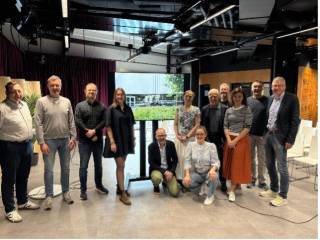
TeC@ses team at the third project meeting in Tampere.
Current status of the project
The major testing and evaluation phase for the TeC@ses tool began in June. During this phase, the two modules developed in English, ‘Design’ and ‘Teach,’ will be evaluated. Only after the two-stage testing process has been completed and all comments from teachers have been taken into account will the individual learning nuggets be translated into the respective national languages.
The newsletter will be sent every four months. If you would like to speed up the time until the next newsletter, you are welcome to discover the new homepage for the TeC@ses project with lots of up-to-date and helpful information.
Contact: ilmari.puhakka@tuni.fi

Funded by the European Union. Views and opinions expressed are however those of the author(s) only and do not necessarily reflect those of the European Union or the European Education and Culture Executive Agency (EACEA). Neither the European Union nor EACEA can be held responsible for them.