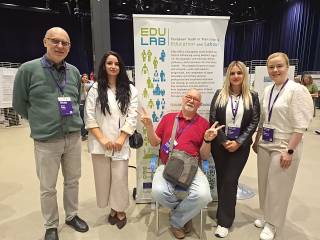

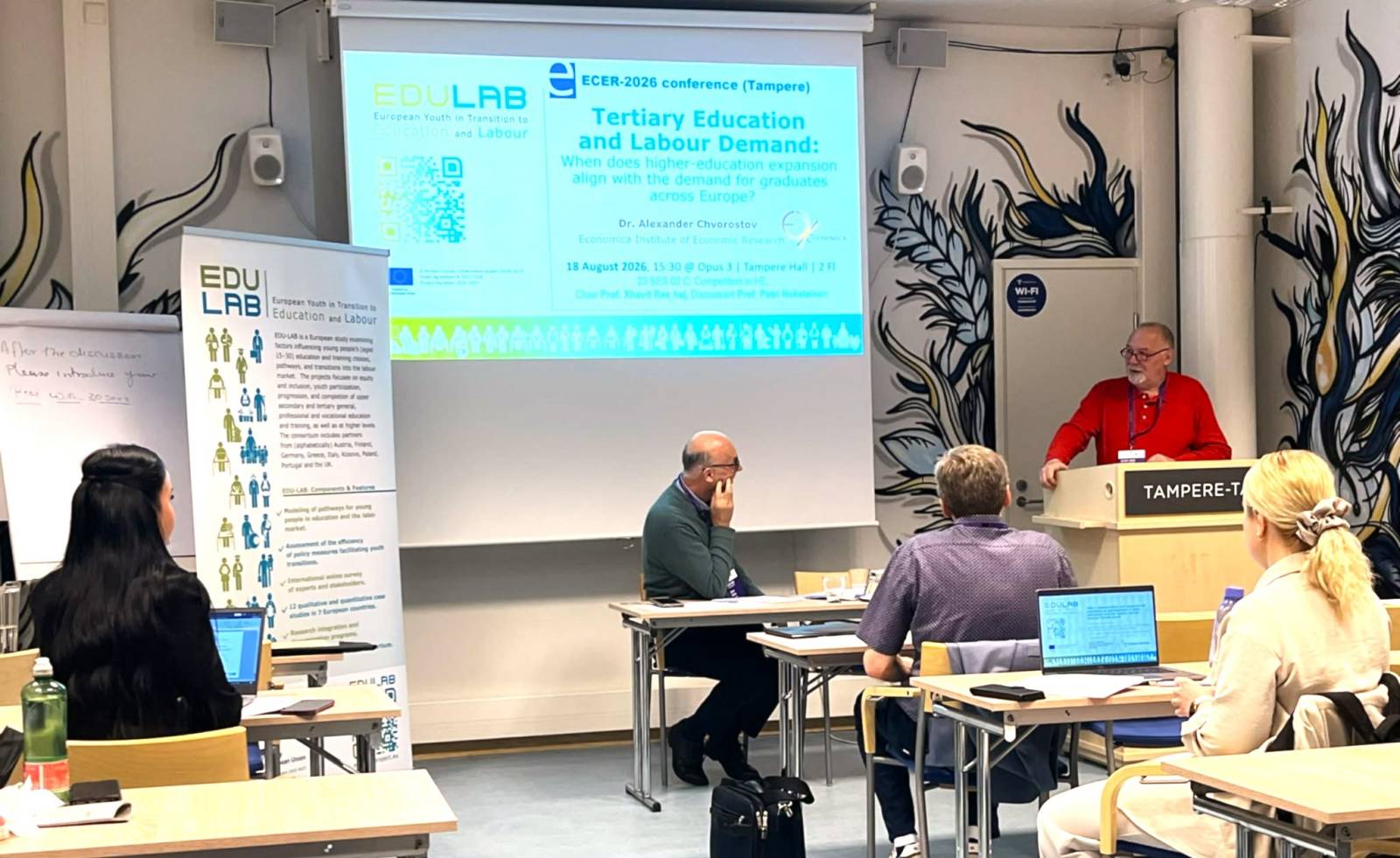
The symposium aimed to understand youth transitions as governed processes shaped by the interaction of individual agency, institutional arrangements and policy regimes. It provided a platform for presenting and discussing the first findings of the multidisciplinary EDU-LAB project from a policy perspective. The symposium was chaired by Professor Xhavit Rexhaj (AAB College, Pristina, Kosovo), with Professor Petri Nokelainen (Tampere University, Finland) serving as discussant.
 The symposium consisted of four presentations by EDU-LAB researchers. The first presentation was given by Professor Theodor Leiber (EVALAG, Heidelberg, Germany). He presented research findings on modelling pathways through general and vocational education and into the labour market, as well as on identifying more than 80 intersectional determinants, more than 30 striking transitions of pathways and data gaps related to these determinants and transitions in large international datasets, such as PISA, Eurostudent, Eurograduate, TIMSS and VET in Europe. In a nutshell, there are no deep data gaps but a few moderate data policy recommendations can be given as well as the request for longitudinal data in the EEA. The accessibility of available datasets can be improved.
The second presenter was EDU-LAB Consortium Coordinator Dr Alexander Chvorostov (Economica Research Institute, Vienna, Austria). He examined the rapid expansion of higher education in Europe and its relationship to the demand for highly educated workers in labour markets. The presentation compared the supply of graduates and labour market demand across countries and discussed the conditions under which the expansion of higher education can benefit both young people and labour markets.
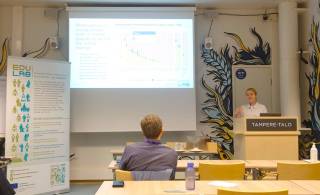
The third presentation was delivered by Dr Sini Teräsahde (Tampere University, Finland). The presentation examined young people’s simultaneous participation in education and the labour market in Finland, as well as the policy factors influencing this participation and young people’s own experiences. Findings based on EDU-LAB case study data show that working while studying provides economic security and valuable work experience for future transitions, but can also place a strain on young people, delay their studies and undermine their well-being. The Finnish student financial aid system and the level of financial support both motivate young people to work alongside their studies and restrict the amount of work they can undertake, as the financial aid system is designed to promote faster progress in studies.
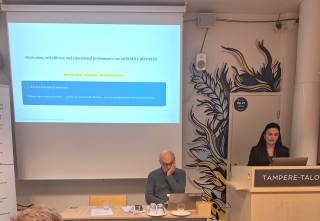
The fourth presentation was given by Professor Xhavit Rexhaj and doctoral researcher Gresa Shaqiri (AAB College, Pristina, Kosovo). They presented quantitative research, conducted together with their colleagues Arberesha Qerimi and Fidan Qerimi, examining the impact of socio-economic factors and parental investments on children’s educational performance in Kosovo. The study was based on a survey of 720 parents, which examined families’ socio-economic status and parents’ investments in their children’s education. Children’s educational performance was assessed using the PISA framework in reading, mathematics and science, and the relationships between the variables were analysed using statistical methods.
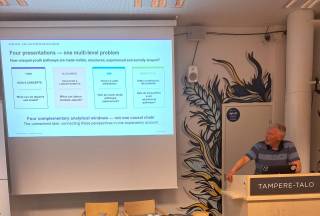
Professor Petri Nokelainen (Tampere University, Finland), who served as discussant, brought the presentations together and opened the discussion. He identified a common core question linking all four presentations: how unequal youth pathways become visible, structured, experienced and socially shaped. He emphasised that the four presentations approached the same problem through complementary perspectives – data and concepts, education and labour markets, policy and lived experience, and family- and individual-level mechanisms – rather than forming a single causal chain. He concluded by asking each presenter which one finding from another presentation most changed, challenged or extended how they interpreted their own results, highlighting the need to connect these different analytical levels within a more integrated explanatory account.
In addition to the symposium, several EDU-LAB researchers gave their own research presentations in paper sessions.
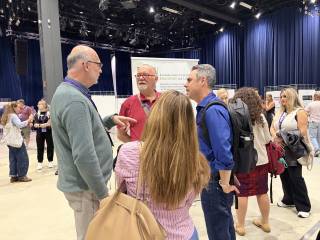
EDU-LAB researchers also participated in the ECER poster session, where they had the opportunity to present the project to conference participants interested in its work. These discussions created valuable new contacts with researchers working on related topics.