
You can find the Master Thesis in Trepo from this link.
What was the topic of your master’s thesis, and what were its main results?
The topic of my master’s thesis was ‘Transition to Circular Economy in infrastructure construction’. The thesis examined whether overconsumption exists on the Finnish infrastructure construction sector. Also, it researched about current circular economy practices, the barriers faced in its implementation, the strategies to overcome them and the indicators that used and those could be developed in the future to measure the transition toward circular economy.
The results revealed several interesting factors in comparison with the global infrastructure sector. Even though overconsumption exists within the infrastructure construction sector globally, the research and interviews showed that it is not currently a major issue in Finland, mainly due to strict budget constraints and resource‑conscious planning in infrastructure projects. Regarding circular practices, the findings indicate that although Finland has strong national ambitions, current implementation is largely limited to the use of recycled aggregates, crushed concrete, low-carbon materials, and occasional structural reuse.
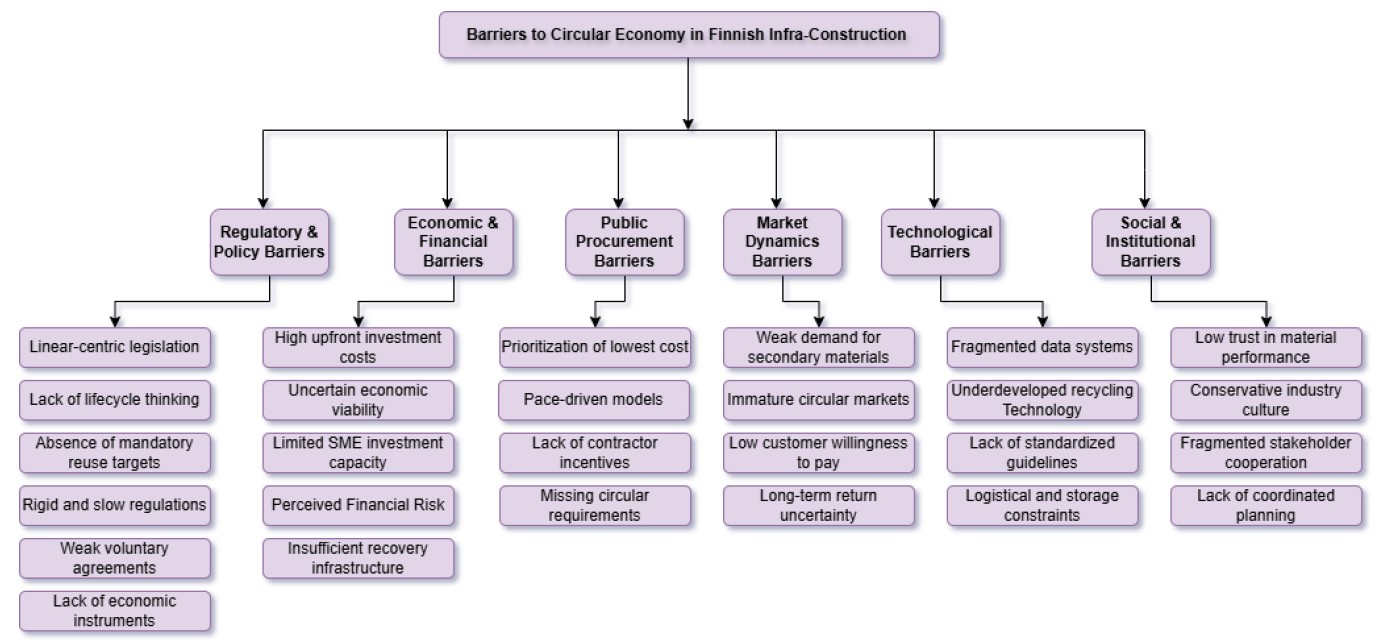
The barrier to the transition is mainly caused by regulatory uncertainty, financial constraints, limited knowledge, inconsistent data availability, and uneven material supply. Some of the strategies identified to address these barriers include strengthening regulations, improving training, and reforming procurement practices. The study also found that although numerous global circularity indicators exist, their use in Finland remains limited, and national metrices are still under development. So, the recommended step is digitalising data collection, standardising definitions of circular practices, and adopting digital tools to support future transitions.
How did you come up with the topic for your thesis?
I would say, I arrived at the topic because of the guidance from my teachers Pirjo and Pauli. As my final semester approached, I was exploring different interesting themes to write my thesis about. Pirjo introduced me to a project she is part of, which is the BLINK project that investigates the root causes of structural overconsumption and how to transform it within the construction sector with a focus on concrete. It is a multi‑organisation collaboration, and the research centre Terra is one of the partners.
Since Terra is responsible for conducting the literature review on overconsumption of concrete and natural resources from the perspective of infrastructure construction, we discussed how my thesis could contribute. We concluded that focusing on the transition to circular economy in infrastructure construction would be valuable.
Also, I was personally interested in learning more about circular economy, sustainability and the challenges of implementing it in practice, during my studies. So, this seemed like a perfect option, and I decided to choose it.
What were the most important things you learned during the process?
The process taught me how complex the circular economy implementation actually is, especially when moving from strategy to practical application. I learned to identify and categorize barriers, to understand how they are interconnected, and to evaluate how different stakeholders influence sustainability outcomes, even in small ways.
On a personal level, I learned how to conduct qualitative research independently, how to do interview-based research, and how to do synthesis of expert perspectives into coherent answers, and how to take constructive feedback and implement them. These academic and personal skills developed throughout the process and shaped the final outcome of my thesis.
You started in the international master program just two years ago, what do you want to highlight in your studies and life in Finland?
Looking back at the past two years, the biggest highlight of my time here has been the opportunity for deep personal and academic growth.
Academically, the international master’s program provides an incredibly supportive environment. It strengthened my understanding of sustainability, critical thinking, and problem-solving capabilities. The professors and supervisors genuinely care about your progress and help connect you with practical, real-world industry opportunities, which has been very helpful.
While navigating the challenges of studying abroad, life in Finland has offered closeness to nature, and the beautiful forests and lakes have provided a very calm environment. Living in Finland has also taught me adaptability, patience, and how to build my own routines.
You will graduate soon – what’s next?
My next step after graduation is to step into the professional world. I recently started an internship as a Geotechnical trainee at Destia, where I am applying the knowledge from my studies, along with gaining hands-on experience in the field. Moving forward, I am excited to continue working there on design and infrastructure projects, and curious to see where these opportunities lead me as I begin my career.