

Each project requires a group consisting of at least 2 students. Each project will be supervised and graded by at least one senior researcher from the AMM group. If you’re interested in a project topic(s) listed below, please send an email to the listed contact person.
Project Descriptions
1. Safe Reinforcement Learning (RL)
Research Roadmap: Simulation & Data Driven Modeling.
Number of Students: 3 to 4
Supervisors (contact): Naeim Ebrahimi Toulkani (naeim.ebrahimitoulkani@tuni.fi), Prof. Reza Ghabcheloo.
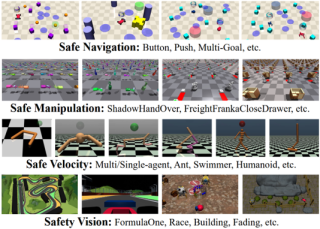
Background: Safe Reinforcement Learning enables agents to learn effective control policies while respecting safety constraints, making it crucial for real-world robotics where unsafe exploration can cause failures or damage.
Your tasks:
- Implementation of three safe RL algorithms (e.g., PPO, SAC, TRPO) on three different control tasks.
- Create a detailed project report explaining methodology, results, and insights.
- Create a GitHub repository with reproducible code, setup instructions, and documentation.
Learning outcomes:
- Fundamental concepts behind safe RL algorithms (PPO, SAC, TRPO).
- How to work with modern robotic simulators (MuJoCo, Isaac Lab, Safety-Gymnasium).
- Techniques for leveraging real-machine data to improve simulators and policies.
Skills required: Python, PyTorch, MuJoCo, Reinforcement Learning basics, & comfortable with mathematics.
2. Terrain Elevation Mapping
Research Roadmap: Task Automation & Physical Interaction
Number of Students: 2 to 3
Supervisors (contact): Golnaz Raja (golnaz.raja@tuni.fi), Dr. Miloš Prágr, Prof. Reza Ghabcheloo
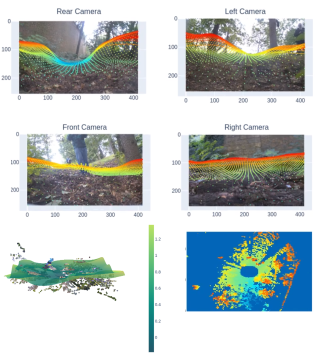
Background: Support real mobile robot navigation by building high-fidelity terrain maps using outdoor RGB and LiDAR data.
Your tasks:
- LiDAR point cloud fusion to build both robot-centric and global terrain elevation grid map.
- Learning-based elevation mapping from RGB inputs.
Learning outcomes:
- Work with real outdoor sensor data.
- Machine learning for real time vision.
- See your work in operation on a real mobile robot.
Skills required: Programming (C++, Python), ROS2, Machine Learning, & Computer Vision.
3. Rock-Ahead Detection from Force Signals
Research Roadmap: Simulation & Data-Driven Modeling
Number of Students: 2 to 3
Supervisors (contact): Mohammad Heravi (mohammad.heravi@tuni.fi), Prof. Reza Ghabcheloo
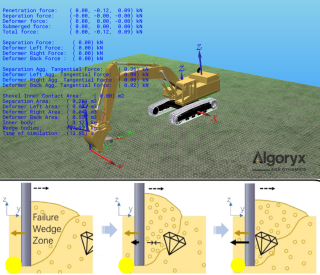
Background: In real sites, individual large rocks are often partly embedded among soil and cannot be treated like homogeneous material; they demand precise bucket positioning and careful handling, rather than continuous bucket filling. Feeling the presence of the rock before contact can help with planning.
Your tasks:
- Data: Log forces on the bucket using a high-fidality simulator and/or real world machine.
- Model: Learn the clean-soil force profile and run an anomaly detector (e.g., dF/dt spike + GP/LSTM residual).
- Ship: code + README + short video; open, reproducible repo.
Learning outcomes:
- Time-series anomaly detection for granular media using advance ML.
- Working with high-fidality simulator (Agx Dynamics), and real world machine.
Skills required: Python, PyTorch, & Machine Learning.
4. Learning to Load: Imitation Learning for Rock Excavation
Research Roadmap: Simulation & Data-Driven Modeling
Number of Students: 2 to 3
Supervisors (contact): Mohammad Heravi (mohammad.heravi@tuni.fi), Prof. Reza Ghabcheloo
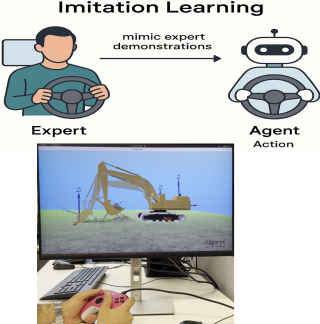
Background: Expert operators make subtle, high-value moves around large rocks; hard to hand-code. Imitation Learning (IL) captures those skills directly, aiming for higher fill and gentler forces.
Your tasks:
- Collect demos: tele-operations in sim (AGX); log pressures, joint states, actions.
- Train a policy: methods like Behavior Cloning/DAgger.
- Harden it: domain randomization over soil/rock size
- Evaluate: cycle time, success rate; compare to baseline.
- Ship: code + README + short video; open, reproducible repo.
Learning outcomes:
- Sim-to-real tactics (randomization, filtering, action smoothing) and field-relevant metrics.
- Building an IL pipeline for heavy equipment.
Skills required: Python, PyTorch, & Machine Learning.
5. Digital Twin of a Real Excavator: Sim Tuning from Field Data
Research Roadmap: Simulation & Data-Driven Modeling
Number of Students: 2 to 3
Supervisors (contact): Mohammad Heravi (mohammad.heravi@tuni.fi), Prof. Reza Ghabcheloo
Background: Make the simulator behave like the real machine so we can test policies safely and plan material scooping with confidence. A calibrated digital twin cuts field trial time, wear, and rework — and unlocks higher-fidelity research.
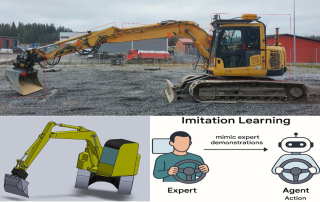
Your tasks:
- Collect data: from the real excavator—cylinder pressures, valve commands, etc.
- Pre-process: synchronize data, filter noise, segment by maneuver, etc.
- Fit the twin: using optimization techniques to minimize a multi-objective sim-vs-real loss.
- Validate: hold-out maneuvers; report RMSE of error.
- Ship: parameter pack (.yaml/.json) + calibration report in a reproducible repo.
Learning outcomes:
- Working with industrial equipments and high-fidelity simulators.
- Practical system identification: loss design, constraints.
Skills required: Python, basics of controls/system ID.
6. SLAM using Custom Sensor Box with Stereo Camera and IMU
Research Roadmap: Perception & Sensing
Number of Students: 2 to 3
Supervisors (contact): Dr. Prashant Rai (prashant.rai@tuni.fi), Prof. Reza Ghabcheloo.
Background: Simultaneous Localization and Mapping (SLAM) system (open-source methods) using a custom-built sensor box consisting of an IMX219-83 stereo camera and an Inertial Measurement Unit (IMU) (Onboard with camera).
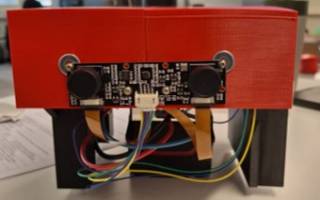
Your tasks:
- ROS2 Node wrapper for the camera.
- Calibrate the stereo camera and IMU (intrinsic and extrinsic).
- Collect datasets in controlled indoor and outdoor scenarios.
- Integrate existing SLAM frameworks into the ROS2 environment.
Learning outcomes:
- A functional real-time SLAM system on Nvidia Jetson Xavier.
- Documentation of design choices, limitations, and improvements.
- A final demo (live or video) showcasing localization and mapping.
- Gain hands-on experience with sensor calibration (stereo + IMU).
Skills required: Python, ROS2, & C++.
7. Calibration of a Multi-IMU Sensor Suite for Robotic Systems
Research Roadmap: Perception & Sensing
Number of Students: 2 to 3
Supervisors (contact): Dr. Prashant Rai (prashant.rai@tuni.fi), Prof. Reza Ghabcheloo.
Background: Inertial Measurement Units (IMUs) are essential for robotic navigation but suffer from inherent noise and bias. These small errors accumulate over time, causing significant “drift” in the robot’s estimated path, making its position unreliable. Precise calibration is a necessity for any autonomous system. The goal is to implement and validate a complete pipeline for the intrinsic, extrinsic, and temporal calibration of a sensor suite containing multiple IMUs and an aiding camera.
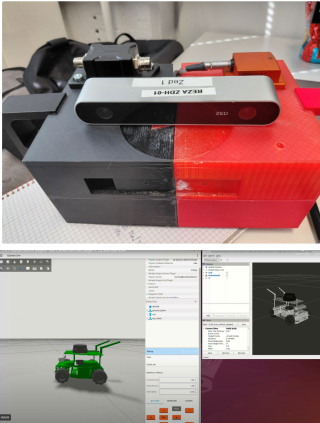
Your tasks: Choose 1 track listed below
Track A: Physical System
- Calibrate a real-world sensor rig with physical IMUs and a camera.
- Manage real-world complexities like lighting and motion blur.
- Validation based on the quality of results (e.g., low reprojection error).
- Deliver calibrated YAML files, Kalibr reports, sensor models (for simulation), and a comprehensive final report.
Track B: Simulated System
- Design and calibrate a virtual sensor rig in the Gazebo simulator.
- Create realistic sensor models and inject known error parameters.
- Validation based on direct comparison of results against a known “ground truth.”
- Deliver calibrated YAML files, Kalibr reports, sensor models (for simulation), and a comprehensive final report.
Learning outcomes:
- Mastery of multi-sensor calibration, from error modeling to validation.
- Hands-on experience with industry-standard robotics software.
- A solid foundation for advanced topics like Visual-Inertial Odometry (VIO).
Skills required: Python, ROS2, C++, & Gazebo