

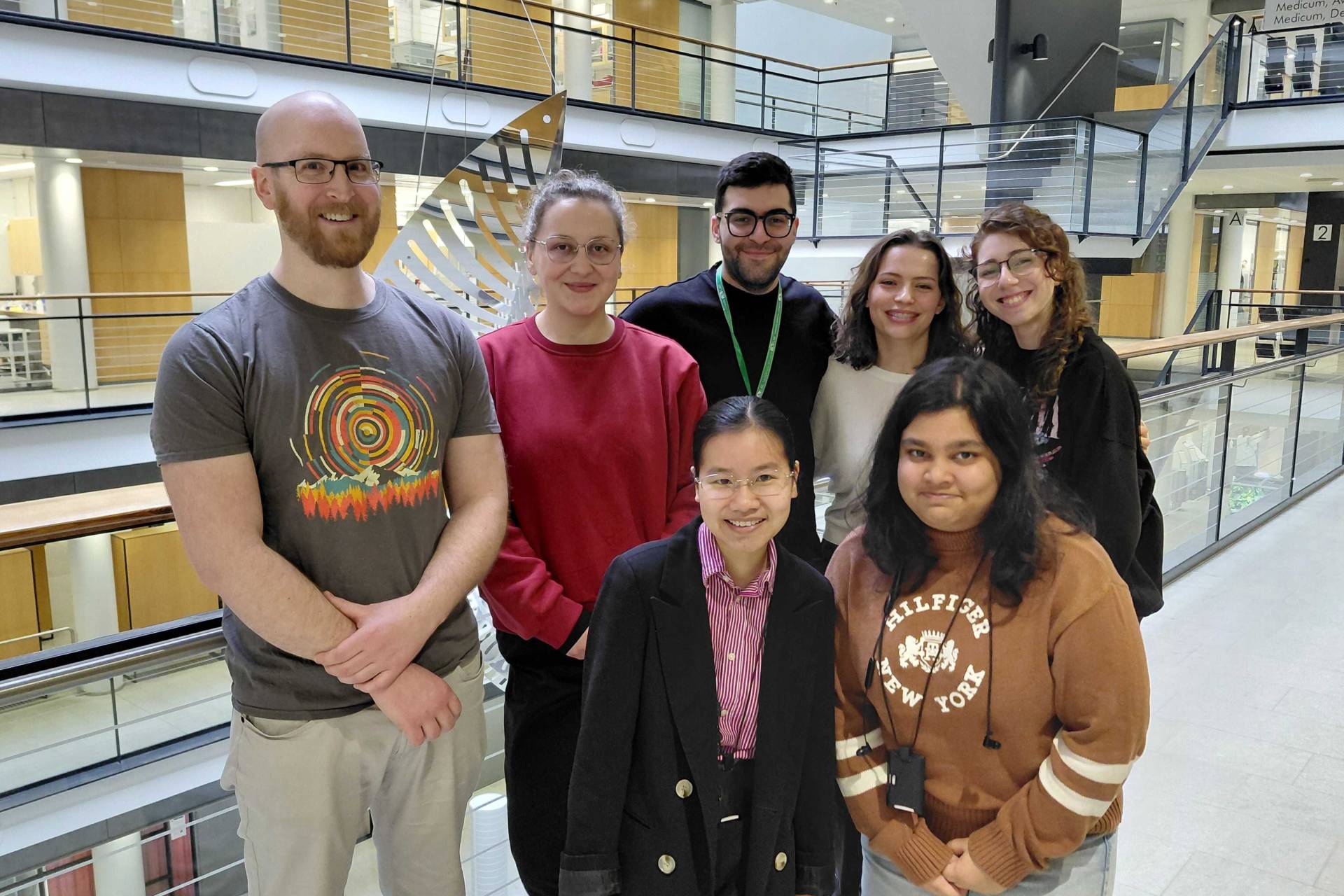
The Tumour Microenvironment and Metastasis group, led by James Conway, studies how the tumour microenvironment (TME) supports cancer progression, therapy resistance and metastatic spread. The TME provides a supportive niche that helps cancer cells evade treatment and move towards metastatic disease. By identifying the key components of this niche, we aim to disrupt it and re-sensitise tumours to therapeutic intervention.
A major focus of our research is the extracellular matrix (ECM) and its role in therapy resistance. We are particularly interested in how the composition and mechanical properties of the ECM change during ageing, and how these changes shape tumour behaviour; particularly for breast cancers. Central to this work is how cancer cells sense and respond to their surroundings through integrin adhesion receptors, and how post-translational modifications, trafficking and signalling of these receptors are tuned to support invasion. Together with collaborators, we also examine how the mechanical properties of tumours contribute to their malignant features, and whether restoring a normal mechanical state can reverse them.
We also investigate the link between cancer invasion and metastatic dissemination. To better understand the temporal dynamics of this process, we are developing probes that mark sites of intravasation, allowing us to follow when and where cancer cells enter the circulation. We are building imaging tools to support this work, including fluorescent reporters for dual-modality imaging, and we use live imaging approaches to study how cancer cells arrest on and interact with the endothelium with the overarching goal of disrupting this process to target dissemination before it occurs.
Contact
Group leader James Conway
james.conway(at)tuni.fi