
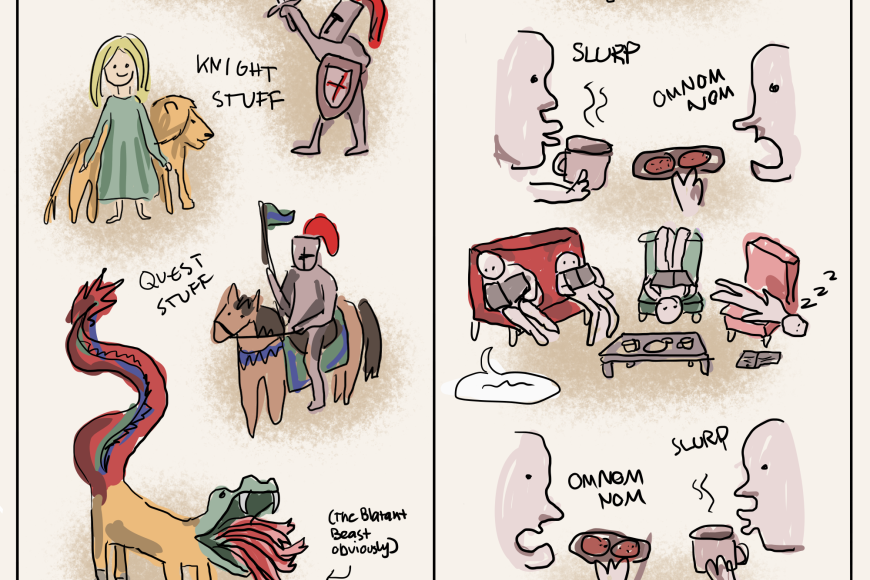
The Faerie Queene confronts its characters and readers alike with perceptual, cognitive, and physical struggles, and the reader’s passage through Spenser’s monumental work is as arduous and seemingly unending as the journeys and quests of its knights. The parallels between the characters’ trials and the readers’ embodied experience of the poem become more pronounced when The Faerie Queene is read out loud in its entirety. In 2019, the English department at Tampere University organised its first marathon reading of Spenser’s epic romance. The 2026 iteration will be the sixth marathon reading overall, and the second to be attached to an international symposium. Over the course of three days – 22-24 May, 9 am-midnight – we will read Books I-VI and the Mutability Cantos. On 26 May there will be a one-day symposium designed as a forum for presenters to reflect on their experience of the marathon reading.
Building on the 2024 symposium (‘Endurance, Excess, and Embodied Readings in/of The Faerie Queene’), we solicit 20-minute presentations that explore the experience of reading Spenser’s poem in relation to its generic, narrative, and formal specificities. What, for instance, does reading the text from beginning to end reveal about its complex narrative pathways? How does the experience of reading the text affect our understanding of the poem’s oscillation between allegory and realism? In what ways does the ever-expanding cast of characters (dis)orient the reader in the geographical and textual landscapes of The Faerie Queene? What specific rhythms of reading does the poem’s division into books, cantos, and stanzas generate?
We aim to propose a special issue on the topic of marathon readings of The Faerie Queene to The Spenser Review after the event. In addition to academic contributions from the 2024 and 2026 symposia, the special issue will include creative work inspired by the marathon reading by students of Tampere University and the University of Zurich. Presentations may, for instance, include the following topics and approaches in their reflections on the experience of reading The Faerie Queene:
- Reading epic romance
- Reading Spenser’s Books, Cantos and/or stanzas
- Narrative pathways and the experience of reading
- Reading Spenser’s cast of characters
- Shifts between allegory and realism
- Reading geographical and textual landscapes
- Spatial and textual (dis)orientation
- Misreading, re-reading and one-directional reading
- Early modern cultures and theories of reading
- Phenomenologies and geographies of reading
- Theories of perception, cognition, and embodied experience
- Endlessness, expansion, deferral, and seriality
- Endurance, exhaustion, and regeneration
Call for abstracts and participation
If you wish to present a paper at the symposium, please send an abstract of approximately 250 words and a biographical note to johannes.riquet@tuni.fi by 10 April 2026. We will notify you of acceptance or rejection by 13 April. Presenters should attend both the marathon reading and the symposium.
If you wish to attend the marathon reading (and/or the symposium) without giving a paper, please sign up for the event by sending an e-mail to johannes.riquet@tuni.fi, ideally by 30 April 2026.
- Kevin McGinley (Tampere University),
- Johannes Riquet (Tampere University),
- Tamsin Badcoe (University of Bristol,
- Antoinina Bevan Zlatar (University of Zurich)
- 22.5.2026 9.00–24.5.2026 23.59
- 26.5.2026 9.30–17.00