

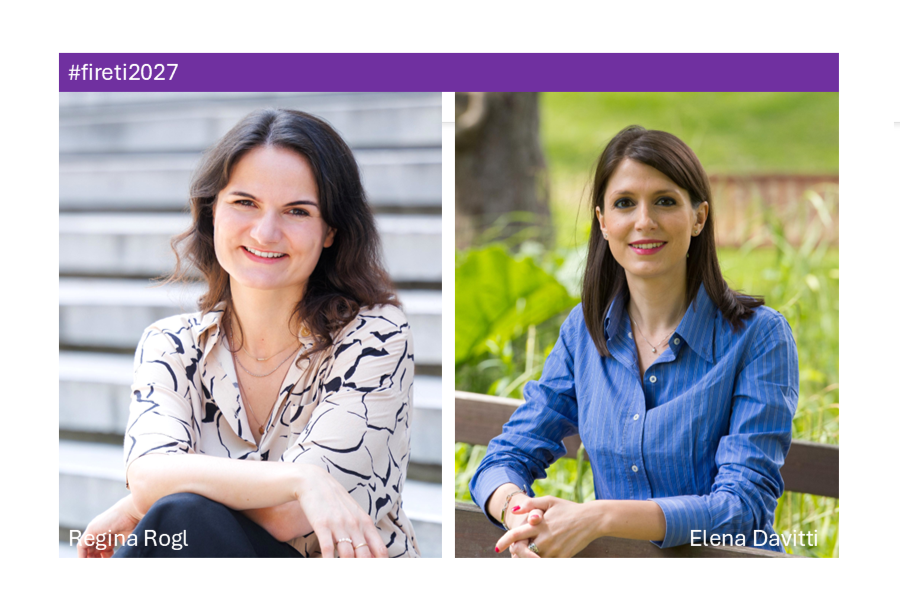
Written by: Maria Annukka Jakkula
We are very much looking forward to your keynotes at FIRE-TI 2 in March 2027 in Tampere. We would like to introduce you to the conference participants and give them a sneak peek into your keynote topics. Could you tell about your paths a little bit and unfold what originally drew you to research?
- Elena: I’m delighted to be contributing to a conference whose topic is so close to my own interests. What has always fascinated me is the live element of communication: people sharing thoughts and ideas there and then, in real time, and how this works when the interaction depends on linguistic and cultural mediation. Working as an interpreter in hospitals and educational settings made this very tangible for me. I saw first-hand how intricate these encounters are, how high the stakes can be, how things shift on a moment-by-moment basis, and how much depends on interpreters calibrating their role and navigating many layers of meaning. I wanted to understand how people make meaning together, not only through words but through gaze, gesture and the way they position themselves in space. At the time this was largely uncharted territory; it has since grown into a rich field of research on multimodality in interpreter-mediated interaction, and its insights matter more than ever as technology and AI increasingly take on a ‘mediating role’ in multilingual interaction.
Regina: I’m very much looking forward to the conference as well. FIRE-TI 2 is sure to be one of my academic highlights next year. My interest in doing translation research grew quite organically out of my own training. I completed my Master’s degree in interpreting in Graz, Austria, where there is a strong sociological tradition in translation studies that resonated with me from the beginning. Alongside my Master’s and PhD, I worked as a public-service interpreter, and I became increasingly interested in the gap between the rather idealised accounts of translation and interpreting that we sometimes find in training materials and the complexities of real-life situations. I also simply enjoyed doing research, and, in particular, working with qualitative data. I have always found it fascinating how much we can learn from the diversity of people’s perspectives and the complexity of their experiences. For my PhD, I had the wonderful opportunity to work with Hanna Risku, and I realised how well my own questions connected with her work on situated cognition and translation workplaces. And this was really where my research journey began.
Staying close to practice
Both of you describe an interest in what happens in actual practice and the complexity that becomes visible when we take a close look at what people really do. How has this orientation shaped your work?
- Elena: I began by video-recording authentic interpreted encounters, and I still believe that looking closely at what people actually do is the best way to understand a practice. But when practices are new, or when technology is built into the workflow, studying them calls for different approaches, and that is an interesting challenge for how we do research.
I am fortunate to work at the Centre for Translation Studies at the University of Surrey, a research-active community where ideas are constantly discussed and tested. Through my direct involvement in the Leverhulme-funded Doctoral Scholarship Network for AI-enabled Digital Accessibility, I work with PhD researchers exploring how AI can help make digital content and communication, much of it language-based and multimodal, accessible to all. This work has broadened my sense of what our field is about and helped crystallise my view of translation and interpreting as fundamental forms of access: across languages, in the traditional sense, but also within a language (e.g. when complex text is made easier to follow), and across modes (e.g. when speech is turned into live text or images into spoken words). Each calls for its own kind of mediation, and increasingly for people and AI to work together. It has also made clear to me that this collaboration should start from evidence, gathered through the humanities and social sciences, about what people actually need, and be shaped together with them from the outset.
Regina: What has enabled my research above all has been the opportunity to work in a fantastic team. Being able to brainstorm and test ideas with colleagues and follow unexpected questions has certainly shaped my work a lot. Field research, in particular, has taught me that we often learn most when we remain open to being surprised by what people say and do, rather than only looking for where theory guides us.
In terms of research topics, I started out with a strong interest in translation in volunteer networks, and in questions of participation and organisation. I became interested in how these practices are shaped not only by ideas about translation coming from beyond the professional sphere, but also by technology and by wider physical and digital environments. Work in Science and Technology Studies has been a major inspiration in pursuing these questions. A central focus of my work is the social role of technology, especially in non-professional or semi-professional translation settings. These practices can be very creative and meaningful, but they can also have important social and political effects. I’m currently especially interested in the role of translation in the circulation of disinformation, and I would like to continue developing this line of research.
Research paths and turning points
Academic careers are shaped both by major projects and by smaller encounters. Can you identify moments that have been particularly significant in your respective research paths?
- Elena: Leading my first large-scale project funded by a Research Council. I approached it with some apprehension: moving from working on large projects to leading one is a real step up in responsibility, and it brings tasks such as budgets and administration that are a long way from the research itself. But it gave me the freedom to scale up my ideas and take my research somewhere new, namely hybrid practices, where people and machines work together to produce live communication across languages, each doing part of the job. That has been at the centre of my work ever since. The project also taught me how complex, and how fascinating, it is to bring different disciplines together around a shared question. In my case, it took time to find a common language with colleagues from cognitive science, but the dialogue was enormously enriching, and those collaborations have outlived the project.
Regina: There have been smaller moments that I’d consider not so much turning points, but that stayed with me because they reaffirmed what I hoped to do with my research. One was when a student asked me how it was even “allowed” or “accepted” that I study something that was not professional translation. Another was during an interview for my PhD, when a volunteer translator asked what my supervisors thought about me studying a form of translation that they themselves saw as “just a fun hobby”. Both moments revealed these persistent assumptions that many still have about what counts as a legitimate research object in translation research. Research on non-professional translation has come a long way over the past two decades, but I feel that it’s still important to give greater visibility to the everyday translation practices that surround us.
What does “the field” mean today?
Both of you raise research practices that increasingly span different environments, be they physical, digital or technologically mediated environments. What are you hoping to explore at the conference?
- Regina: For me, and I know this is true for many colleagues I talked to as well, FIRE-TI 2 will be a space to talk not only about our findings, but also about the practical and ethical realities of doing field research. There’s a great deal we learn during research that never makes it into publications, simply because there is no room for it. For example, how do colleagues gain access to field sites, organise observation periods, and build trust with participants? I’m also hoping to hear how colleagues approach sensitive material and ethical challenges.
And, on a more personal note, it’s just wonderful to see this conference continue in Tampere after the first FIRE-TI conference in Vienna, which we unfortunately had to move online because of Covid at the time. I’m very much looking forward to meeting in person this time, and to seeing a research community emerge around our shared interest in field research.
Elena: The landscape of translation and interpreting is changing fast: some established practices are shifting, new ones are forming, and the boundaries between them are increasingly blurred. For field researchers, this is an opportunity to study practices as they emerge, but it also raises new questions, such as what does “the field” mean when an interaction takes place partly on a screen and partly through a machine, and what kinds of data we need to make sense of it. Practices are evolving faster than our research cycles, so I am curious to see how colleagues are adapting their methods and what we can learn from each other’s approaches. I can’t think of a better community to explore these questions with.
A sneak peek of the keynotes
Finally, could you give us a glimpse of where you will take these questions in your FIRE-TI 2 keynotes?
- Regina: In my keynote, I would like to invite everyone to think with me about a question that might seem rather simple, at first glance:“Where does translation actually happen, and what does that mean for our research?”.
We often imagine field research as going somewhere – maybe to a translator’s workplace – and then sitting in a specific office space and observing people at their desks. And that is still an important part of what we do. But translation today often extends far beyond a single physical place. So, I will be exploring what it means to study translation when the ‘field’ is partly physical, partly digital, and spread across different places, people and objects. The central question for me is how we can follow these complex practices without losing sight of the people whose bodies, experiences and relationships still anchor everything that happens as a translation is being created.
Elena: The title of my keynote, at least for now, is “What does ‘the field’ become? Researching hybrid human-AI practices for live multilingual communication”. It picks up the question I raised above and approaches it through my own research path. I’ll save the rest for Tampere!
Many thanks for this discussion. We’re looking forward to learning more at FIRE-TI 2!
____________
Elena Davitti holds a PhD in Translation and Intercultural Studies from the University of Manchester and an MA in Conference Interpreting from the University of Bologna at Forlì. She is Associate Professor at the Centre for Translation Studies, University of Surrey (UK), co-director of the Leverhulme Doctoral Scholarship Network for AI-enabled Digital Accessibility (ADA) and co-editor of the journal Translation, Cognition & Behavior.
Regina Rogl holds a PhD in Translation Studies / Transcultural Communication from the University of Vienna (Austria). She is currently working as a Post-Doc Researcher at the Department of Translation Studies, University of Graz (Austria), where she is part of the research group TransMigra (Translation, Migration, Minorities).
____________
Link to the FIRE-TI 2 conference website: https://events.tuni.fi/fireti2027/