

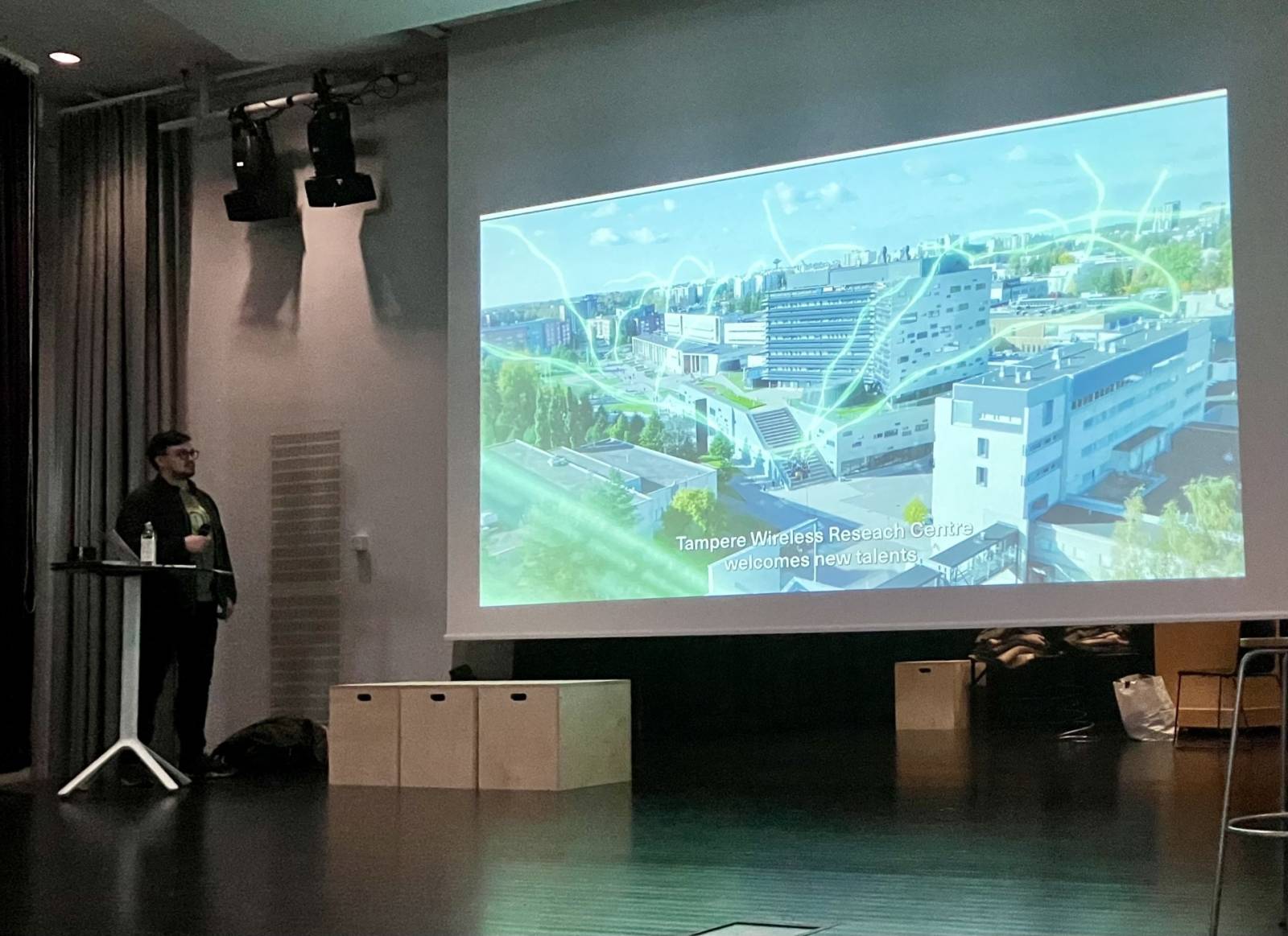
The talk introduced modern AI from an engineering perspective, including a brief historical overview and an explanation of why recent progress has enabled today’s large‑scale AI systems and how it is shaping the technology of tomorrow. We discussed where current AI methods perform well, where their limitations lie, and how these trade‑offs become critical when AI is embedded into real human-driven systems rather than used as isolated software.
A recurring theme was the role of AI in wireless communications and sensing. We also touched that Machine Learning can be used to infer physical context, such as user location, movement, and surrounding environment, using radio signals and network data. This capability is increasingly important for next‑generation wireless systems, where AI enables adaptive resource allocation, improved reliability, lower latency, and more efficient use of spectrum. In this sense, AI is becoming a core component of how future networks observe, learn from, and react to the physical world with us, humans, being an integral part of.
Questions about automation and intelligence naturally led to discussions about system design and responsibility. From an engineering viewpoint, we emphasized that AI systems do not act autonomously in a vacuum; their behavior is determined by data, objectives, constraints, and design choices made by humans. Understanding these dependencies is essential when deploying AI in safety‑critical domains such as communications infrastructure, healthcare, or transportation. Yet, ethics of such systems operation could not be neglected.
The students also showed interest in practical applications, ranging from AI‑assisted diagnostics to human‑robot interaction and creative tools. These examples reinforced the idea that modern AI systems are best understood as engineering tools that augment human capabilities, rather than replacements for human judgment.