Projects

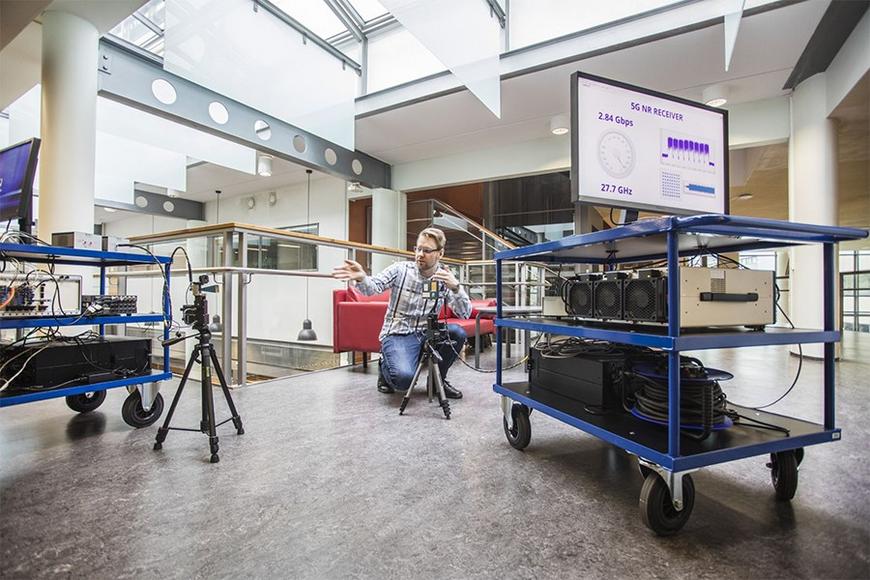
Researcher close to movable equipment utilized in wireless research related to 5G and 6G
Markus Allén planning an RF measurement campaign with 5G equipment. Developing future wireless 6G systems requires plenty of experimental measurements in varied environments. Photo: Jonne Renvall / Tampere University
Our project portfolio includes funding from the Research Council of Finland and Strategic Research Council, Business Finland, and EU Horizon funding instruments. In addition, our activities are supported by commissioned research and foundation funding. Examples include researcher mobility grants, professorship funding from the Tandem Industry Academia (TIA) programme of the Finnish Research Impact Foundation, and the organization of the ICL‑GNSS conference.

With an annual research portfolio of approximately 4 MEUR, we collaborate actively with leading industry partners and top-tier research institutions worldwide.​


The Research Council of Finland

2022-2026

Enabling clean and sustainable water through smart UV/LED disinfection and SOLar energy utilization (LEDSOL)

PI: Lohan Elena-Simona

The LEDSOL project is fostering renewable energy to provide clean and safe drinking water based on UV/LED disinfection augmented with classical decontamination and powered by lightweight flexible solar cells. The LEDSOL system is designed to be packed in a self-powered wearable backpack with a positioning engine, which offers an easy to use and affordable technology to local population who is off the grid.

Read more: LEDSOL – Enabling Clean and Sustainable Water through Smart UV/LED Disinfection and Solar Energy Utilization and
Enabling clean and sustainable water through smart UV/LED disinfection and SOLar energy utilization (LEDSOL) | Tampere universities

2022-2026

macHine leARning MethOds aNd algorIthms fOr 6G terahertz cellUlar acceSs (HARMONIOUS)

PI: Lempiäinen Jukka

The terahertz band offering tens or even hundreds of gigahertz of consecutive bandwidth is nowadays considered as a major candidate for new radio access technology in 6G systems. By wisely utilizing this bandwidth one may not only provide extreme data rates at the access interface but enable principally new applications over-the-air such as Tactile Internet, holographic telepresence, and virtual reality. The aim of the project is to develop the set of fundamentally new models and algorithms to enable truly mobile ultra-broadband THz cellular radio access technology. These models will contribute to better understanding of THz specifics as well as requirements and constraints imposed at practical communications mechanisms and algorithms in THz systems. Thus, the successful completion of the project will make a decisive step closer to enabling principally new applications over the commercial systems.

2022-2026

Multimodal and Robust Implantable and Wearable Antenna Systems for Interconnected Wireless Health Devices and the Human Intranet (IWABS2)

PI: Björninen Toni

Wireless technology is commonplace in our daily life. Soon, it will become equally diffused in the fields of medicine and healthcare, where it aids people’s well-being and improves the quality of life. This project produces novel multimodal body-centric antenna systems that enable robust intra- and on-body communications and centralized wireless power transfer to multiple implanted devices simultaneously. Here, anatomically accurate models of the human body combined with modern electromagnetic field solvers will enable the judicious optimization of the system, considering the robustness of operation within the inherently variable and dynamic operating environment as its key characteristics. The centralized wireless powering enables miniature battery-free implantable devices that achieve the longevity of a lifetime, and through the multimodal operation, they also signal with other implants and wearable units wirelessly.

2022-2026

Switch-Mode Analog Integrated Circuits for beyond-5G Radio Transceivers (SMASH)

PI: Unnikrishnan Vishnu

SMASH is an ambitious project with an aim to perform groundbreaking scientific research, bringing a paradigm-shift to the analog circuit design methodology by representing analog information with time-based parameters of pulse waveform and processing it with switch components. The project will demonstrate the results through applied research that significantly advances the performance of radio receivers, thereby enabling low-cost fixed wireless broadband coverage in rural areas with speeds up to 100 Gbps, 10X the state-of-the-art cable technology.

2022-2026, 2025-2027

Research Infrastructure for Future Wireless Communication Networks (FUWIRI)

PI: Valkama Mikko, Joonas Säe

FUWIRI is a national high impact research, innovation and collaboration platform in the area of wireless technologies. The FUWIRI service is offered in cooperation with the University of Oulu, the University of Tampere, Aalto University and VTT. In addition, FUWIRI is closely linked to the 6G flagship programme, being its experimental research infrastructure. The research infrastructure enables research, development and testing of new device solutions, algorithms, software and applications. Radio positioning methods capable of less than cm accuracy and associated radio frequency imaging and sensoring methods are also developed on the platform.

Read more: FUWIRI

2023-2026

NSF-AoF: CNS Core: Small: Machine Learning Based Physical Layer and Mobility Management Solutions Towards 6G

PI: Valkama Mikko

5G evolution and future 6G cellular networks are targeting operation at higher millimeter wave and sub-THz bands due to large available channel bandwidths. However, the use of these bands for mobile radio access imposes substantial technical challenges, including the quality, cost- and energy-efficiency of the electronics, the extreme path loss and propagation characteristics, and the overall deployment costs to provide indoor and outdoor network coverage with mobility support. Considering these challenges, this project will harness machine learning algorithms for designing physical layer technologies and network management procedures that aim to improve robustness and reliability of connectivity under mobility. The project’s expected contributions are at the forefront of emerging 6G standard and applications of modern machine learning tools in wireless communications at high frequency bands. The project is a joint effort between Tampere University, Finland, and UCLA, US.

The objective of the jointly funded projects is to support research collaboration between Finland and the United States in the fields of artificial intelligence (AI) and/or wireless communication technologies.

2024-2026

Multifunctional Radios in Radio-Frequency Systems’ Convergence (MULTIFUN)

PI: Riihonen Taneli

Radio-frequency (RF) systems are converging in terms of spectrum allocations, equipment and waveforms toward united applications, in which each radio’s operation is defined by programming software and firmware only. To fully harness the benefits of this so-called ‘RF convergence’, the emerging general-purpose multifunctional radio devices need to be capable of in-band full-duplex (IBFD), i.e., same-frequency simultaneous transmit and receive (SF-STAR), operation. For instance, a united cellular base station and radar would be transmitting shared downlink communication and radar waveforms while simultaneously receiving signal reflections for sensing its surroundings. The research investigates how to achieve the IBFD/SF-STAR capability for multifunctional radios under self-interference and how to exploit them in new RF convergence applications, e.g., joint radar sensing and wireless communication at millimeter-wave frequencies.

2024-2026

Fundamental Limits and Performance Trade-Offs in Integrated Sensing and Communications (6G Fun-ISAC)

PI: Valkama Mikko

Extracting information and performing learning, inference, and choosing optimal actions through sensing the physical world and its phenomena with large numbers of networked multimodal sensors are of high and rapidly increasing importance in various applications. An important special case of networked sensing is the use of communications networks, devices, and spectrum to also perform the sensing tasks so that the resources are shared within the two functionalities. The concept is known as integrated sensing and communications (ISAC) or joint communications and sensing (JCAS). FunISAC project will explore the underlying theories, optimality, and performance boundaries of ISAC to create fundamental research understanding of the field. The focus is on ISAC functionalities and their fundamental performance bounds, optimization of operational parameters and trade-offs between sensing and communications performances and resource consumption.

2024-2026

Energy-Conscious Operation: Network Efficiency for Wireless Sustainability (ECO-NEWS)

PI: Andreev Sergey

This project focuses on finding the limits of communication networks in terms of energy efficiency that can establish key design principles to enable a sustainable operation of future wireless systems to support different types of end applications. To reach such an ambitious goal, ECO-NEWS has a complementary consortium composed of two research teams, one from LUT and the other from Tampere University. The research work will be built upon fundamental results from physics of computation, information thermodynamics, information and communication theories in order to rearticulate them in a way to allow the derivation of new energy-related performance bounds and energy-efficient design principles. The project will be mostly based on data generated through mathematical equations and simulations. ECO-NEWS is expected to contribute to a truly sustainable green-digital transition.

2025-2026

Distributed AI for enhanced security in satellite-aided wireless navigation (RESILIENT)

PI: Kuusniemi Heidi

RESILIENT will address the challenges of ensuring cyber-security and privacy for civilian location-based applications, offering increased robustness and resilience of satellite-based positioning signals to various types of intentional and non-intentional interference. This project is composed of a team of researchers from US and Finland, in a joint effort to advance worldwide security of GNSS against existing threats while providing an excellent opportunity for students to participate in an international project on cutting-edge technologies and methodology development.
The goal of this project is to develop tools for interference management in geolocation applications. The specific goals of the project are divided into three research goals. The first goal investigates the use of deep learning for detection/classification of interference and fusion of multiple correlated classifiers providing local threat detection probabilities. The second goal aims to localize and track the interference sources through the creation of global threat probability maps. This goal is achieved by advancing the field federated learning in a threefold way: (i) to efficiently digesting non-independent and identically distributed data; (ii) combining with active learning methods, whereby moving agents sample specific locations to improve estimation performance; and (iii) investigating federated meta-learning strategies that use task-level knowledge to improve global learning. The third goal of the project investigates the use of those global threat maps to mitigate their effects on collaborative receivers using robust factor graph optimization.

2025-2028

Autonomous robot navigation in the wild using satellite-based 3D geographical information (ROBOSAT)

PI: Lohan Elena-Simona

In the ROBOSAT project we develop a scalable MultiGIS high-quality data-collection platform through the use of a quadrupedal robot, equipped with multimodal sensors (including i.e. GNSS, camera, lidar) and an I/Q data grabber that can autonomously perform long-distance missions in challenging environments. With MultiGIS data fusion we provide increased accuracy and robustness of GNSS algorithms. In addition, we aim to build a novel large-scale open-access MultiGIS data storage system with automatic labelling.

Read more: ROBOSAT | Tampere universities

2025-2028

Advancing Sustainable Economic Growth through Space Economy (SpacEconomy)

PI: Kuusniemi Heidi

The SpacEconomy project strengthens Finland’s position in the rapidly growing global space economy. A key challenge is the fragmentation of Finland’s space-related activities and the underutilization of growth potential. By promoting innovation, education opportunities, and cross-sector collaboration, we bring together experts from science, industry, business, and the public sector to enhance the foundations of economic growth, productivity, and societal well-being through the space economy.
Within SpacEconomy, we develop space-data-driven AI innovations, multidisciplinary education pathways, and new business models. We promote fair and sustainable growth using metrics beyond GDP and engage stakeholders from all sectors of society through citizen and expert panels. The project is multidisciplinary, combining expertise in space technology, economics, governance, social sciences, and AI to drive systemic change. In collaboration with diverse actors, we strengthen national resilience and safeguard critical infrastructures.

The project is funded by the Strategic Research Council, established within the Research Council of Finland.

Read more: www.spaceconomy.fi

2026-2028

Tampere Chip Characterization Infrastructure (ChipIn)

PI: Majumdar Sayani, Hämäläinen Timo Daniel, Unnikrishnan Vishnu

The current global geo-political situation demands resilience of semiconductor value chain, necessitating improvement in research and development infrastructures for Europe. Tampere University together with the City of Tampere is intensifying its research activity around Semiconductor Chip design, fabrication and packaging. Two major steps in this direction are SoC Hub ecosystem and SiPFab for design, fabrication /packaging of advanced chips. A crucial complementary missing piece in the current Tampere Chips infrastructure is the set of tools necessary to perform characterization of the advanced devices, integrated circuits and systems. ChipIn aims to fill the gap by providing the characterization infrastructure and analysis platform, strengthening Chips from Tampere initiative. The project will serve a wide range of research and innovation area including artificial intelligence (AI), hardware security, telecommunication and many other sectors.

2025-2029

Sustainable 6G Radio Access Networks: Methods, Models, and Algorithms (S6GRAN)

PI: Valkama Mikko

When entering towards the sixth generation (6G) mobile communications era, the huge numbers of connected devices with increased data traffic and new services imply significant challenges for the involved radio access network (RAN) design to be able to provide the system capacity and Quality-of-Service (QoS) with sustainable power and energy consumption. The S6GRAN project focuses on fundamental research for design and optimization of 6G RAN, wireless transceivers, and the related algorithms. The overall objective is to develop new scientific knowledge and novel wireless transceiver and system optimization solutions enabling sustainable 6G radio access networks. The core academic collaborators include Chalmers University of Technology, University of Luxembourg, and Queen’s University of Belfast. Industrial collaboration is also conducted largely with several companies creating the 6G technology.

Business Finland

2022-2026

Ultra Scalable Wireless Access (USWA)

PI: Valkama Mikko

The project Ultra Scalable Wireless Access (USWA) focuses on technology research how to utilize the new DECT-2020 NR radio technology developed in ETSI in various use cases. DECT-2020 NR provides modern radio interface design with state-of-the-art radio capabilities for industrial use cases. DECT-2020 NR technology supports natively mesh radio network architecture which is enabling large scale local networking by relaying data between different devices and also enabling direct communication between devices. DECT-2020 NR technology can operate in a specific license exempt band used by legacy DECT. This provides an interesting opportunity for industrial IoT network deployments in industry facilities without the need of spectrum licenses and with the possibility for self-deploying and – managing by the industry itself. Autonomous communication network provides new business opportunities for industry developing their digitalization roadmap, as well as opens new opportunities for new small and mid-size industry.

Read more: https://www.celtic-next-uswa.org/

2023-2026

Stochastic 3D Modelling of 6G Networks (3D6GNet)

PI: Riihonen Taneli

Traditional computational and simulation-based analysis of wireless communication networks relies on deterministic modeling of individual time instants, where network nodes are treated as momentarily static and mobility is incorporated only through fading models. Statistical performance information is obtained by repeating Monte Carlo simulations over multiple time instants, with network geometries determined by deterministic mobility models. This approach has been feasible because mobility has mainly been limited to user devices moving approximately on a two-dimensional plane and analyses have focused on localized network segments. Future 6G mobile networks will be highly dynamic, massive, geographically extensive, heterogeneous, and three-dimensional. In such environments, traditional deterministic modeling and performance analysis become computationally infeasible and fail to provide statistically representative results, as they capture only a limited set of time instants. To address this challenge, the project introduces a paradigm shift in network modeling and analysis. Network node properties, such as location, are modeled using probability distributions, and network performance is analyzed using analytical expressions without Monte Carlo repetitions, enabling results that simultaneously represent all possible network geometries and operational scenarios.

2023-2026

6G Integrated Sensing and Communications (6G iSAC)

PI: Valkama Mikko

Radio-frequency (RF)–based sensing and communications are expected to be a key enabler of future wireless 6G systems. Their applications are diverse, including vehicular systems (V2X), healthcare applications, positioning, the Internet of Things, and beyond. Rather than competing for the radio spectrum, integrated sensing and communications (ISAC) systems represent a new vision and a paradigm shift, in which communication and sensing functionalities are jointly designed and operate cooperatively for mutual benefit.

In this project, we develop new signal processing and machine learning models, theory, and algorithms, as well as multifunctional RF transceiver systems for 6G ISAC, by efficiently sharing computational resources across multiple tasks. Particular emphasis is placed on dual-use applications, as the industrial partners of this project proposal are key players across several business domains, spanning commercial ICT as well as the security and defense sectors.

Key publication: Tampere University researchers featured in top 6G ISAC article – published in the Proceedings of the IEEE: 2025 Highlights and What’s Next” | Tampere universities

2025-2027

Automated and Connected Machines – TAU-Aurora Partnership

PI: Ghabcheloo Reza, Valkama Mikko

The target of Aurora co-innovation project is to research technologies required in the field of heavy machine automation, applicable to wide range of industries, such as, forest machines, cargo handling solutions, mining related machines and excavators, just to name a few.  Research will especially focus on combining advanced sensing and control methods with state-of-the-art radio-based technologies. Project results can be generalized and utilized also in other fields where, for example, robust wireless sensing and control is needed.

The Aurora project’s objectives will be achieved through cooperation between project partners, that have a different role in the industrial ecosystem representing machine manufacturers, technology providers and research organizations in wireless technologies, robotics, and AI.

More information: Aurora – Automated and Connected Machines | Tampere universities

2025-2027

E! Celtic Mutiracs

PI: Valkama Mikko

In the E! Celtic Multiracs project we develop a multifunctional radio transceiver operating in the FR3 frequency band (7–24 GHz). The transceiver is largely digitally implemented, enabling extensive adaptability to different targets. This adaptability supports high energy and material efficiency, as the same device can be utilized across a wide range of applications. Currently, application-specific devices are predominantly used.
The transceiver employs novel three-dimensional antenna arrays with element-level tunable filters integrated into the antenna structure. These filters are used to mitigate interference and to enable full-duplex communication, allowing simultaneous bidirectional transmission within the same frequency band.

2025-2027

RF ECO3 – Economical and Ecological RF Ecosystem

PI: Valkama Mikko

The RF ECO3 project develops new solutions to RF design challenges in ultra‑high‑speed data transmission and explores opportunities for high‑precision sensing in future sixth‑generation (6G) radio systems. The solutions developed within the project already have significant existing international markets. The objective is to generate ecological and economic benefits for society and industry.
Components and efficient workflows that meet future application requirements are essential for succeeding in the industry, particularly in highly complex radios supporting new 6G applications. These future requirements include extremely high data rates as well as simultaneous sensing of objects and the surrounding environment. Energy efficiency and robustness under diverse environmental conditions are among the project’s key challenges, alongside the increasingly complex use of the radio spectrum.

EU Horizon

Stent-based Sensing, Monitoring, And theRapy sysTem for Coronary Artery Diseases (SMART-CAD)

PI: Björninen Toni

Coronary artery disease (CAD) is mainly due to plaque build-up in the arteries. While treatments such as balloon angioplasty and stenting are common, they can sometimes cause restenosis. There is a need for technologies to monitor and manage these CAD-related complications. Supported by the Marie Skłodowska-Curie Actions programme, the SMART-CAD project aims to develop a stent-based sensor that continuously monitors the arteries and enables early treatment of in-stent restenosis (ISR). This device will combine a microwave sensor to detect ISR with RFID technology for ongoing assessment of coronary artery health. If ISR is detected, microwave ablation will be used to treat the plaque directly. SMART-CAD contributes to the broader goal of reducing premature cardiovascular deaths across Europe by 2030.

Unleashing Integrated Sensing and Communication Pontentials by Exploiting Shared Scatterers in Millimeter-Wave Systems: ISAC-SS

PI: Riihonen Taneli

Unleashing Integrated Sensing and Communication Pontentials by Exploiting Shared Scatterers in Millimeter-Wave Systems: ISAC-SS

In the next-generation millimeter-Wave (mm-Wave) networks, sensing is assumed a vital role in various applications, including transport systems, smart cities, and public safety. Integrated sensing and communication (ISAC) is identified as a key technology to achieve ubiquitous sensing with communication systems, where the convergence of sensing and communication functionalities on shared hardware holds the promise of reduced costs, enhanced spectral and energy efficiency, and reduced latency. Before incorporating ISAC into next-generation communication standards, however, the sensing and communication capacities of ISAC should be further improved.
The 2-year MSAC Postdoctoral Fellowship, ISAC-SS, seeks to unlock the full potential of ISAC systems by exploiting the shared scatterers in communication and sensing channels. The state-of-the-art (SoA) in ISAC signal processing has largely overlooked this critical element, leaving room for performance improvement.

ANCHOR

PI: Unnikrishnan Vishnu

The ANCHOR project brings together leading academic, industry stakeholders, and SMEs to establish a structured doctoral training program addressing critical technical challenges and skill shortages for next-generation of communication networks. Traditional wireless networks, often reliant on single radio communication and inflexible architectures, will not be able to meet growing demands on bandwidth, reliability, energy efficiency, and sustainability, as well as extended coverage from underwater, terrestrial, and aerial network components. To overcome these limitations, ANCHOR leverages innovations in the untapped potential of THz and optical wavelengths alongside existing radio technologies. ANCHOR has meticulously designed fifteen doctoral projects that focus on cutting-edge innovations in optical, radio, and THz wireless communications and the harmonization of coexisting spectrums and networks. Through these efforts, ANCHOR will not only deepen fundamental theories but also provide practical, scalable solutions to improve 3D coverage, mobility, latency, network capacity, energy efficiency, and suitability for the future telecommunications infrastructure.

Jamming and Spoofing Resilient Deep Learning based Software-Defined multi-antenna GNSS Receiver (JASMINE)

PI: Nurmi Jari

The goal of this project is to develop ‘Jamming and Spoofing Resilient Deep Learning based Software-Defined multi-antenna GNSS Receiver (JASMINE)’, that inherits the superiority of signal and navigation processing through Deep learning technology. To achieve reconfigurability and optimized performance, Graphics processing unit (GPU) based Software Defined Radio (SDR) approach is preferred for JASMINE.

Read more: Jamming and Spoofing Resilient Deep Learning based Software-Defined multi-antenna GNSS Receiver (JASMINE) | Tampere universities

Integrated Sensing and communications for future Vehicular systems – a Network of Doctoral Students (ISLANDS)

PI: Valkama Mikko

ISLANDS is a doctoral network that focuses on the theoretical and algorithmic foundations of integrated sensing and communication for the automotive sector, with the objective of developing new physical-layer and network-level solutions, to explore the fundamental limits of such technology, and to provide experimental validation and testing for the developed techniques. Specifically, ISLANDS will: a) develop new transceiver algorithms, capable of integrating and leveraging the communication and sensing functionalities, with the purpose of achieving superior performance and energy and hardware efficiency; b) investigate the ultimate network performance limits that the integration of communication and sensing can achieve in environments with extreme mobility and c) provide experimental validations of the developed techniques with proof-of-concept testbeds and realistic system-level simulators.

Read more: Project – ISLANDS