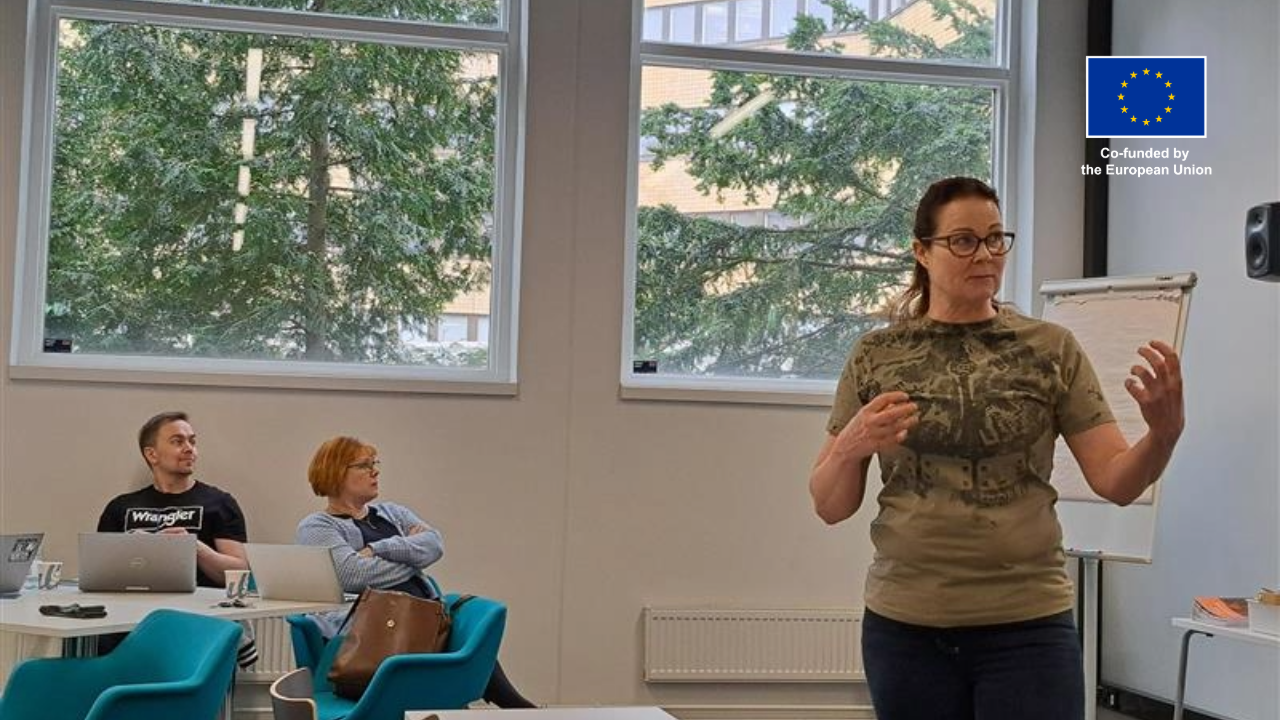
The workshop was the collaboration result of two similar projects: Tampere University and Häme University of Applied Sciences (HAMK)’s CircBuild and the HAMK and LAB University of Applied Sciences’ KIVAKIRA.
“We felt that our projects had a lot in common with the circular economy of the real estate and construction industry, which gave us the idea to organize a joint workshop. We were able to combine the experiences of the CircBuild project’s research exchanges with the information collected during the KIVAKIRA project on the competence needs of the industry and practices that support low-carbon and circular economy in Finland,” says Tampere University doctoral researcher Juha Franssila, who was on a three-month research exchange in Northern Italy at the end of 2025.
The University of Trento was selected as the exchange destination, because it is also a member of the European Consortium of Innovative Universities (ECIU) alongside Tampere University. The universities’ areas of research were also complimentary as the climate in northern Italy has changed rapidly over the past decade. Nowadays there is a need for sustainable city planning and building solutions, which is visible, for example, in the research projects of the University of Trento.
Innovative thinking has become a part of Australian life
Regenerative thinking has become integrated in the lives and studies of Australians. HAMK Senior Lecturer and Tampere University Doctoral Researcher Sanna-Maaria Siintoharju noticed this during her research exchange when people practiced regenerative thinking through visits to construction sites, designing in cooperation and shared discussions.
“Passive construction is trending now in Australia. For example, when situating a new building, the optimal sun, wind and cardinal directions are considered. Regenerative thinking is already strongly involved in science and construction projects there. I also saw representatives from many other professions, such as builders and cooks, learning more about regenerative thinking” says Siintoharju.
In short, regenerative thinking isn’t restricted only to encouraging circular economy and practices that renew nature. Instead, the goal is a broader change: a renewal and regeneration of ecosystems and cultures with holistic decision making that is based on systemic thinking. This would benefit both the society and the environment. Regenerative thinking can be utilized on almost any field, from business to building and farming.
The Finnish real estate and construction sector needs systematic understanding to complement technical expertise
The KIVAKIRA project collected insights on the skills needed to advance the circular economy in the real estate and construction industry, as well as on technologies that support low‑carbon and circular practices. The survey results show that, although the industry already possesses strong technical expertise, there is still a need for a more systematic understanding of the entire value chain in the built environment. In other words, more knowledge is required about which issues are seen as significant, and how important topics such as the circular economy are listed within the sector.
They also note it would be important that companies, cities and the state would lead the change in the industry and also influence the prevailing attitudes to enable change towards more sustainable construction.
“The workshop reinforced the idea that the client plays a key role as a driver of change – without clear requirements, practices will not evolve. At the same time, it became evident that promoting the circular economy requires close cooperation and also sharing risks between different actors. From the designers’ perspective, a major missing piece is still an open marketplace for materials and building services technology, so that solutions can genuinely be put into practice,” says nolla_E Energy Specialist Tuomas Ojanperä.
The CircBuild project continues to share information and promote circular economy in the last workshop before the final seminar in Brussels in December. The six pilots implemented together with with cooperation partners will feature in the spring and autumn webinars. Welcome to join our events!
The Promoting circularity and sustainability for the construction and real estate sector (CircBuild) project is implemented in collaboration between Tampere University and Häme University of Applied Sciences (HAMK). The project has received European Union co-funding from the Economic Development Centre. In addition, funders and co-operation partners include A-Kruunu Oy, Hartela-Yhtiöt Oy, the Foundation for Student Housing in the Helsinki Region (Hoas), Kiinteistöalan Koulutuskeskus Oy (Kiinko), Saint-Gobain Finland Oy and Y-Säätiö.
The KIVAKIRA – Circular Economy Driving Low-Carbon and Sustainable Real Estate and Construction Industry project, implemented by Häme University of Applied Sciences and LAB University of Applied Sciences, is funded by the Finnish Economic Development Centre. The project is co-funded by the European Union.