
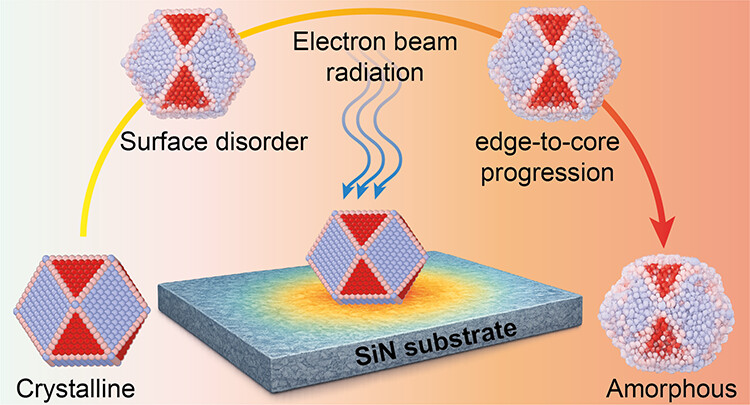
We demonstrate that the thickness and surface chemistry of silicon nitride substrates play a critical role in controlling the stability of gold nanoparticles under electron beam exposure. Using in situ transmission electron microscopy, we show that thicker substrates trap heat more effectively, accelerating edge-initiated structural transitions and melting. In contrast, thinner substrates and plasma-treated surfaces enhance heat dissipation and nanoparticle adhesion, delaying destabilization. These findings provide practical guidance for designing more stable nanomaterial systems in advanced microscopy environments. Read more at: The Journal of Physical Chemistry C