
Conference on multimodal texts and their translations
The international conference was organised at the University of Naples L’Orientale in collaboration with Tampere University. The presentations addressed multimodal texts and how they are translated, for example, how cultural references in Marko Raassina’s Kalevala comic were translated into Italian. The conference speakers came from several countries: Italy, Poland, Singapore and Finland.
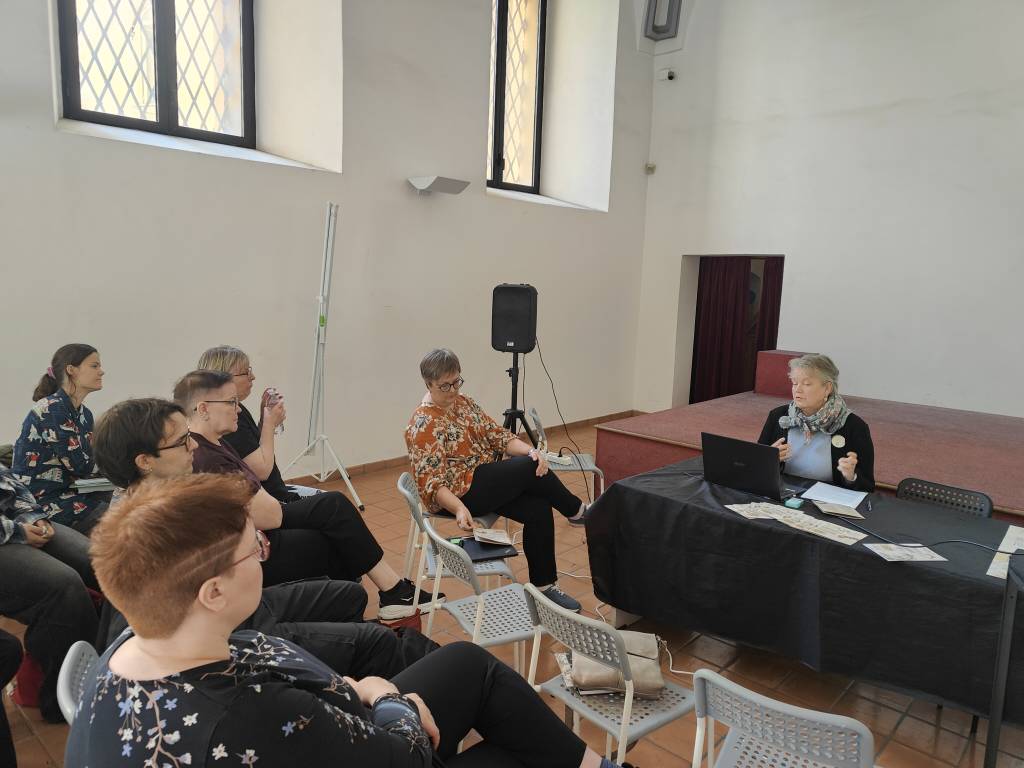
On the second day of the conference, Sarjis researchers held a workshop titled “Accessible Communication: Legal and Social Welfare Documents in Comics-format”. In it, we presented our work from different angles.
Laura Kalliomaa-Puha spoke about comics from the viewpoint of law and access to justice in social welfare and health services. Accessible information is a prerequisite for participation, autonomy and accessing welfare services – first of all, people need to be aware of the services, learn how to apply for them and, finally, understand the criteria in order to get help. Finnish legislation actually requires accessible information in and of social welfare and health care. Visuality can be one of the tools to clarify complex messages, and sometimes documents in a comic format may do the trick.
Laura presented the work done in the Sarjis research group, as we have already translated quite a few social welfare documents into comics, as well as tested their accessibility. A comic may well tempt clients to take the first step – to actually read the document. It also helps many clients to understand and remember the contents better. Accessible documents make participation possible, may increase commitment, transmit appreciation and dignity, and visualise what a successful service situation looks like. And yes, comic documents can also be legally valid as long they are clear. It remains to be seen how a judge reacts to such a document, though: perhaps due to their clarity, comic documents have not yet been tested in court.
Mira Kainulainen continued the workshop by discussing the accessibility of the Safety service comic for older people. She did this by using functional text analysis. The analysis revealed, among other things, that the visual and colourful layout of the comic engages readers and helps readers remember the content. Plain language and multimodality aid understanding if the reader has problems with memory or if Finnish is not their first language. Large pictures and texts as well as clear colour contrasts help readers who have impaired vision. The physical format also allows using assistive tools, such as a magnifying glass.
Vaula Haavisto talked about visual meaning-making in comic documents, focusing particularly on affective meaning. She examined how pictures allow conveying not only factual information but also various emotional meanings. The affective effect of a picture refers to its emotional dimension, that is, the emotional meanings we see in pictures. The fact that pictures contain both factual and emotional information enables conveying messages that could not be conveyed with words alone in official communication.
Kirsi Günther and Sarjis’ long-time collaborator Outi Oja delved into the rhetorical devices and narrative strategies used in the Meal service comic. They examined how comics can multimodally – by visual and verbal means – make information easier to access and, thus, make services more accessible. The advantages of the Meal service comic can be summarised in four main points: narrative structure, rhetorical effectiveness, multimodal accessibility and institutional functionality. The comic format supports understanding in different ways. For example, the chronological story – consisting of the meals arriving and the client preparing the food and placing a new order – forms a clear and coherent whole.
Eliisa Pitkäsalo approached comic documents as a form of Easy Communication. She defined Easy Communication as an umbrella term under which also Easy Language belongs. According to the definition, Easy Communication is communication that utilises one or more modes (e.g. visual, verbal and auditory) and is aimed specifically at users of Easy Language. She also examined the clarity of a comic document as an entwined combination of written language and pictures.
Finally, Jan Pitkäsalo presented a comic artist’s viewpoint on the practicalities of translating documents into comics. In this final section, the audience got the opportunity to try for themselves what kinds of decisions the process involves: they were asked to organise the panels of the Meal service comic into a logical story. The results were quite insightful!
Workshop with Finnish students
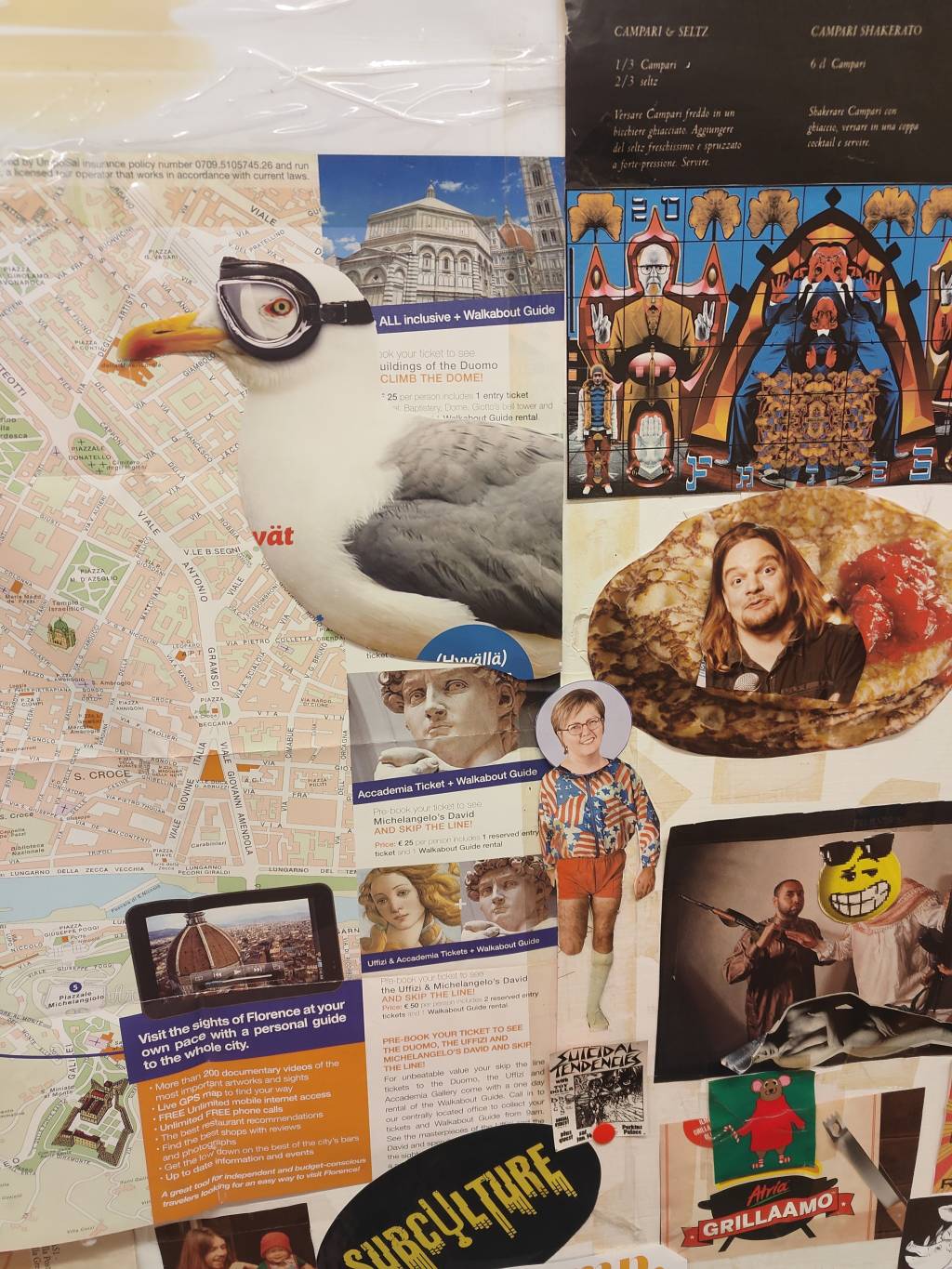
On Wednesday 29 October 2025 we had a special opportunity to tell about our research to Finnish language students at the University of Naples. We organised the workshop in a charming space that the university students had occupied. The space also had a splendid “Finland wall”. We were quite surprised to spot a familiar face on there: it was none other than the students’ Finnish teacher, Eliisa Pitkäsalo!
At the workshop, the students were tasked with drafting a comic script based on a document. The source text was genuine instructions on what to do in case of an earthquake, issued by the University of Naples. The students’ discussion about the translation process and the results of the session were very interesting.
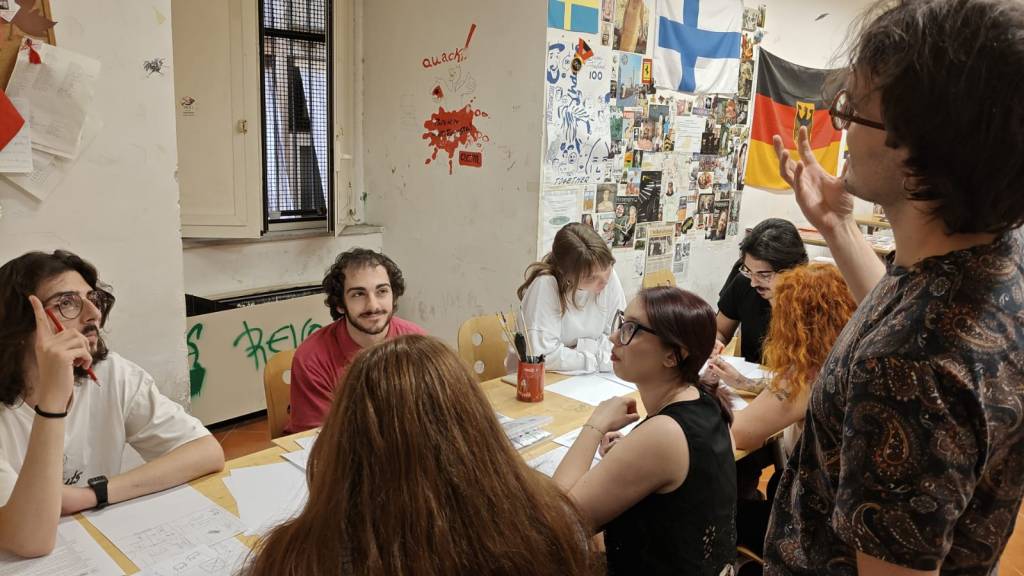
At first, the students discussed with us what is the target audience of the current earthquake safety instructions. It turned out that the document includes a mix of instructions for different target groups: students, staff and the mysterious “responsible persons” who have a central coordinating role in an emergency yet are not named in the document. None of the Naples University students or staff present at the workshop knew who this person is (or these people are).
The students accepted the translation task eagerly and were quite quick to start translating the instructions into a comic. While they were working, we asked them to think about these questions, among others:
- Which parts of the text are the most important to understand?
- What things are the most difficult to understand? How can different visual means support understanding those things?
- Which things can be visualised and which ones need to be written out verbally?
- What happens if the students choose to include not one but several characters in their comic?
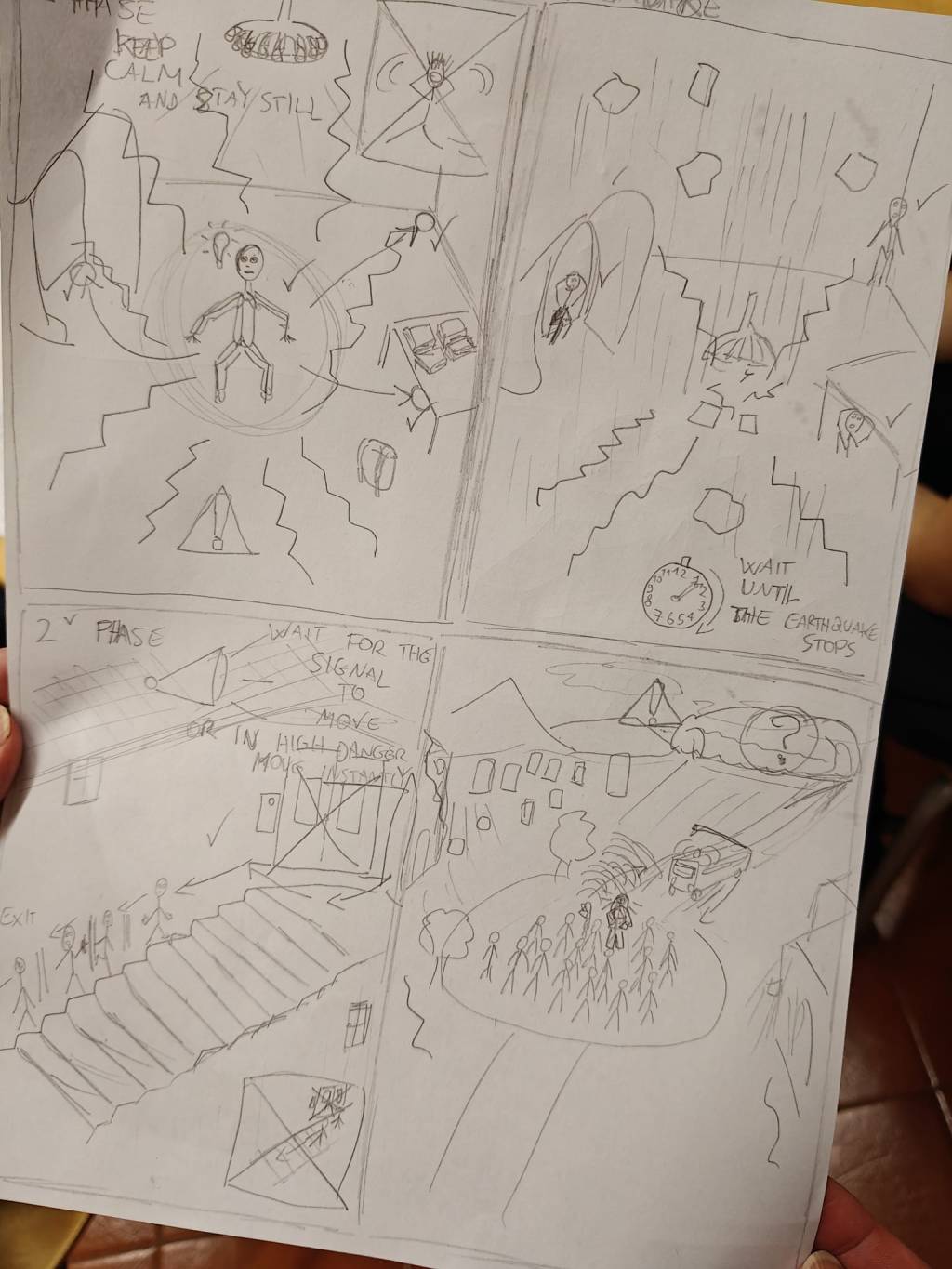
The students seemed to intuitively select the most important things in the text, and these things appeared in all of the comics. These were: staying calm; taking cover in room corners or doorways;, leaving in a single file an arm’s length away from the next person after the alarm has stopped; using stairs instead of a lift; and moving to a marked meeting spot.
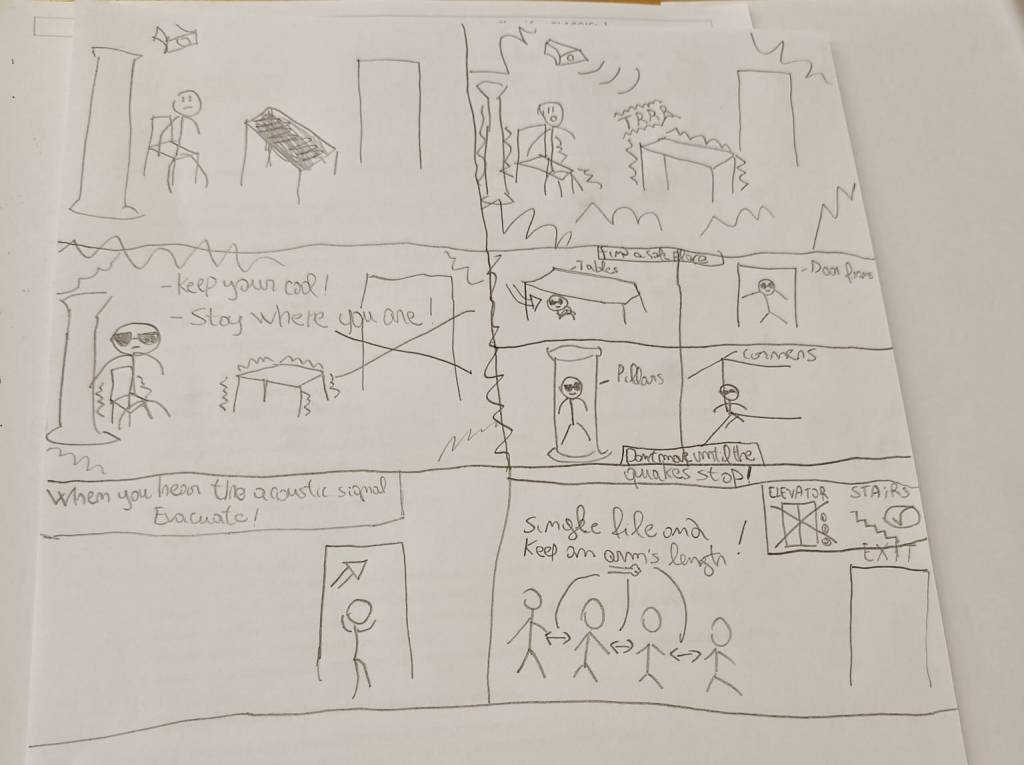
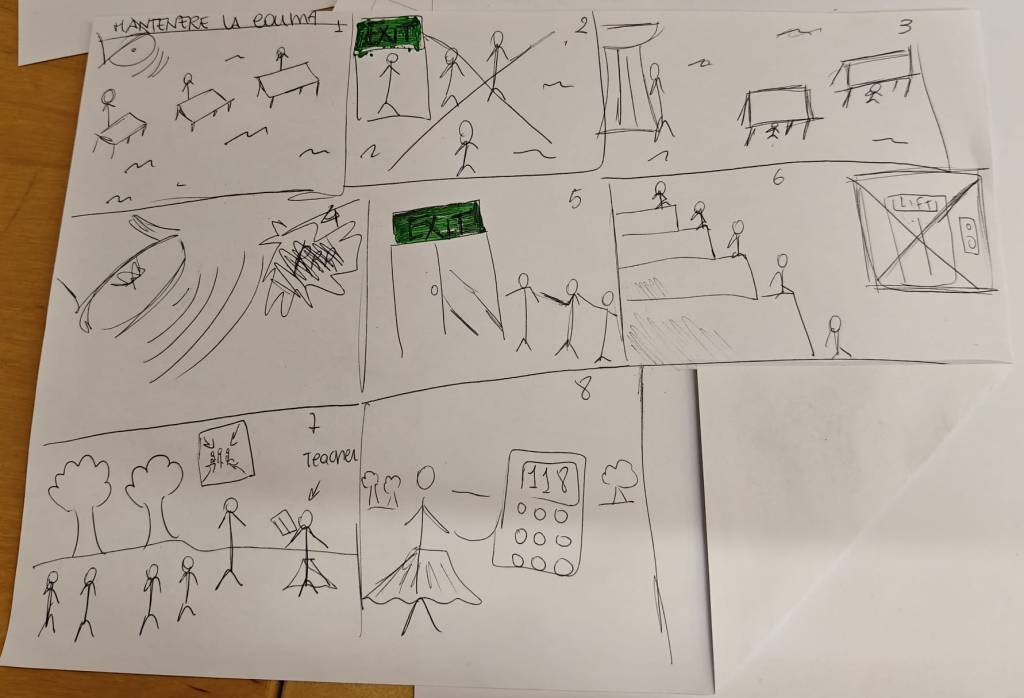
However, the instructions also included parts that were difficult to visualise. A particularly memorable discussion dealt with how to depict earth shaking and ceasing to shake as well as the sound of the alarm and ceasing of the alarm. There were various proposals for translation solutions. One group marked the ceasing of the alarm by a musical symbol denoting silence (comic #4). The solution was innovative, but the workshop participants agreed that many readers of the comic would not understand such a symbol. An interesting way to depict earth shaking and ceasing to shake was using the panel borders: the panels in which the earth was shaking could have wavy borders (comic #1).
One group created three humorous characters for the comic, each of which had a distinct role in the events (comic #4). At the end of the workshop we concluded that humour is a very effective way to get the reader interested in the document and remember its content.
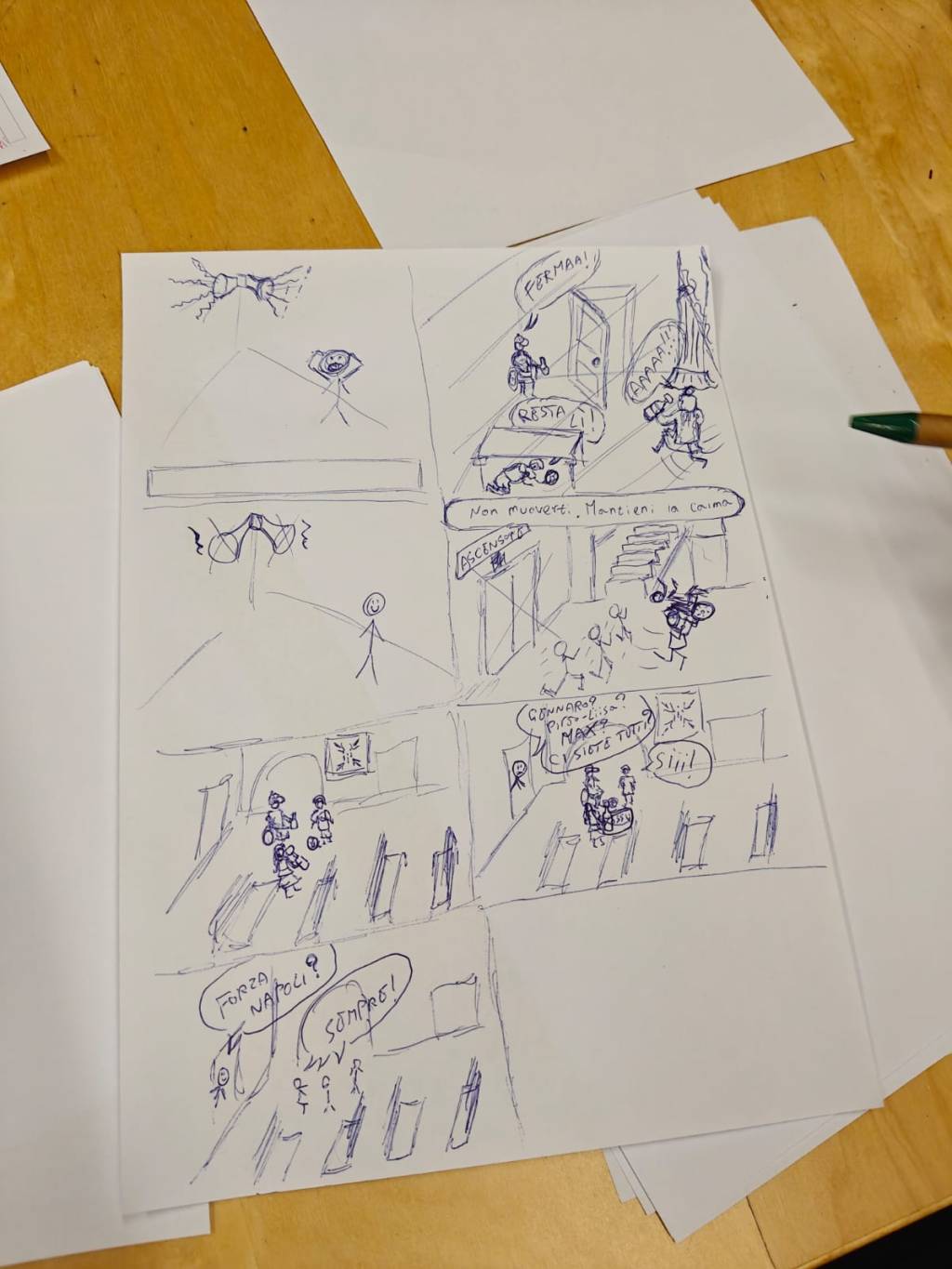
The characters present different ways to act in the situation. With the help of Max, a wheelchair user, the comic could convey instructions on, for example, making sure that everyone gets out. The Finnish exchange student Pirjo-Liisa (with a bottle of Koskenkorva booze in her hand, of course) could not follow the safety instructions, whereas the local football fan Gennaro knew the right way to act.
Forza Napoli!