



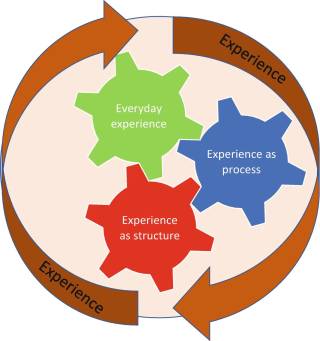
To state that all history is the history of experience would, at first glance, be stating the obvious. However, the history of experience homes in on experience as a category of historical analysis, and, in so doing, rethinks how experience is defined, its roles in history and historiography analysed, and its meanings theorized. History of experience thus not only denotes a field defined by a particular research topic; it also refers to a particular theoretical framework for tracing social and cultural change, in which experiences both drive change and underpin continuity as they circulate between individual, community, and society. History of experience thus also constitutes a particular historical approach. What is more, it also forms a cluster of methods for the study of historical experience. These methods frequently share attention to not only the historically situated, socially mediated, and linguistically determined nature of experience, but also an even greater interest in how experience emerges in the interaction between lived experience, interpretation, and societal structure. Such interplay as constitutive of experience has for instance been theorized in a foundational model recurring in much HEX research, Sari Katajala-Peltomaa and Raisa Maria Toivo’s three-level model of experience: it presents experience as, simultaneously, the embodied encounter with the world, the interpretative processes brought to bear upon this encounter, and the way in which that sense-making, in turn, refracts the encounter with the external world by creating societal and cultural structures (including social categories). Such a position thus rejects the idea of any “unmediated” or “direct” experience, instead directing our attention to cultural scripts, communal expectations, and the particular “horizon of expectation” (Koselleck) against which experience operates.
The centre thus explores society from the perspective of experience, by, for instance, and considers a range of periods, from ancient Rome through the Middle Ages to the early modern period as well as the twentieth century. Our scholars consider experience in a variety of contexts, and with reference to a diversity of topics: these contexts and topics range from emotion, religious practice, and childhood to war and prison life. HEX concerns also inspire our scholars’ teaching. HEX is also home to a range of other projects.
The three key themes defining the Academy of Finland’s Centre of Excellence in the History of Experience (HEX, 2018–2025) were lived religion, lived nation and lived welfare state, with a cluster of scholars working on each of these themes. The interest in lived nation sparked a Centre of Excellence in Nationalism Research in the Humanities (NARS), which hosts several HEX scholars, some of which also belonged to the lived welfare state cluster. Furthermore, lived religion continues to be explored by a group of scholars devoted to examining how past individuals and communities interpreted, adapted, and reconfigured religious doctrine in their daily lives. (The group meets regularly to discuss the history of experience and lived religion. to join the group, please contact Professor Raisa Toivo). In brief, the reorganized Centre continues to abound in (inter)disciplinary expertise in the historical specificities and contingencies of experience, and persists in texturing scholarly understandings of the history of experience and developing novel approaches to it. We warmly invite you to join us in this endeavour.