
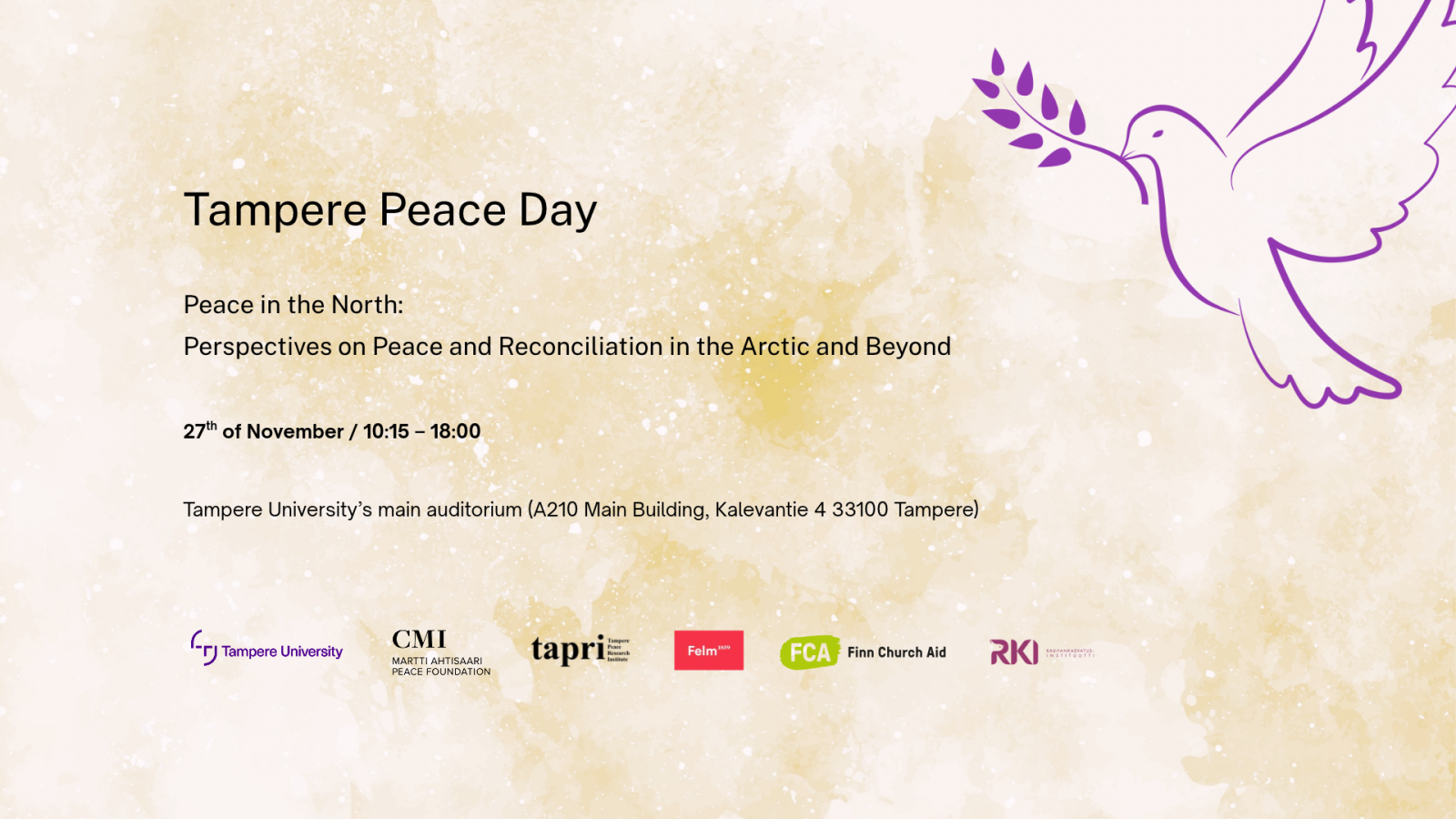
Tampere Peace Day 2026: Peace in the North: Perspectives on Peace and Reconciliation in the Arctic and Beyond
Date: November 27th
Time: 10:15-17:00 Followed by reception
Location: Tampere University, A210 Main Building (Päätalo)
Address: Kalevantie 4 33100 Tampere
The fourth annual Tampere Peace Day examines what peace, justice, and reconciliation mean amid rising geopolitical tensions, climate change, competition over resources, and renewed security concerns. This year’s focus is the North, especially the Arctic, where geo-politicisation, militarisation, and the green transition shape everyday life of nations and peoples. The programme links Arctic and a variety of northern perspectives with experiences from other parts of the world, highlighting both the specific challenges of northern contexts and broader lessons for peace and reconciliation. Tampere Peace Day invites participants to move beyond conventional understandings of security and peace by considering the roles of environmental justice, Indigenous rights, education, preparedness, memory, missing persons, and reconciliation in peacebuilding.
Tampere Peace Day 2026 will be organized jointly by Tampere Peace Research Institute (TAPRI), Tampere University, The Peace Education Institute (RKI), CMI – Martti Ahtisaari Peace Foundation (CMI), Finn Church Aid (FCA) and the Finnish Evangelical Lutheran Mission (Felm).
TPD 2026 Registration Link: Tampere Peace Day 2026: Peace in the North – Fill out form
Programme of Tampere Peace Day 2026:
Pre-session programme Thursday
Movie Night: Eatnameamet – Our Silent Struggle
Venue: Cinema Niagara
Directed by Suvi West, Eatnameamet – Our Silent Struggle explores Sámi rights, land, identity, self-determination and the impacts of colonisation in Finland. The film also engages with the beginnings of Finland’s Sámi truth and reconciliation process and the difficult questions of what truth and reconciliation can require.
The discussion after the screening brings these questions into the present and into dialogue with experiences from other contexts, connecting them to wider questions of justice, recognition, reconciliation and Peace in the North.
16.45–17.30 Snacks and beverages
17.30–19.00 Introduction and film screening (74 min)
19.00–19.45 Discussion
Tampere Peace Day (Friday)
10.15-10.30 Welcome Remarks (Room: Main building, A210)
Marko Lehti (Research Director of TAPRI – Tampere Peace Research Institute)
10.30-12:00 Keynote Session (Room: Main building, A210)
Keynote Address 1: TBA by Laura Junka-Aikio (Professor, University of Lapland)
Keynote Address 2: TBA
Facilitated dialogue with keynote speakers
Open questions to keynote speakers
Moderated by : TBA
12.00-13.00 Lunch Break
13.00-15.00 Parallel Roundtable Sessions:
The roundtable session features five parallel discussions. Each roundtable explores one overarching theme through focused questions. Designed to foster collaborative dialogue, each session includes a facilitator, an inner circle of invited experts, and an outer circle of participants who may also engage.
Session I – Environmental Justice and Peace
Facilitated by: TBA
This roundtable explores how environmental pressures and the governance of natural resources shape peace and security, and how more just and sustainable approaches can contribute to peaceful futures. Environmental justice and peace are deeply interconnected. Climate change, environmental degradation, and unequal access to land, water, and natural resources can reinforce historical injustices, exclusion, and conflict, but can also create opportunities for cooperation and peacebuilding. The discussion will highlight the importance of local and Indigenous knowledge, collective rights, meaningful participation, environmental stewardship, and cooperation over shared resources. It will also consider how environmental and water governance can strengthen dialogue, trust, resilience, and sustainable peace.
Faciltator: Henrietta Toivanen (CMI)
Invited experts: Ann Hironaka (University of California), Golda Ibarra, (Lutheran World Federation / Colombia Country Representative), Lasse Peltonen (University of Eastern Finland),TBA
Session II – Searching for Peace: Missing Persons, Families, and the Path to Reconciliation
This roundtable will create a critical space for discussing the issue of missing persons and the role that the missing and their loved ones play in post-conflict reconciliation. Bringing together scholars and practitioners from diverse disciplines and contexts, it will examine how corporeal approaches to peacebuilding can deepen our understanding of truth recovery, social repair and the rebuilding of trust in societies affected by violence. By foregrounding the experiences of those living with absence, this roundtable seeks to advance dialogue on one of the most enduring legacies of conflict and to identify pathways through which truth, justice and reconciliation can become mutually reinforcing dimensions of sustainable peace.
Facilitated by Vadim Romashov (TAPRI)
Invited experts: Laura Huttunen (Social Anthropology, Tampere University), Élise Féron (INCORE (International Conflict Research Institute), Ulster University), Anush Petrosyan (TAPRI), TBC
Session III – Preparedness for What? Peace Education, Security, Fears and Responsibility in the North
This roundtable explores how do we prepare for peace in education? Peace requires participation, trust, belonging and the ability to address conflicts constructively. These capacities can be strengthened through education, but preparing for peace also requires societies to create the conditions in which trust, participation, belonging, justice and constructive ways of addressing conflict can take root. Drawing on northern contexts, the discussion explores what preparedness means for communities, educators and young people. It asks whose security is prioritised, what futures young people are being prepared for, and how hope can be sustained amid war, ecological crisis, polarisation and insecurity. Participants will consider what a society genuinely prepared for peace might look like — and what actions, relationships and structures are needed to build it.Peace Education in Practice: Learning for a Non-Violent World.
Facilitated by Eeva-Liisa Kiiskilä (Peace Education Institute) & Risto Heikkinen (Felm)
Speakers: Marcela Douglas (The Arctic University of Norway); Samin Rassouli (Åbo Akademi University), Phill Gittins (World BEYOND War)
Session IV – Memory, Dialogue and Reconciliation: From Truth Commissions to Prevention and Peacebuilding
Facilitated by: TBA
Invited experts: Lisa Strömbom (Lund University); Maria Cárdenas (TAPRI), Rauna Kuokkanen (University of Lapland),
Session V – Contested Nordic / Baltic Peace(making) at Home and Abroad
This roundtable examines how the Nordics position themselves as peacemakers as liberal peace loses normative and epistemic authority. Their recent peacebuilding role has been largely tied to the Western-led liberal international order, but as global order becomes more plural and contested, assumptions about whose peace is promoted and how can no longer be taken for granted. How the Nordics can pursue peacemaking while preparing for war at home through investment armament and preparedness and emphasising peace through strength. This roundtable asks how shifting power relations unsettle Nordic imaginaries and practices of peace and security.
Facilitated by:
Invited Experts: Birgit Poopuu, (University of Tallinn); Louise Ridden, (IFHS, University of Hamburg); TBA
15.00 – 15.30 Coffee break
15.30 – 16.55 Plenary roundtable: Paths to Peace in the North (room: Linna K104)
Facilitated by TBA
Invited experts: Lisa Strömbom (University of Lund), Ann Hironaka (University of California), Rauna Kuokkanen (Universityt of Lapland), TBA
16.55-17.00 Closing of the Event (Room: Linna K104)
17.00 – 18.00 Reception – Hosted in the lobby of Linna Building at Tampere University
If you have questions about the event, please feel free to contact Marko Lehti, Research Director of TAPRI, at marko.lehti@tuni.fi or TAPRI Intern Ariana Blair, at ariana.blair@tuni.fi