

Finnish version of the article here.
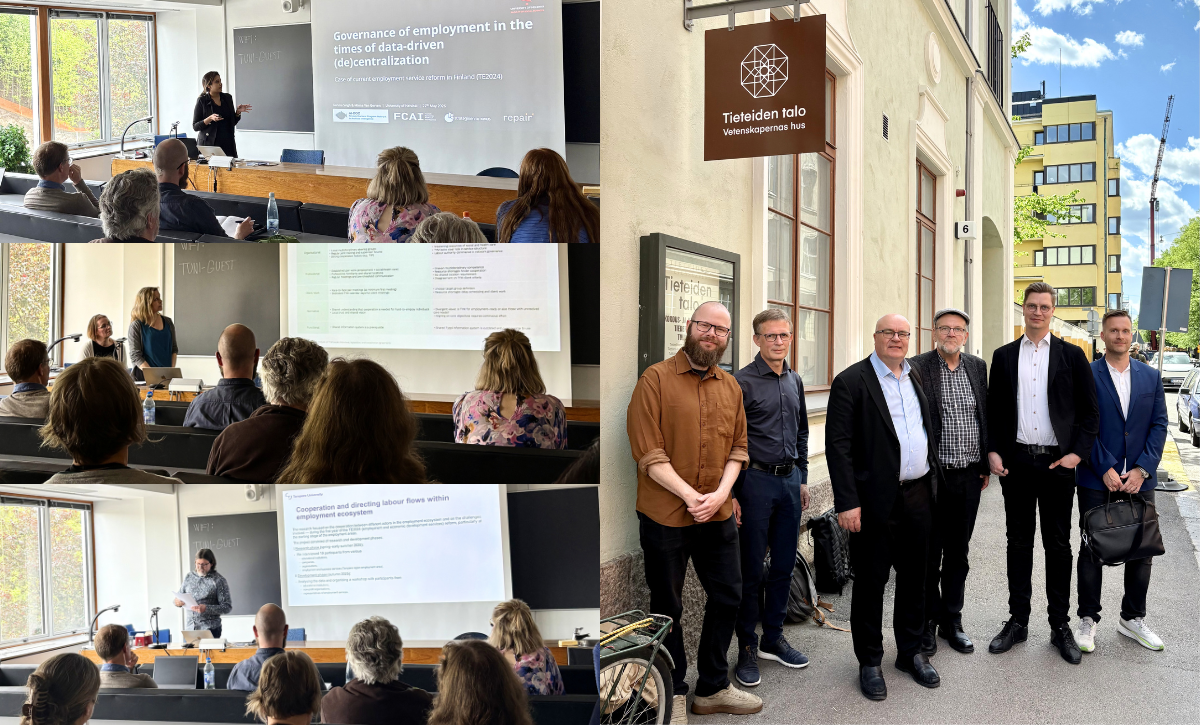
Tampere University’s Work Research Centre, together with the Ministry of Economic Affairs and Employment and other actors involved in employment policy research and evaluation, organized two workshops on the evolving landscape of employment policy. The Helsinki workshop on 26th May gathered around 50 participants and the Tampere workshop on 27th May around 30 participants, including researchers as well as representatives from state administration and municipal employment services.
Recent reforms in Finnish employment policy inspired the idea of a multi-sectoral stakeholder workshop where experts could come together to discuss these developments. Denmark has long served as an important benchmark for Finnish employment policy, and it was a pleasure to welcome experts Professor Flemming Larsen and Associate Professor Niklas Andersen from Aalborg University to share their insights into the history and current state of Denmark’s employment policy.
The workshops also featured contributions from the Ministry of Economic Affairs and Employment, the KEHA Centre, and researchers from the Labour Institute for Economic Research LABORE, the Finnish Institute for Health and Welfare, the University of Helsinki and Tampere University’s Work Research Centre.
The main goal of the workshops was to bring together actors from different sectors and stimulate discussion on employment policy, its recent changes, current challenges, and future directions. In addition to examining the development, challenges and future prospects of the Finnish and Danish models, the workshops addressed the evaluation of services and lessons learned from projects aimed particularly at improving services for people with a weak attachment to the labour market.
Future prospects for employment policy and evaluation?
The Helsinki workshop examined the development of employment policy in recent decades as well as its future prospects in Denmark and Finland. A key perspective was the role of evaluation in policymaking and service development.
The seminar began with a comparison of the Danish and Finnish labour market models. Heikki Räisänen from the Ministry of Economic Affairs and Employment presented the results of a recent report comparing Denmark’s flexicurity model with Finland’s current system. He discussed whether flexicurity could serve as a strategic framework for Finland and examined how Finland could transition towards a more flexicurity-based labour market model. According to Räisänen, this transition would require strengthening active labour market policy, improving unemployment benefits, and implementing pending reforms. Even with these changes, he reflected that Finland would not reach Denmark’s level in implementing flexicurity.
Professor Flemming Larsen from Aalborg University presented the historical development of Denmark’s active labour market policy and employment services. Danish policy has increasingly emphasized duties and incentives, resulting in a system that is locally implemented by municipalities but strongly governed by central authorities. At the same time, the system has become highly bureaucratic due to extensive legal and procedural requirements, which has also attracted criticism. Recent developments, however, aim at a shift toward a more flexible approach that increases local autonomy, along with cost savings.
Associate Professor Niklas Andersen discussed the evaluation of employment policy and analyzed Denmark’s highly institutionalized evaluation system. He raised the question of the purpose and users of evaluations, which according to him are often directed toward administrative control and steerability rather than the learnings for service providers. Andersen also provided examples of how evaluations have influenced policy, for instance toward greater emphasis on individualized support, employer collaboration, and “work-first” policies.
Santtu Sundvall, Head of the Evaluation and Knowledge-Based Management Unit at the Keha Centre, presented Finland’s developing system of knowledge-based management following the 2025 reform of employment services. The KEHA Centre is responsible for monitoring public employment services and evaluating their effectiveness. Sundvall introduced the evaluation system and its key focus areas as well as presented some key findings following the TE reform. He examined differences with Denmark and suggested that the aim is to build an evaluation infrastructure similar to Denmark’s, although current resources seem insufficient for this. He also noted that the division of steering power and responsibility between central government and municipally led employment regions remains contested.
Hannu Karhunen from LABORE critically examined evaluation capacity in Finland and highlighted gaps in data and infrastructure that weaken the possibilities of sound evaluation. Karhunen argued that Finland lacks, for example, a national infrastructure based on randomized controlled trials (RCTs), as well as a clear actor responsible for the field of evaluation. He emphasized the need for both stronger infrastructure and a clearer evaluation framework.
Simo Aho from Tampere University’s Work Research Centre discussed the use of research evidence in policy reforms. He noted that evidence is often lacking or contested, and political visions sometimes outweigh it. Aho argued that improving the targeting of services requires more time and financial resources, long-term investment, and a sustained commitment to building competence and cumulative knowledge.
Questions of integrated and client-centered services
The Tampere workshop focused more on the micro-level of employment policy, particularly on integrated services, multisectoral cooperation, and client-centered approaches.
Flemming Larsen introduced the CUBB (LISES) project (https://www.cubb.aau.dk / LISES – Local Innovation in Social and Employment services – Aalborg University), which has focused developing more co-produced and involving social and employment services, especially concerning vulnerable groups, through a collaboration between Aalborg University and six municipalities since 2016. The project demonstrates how municipalities can redesign services through collaboration between research and practice to support collective learning and client participation.
Niklas Andersen examined the challenges and potential of organizing more holistic and client-centered employment services. He highlighted increasing individualization, especially concerning vulnerable groups, and discussed two developments: stronger cross-sectoral integration and reforms in performance measurement systems to better reflect clients’ needs. These developments open new possibilities but also create governance and coordination challenges.
Peppi Saikku and Sanna Blomgren from the Finnish Institute for Health and Welfare analyzed Finland’s new multisectoral employment service model (TYM). They described the transition and examined different dimensions of integration as well as related barriers and enabling factors. They described the transition to this new model and presented dimensions of integration as well as barriers and enablers relating to these. For example, the normative dimension could present a barrier concerning divergent views on whether TYM serves those who are employment-ready or also those with unresolved care needs.
Garima Singh, a doctoral researcher from the University of Helsinki, brought to the discussion the viewpoint of data-driven governance in employment services. Critical questions concerned decentralization and, on the other hand, re-centralization through digital tools and infrastructure.
Work Research Centre’s postdoctoral researcher Sami Lind from Tampere University examined coordination of labour transitions across institutions such as educational institutions, companies, and employment services. His critical observations on the functioning of employment ecosystems concerned the challenges related to hard-to-employ individuals and ensuring the skills of the working-age population. In addition, Lind highlighted that cooperation between different actors relies too heavily on informal connections.
Opportunities for Nordic comparative learning
Overall, the workshops provided a valuable learning environment and an opportunity for multi-perspective discussion. The workshops supported comparative Nordic learning by bringing together two welfare states in dialogue and connecting a wide range of actors across sectors.
For more information: simo.aho@tuni.fi