

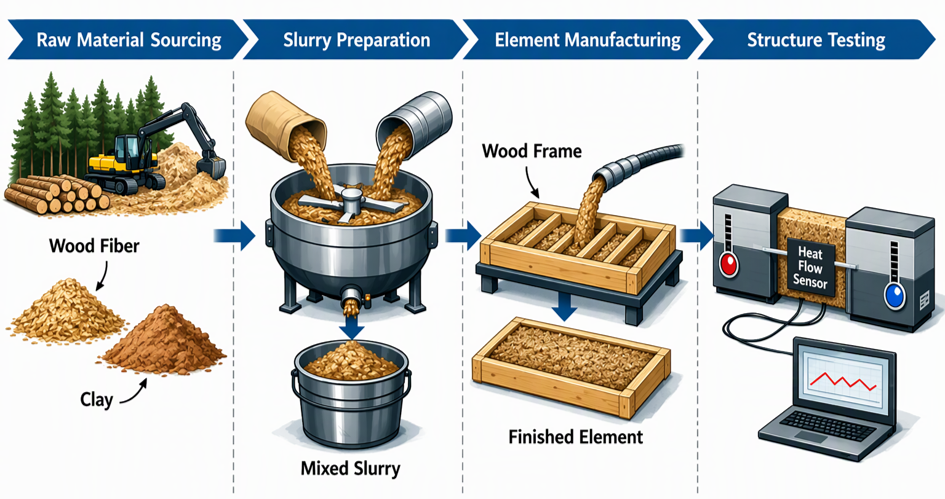
In today’s wood construction, the key technical challenges are the requirements related to the fire safety of bio-based insulation materials, as well as the multi-layered nature of the structures and the complexity of manufacturing. To overcome these challenges, the VALUPUU project is developing a new wood-based building material and structure concept in which foam-formed wood fiber pulp and clay are used to make a castable single-material exterior wall structure (Valupuu). The material, developed by the Building Physics research group at the Tampere University, combines thermal insulation, fire safety, and moisture performance. The aim is to provide the capability to develop an industrially manufactured wood-framed element filled with this material, which enables simple, fault-tolerant, cost-effective and low-carbon structural solutions, especially in the construction of wooden apartment buildings. The VALUPUU project originated from the BIORENO project, funded by Business Finland, which develops a similar material for renovation needs. The Technical Research Centre of Finland is further developing the material’s manufacturing method and optimising its composition.
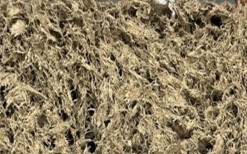
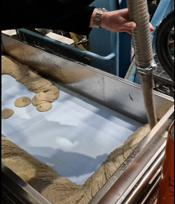
The project consists of five work packages:
- Material development. The composition of the cast wood material is optimized and the additives are compared. The initial data is that the density of the material varies between 50-150 kg/m3 and the thermal conductivity between 0.035-0.055 W/(mK).
- Material research and structural design. The building physical properties of the structure are investigated, a timber frame solution is designed and the susceptibility to mould is assessed.
- Demonstration of the production process. Manufacture of wood-framed elements by casting the material into them and assess the suitability of robotics and drying techniques. The material is highly capillary, which is expected to speed up the drying process.
- Structural research and computational review. The functionality of structures is measured, sound insulation is tested, and the environmental impacts of structures are modelled and compared.
- Production economic assessment of the elements. The suitability of the material for element production, as well as the carbon footprint, recyclability and reusability of the elements, are assessed.