

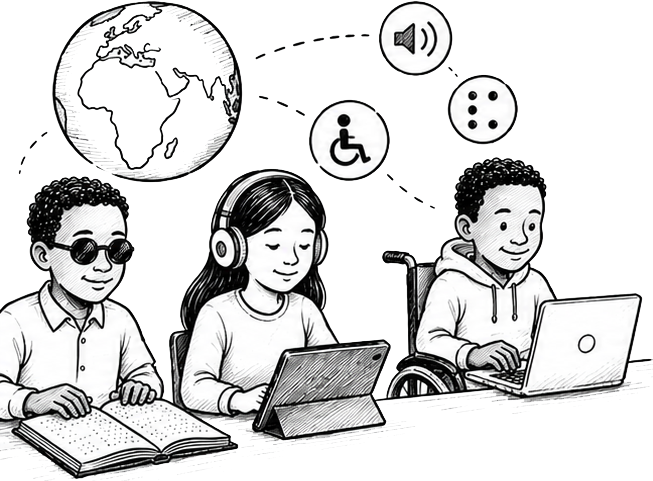
 This manual builds on the work of TACCU and BERT project partners, contributing to the global mapping and landscape analysis of assistive technology (AT) in the East African context. The global mapping of assistive technologies focused on discovering what kind of ATs are currently used worldwide and assessing them from the perspective of complexity, functionality and target group among others. The BERT landscape analysis centered on enhancing the knowledge and skills in creating inclusive education for students with disabilities in Rwandan and Tanzanian context. However, the content and practices in this manual are designed to provide general knowledge and insights from a global perspective.
Purpose of the manual
This manual provides an introduction to the role of assistive technologies in promoting inclusive and accessible learning.
- Explains key concepts, principles, and the categorization of ATs, highlighting their relevance for diverse learner needs and educational contexts.
- Demonstrates how ATs can be effectively integrated into daily teaching practices, including approaches for selecting, implementing, and supporting their use.
- Highlights essential aspects of accessibility and provides links to resources for creating accessible materials, applying inclusive design principles, and ensuring that digital learning environments support all learners.
Use of the manual
This manual is designed as an overview and guiding framework for assistive technologies and accessibility in the education context. Therefore, this manual doesn’t target the intended audience, but it hopefully provides useful resources to consider when working in the education field in any position. For detailed procedures and specific actions, you are encouraged to consult the original source materials and referenced resources.
Structure of the manual

The manual is structured into five main categories:
- Accessibility and inclusive education
- Assistive technologies
- Governance and compliance
- Lifecycle and training
- Materials and tools
Alignment into BERT tasks
The structure and content presented here are derived from the outcomes of project tasks 1.3.2 and 1.3.3, ensuring coherence, traceability, and alignment with the overall project objectives.
Task 1.3.2: Creation of standards and user manuals for AT in school settings.
This task provides the foundation for:
- Core concepts related to AT basics and accessibility
- The comprehensive framework of AT standards, including:
- Procurement and acceptance
- Safety, security, and data protection
- Inclusive pedagogy and reasonable accommodation
- Training and competency
- Maintenance, support, and lifecycle
- Monitoring and evaluation
- The definition of AT categories
- The structure of user manuals
Task 1.3.3: General guidance on digital accessibility and rehabilitation.
This task contributes:
- Core principles of digital accessibility and rehabilitation
- Practical classroom strategies tailored to different educational levels
- Approaches to school-based digital rehabilitation
Navigation across sections is facilitated by the “Content and Navigation” table in the footer of each page. Or by clicking the hyperlink at the bottom of each page.
Next page: Accessibility and Inclusive Education