

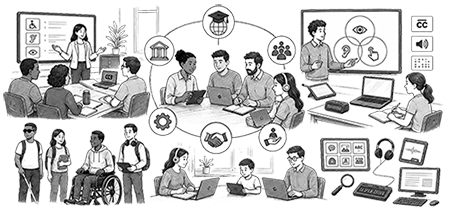
Creating inclusive and accessible learning environments in higher education requires continuous training, collaboration, and institutional commitment. Educators, lecturers, and support staff play an important role in ensuring that all students can participate meaningfully in learning.
Many faculty members may have limited knowledge of accessibility, assistive technologies (AT), inclusive pedagogy, or the needs of students with disabilities. Inclusive teaching is often approached individually without clear institutional guidelines or consistent training. This highlights the need for stronger accessibility standards, shared practices, and ongoing professional development.
Research shows that effective accessibility and inclusion training should not only focus on awareness, but also provide practical skills, hands-on experience, and opportunities for continuous learning.
Accessibility, UDL, and AT in higher education
Training in accessibility should include both digital and pedagogical perspectives where educators should understand:
- Accessibility standards and legislation
- Web Content Accessibility Guidelines (WCAG)
- Universal Design for Learning (UDL)
- Assistive technologies and accessible learning materials
- Flexible and inclusive teaching methods
UDL provides a practical framework for inclusive education, and encourages educators to design learning environments that work for diverse learners from the beginning, rather than adapting materials afterward.
In practice, this means offering:
- Multiple ways to access information
- Multiple ways to participate
- Multiple ways to demonstrate learning
UDL benefits both students and educators by improving flexibility, accessibility, engagement, and participation.
Assistive technologies also play an important role in supporting participation and accessibility. Faculty training should include opportunities to explore and practice using assistive technologies and creating accessible learning materials.
Competency frameworks and institutional development
Several international frameworks support accessibility and inclusion in education. The IIEP competency framework for educational planners and managers focuses on technical, relational, and strategic competencies related to educational planning and management. Erasmus+ SKATE framework (Support, Knowledge, Access, Teaching, and Evaluation) highlights competencies teachers need to effectively support the use of assistive technologies in learning environments.
These frameworks emphasize that accessibility and inclusion require coordinated action across policy, teaching, support services, and institutional planning.
Common barriers in higher education
Despite growing awareness, many barriers still affect accessibility and inclusion in higher education.
Common challenges include:
- Insufficient training and support for staff
- Limited awareness of assistive technologies
- Negative attitudes or stigma
- Weak assessment and planning procedures
- Limited financial resources
- Lack of time
- Difficulties acquiring and maintaining equipment
Please, note that solving these barriers takes time. However, recognizing these challenges and maintaining ongoing discussion and development are important steps toward improving accessibility and inclusion.
Checklist and practices
Faculty training and institutional support:
- Engage all faculty members in accessibility and inclusion training
- Provide flexible and tailored training opportunities
- Support continuous professional development
- Encourage collaboration between educators, support staff, and administration
- Build institution-wide competence in accessibility and inclusion
Accessibility and inclusive teaching:
- Provide training on accessibility laws, regulations, and responsibilities
- Train educators on WCAG and digital accessibility
- Promote Universal Design for Learning (UDL)
- Encourage flexible teaching methods
- Design accessible learning materials from the beginning
Evaluation and continuous improvement:
- Evaluate training effectiveness through feedback and assessment
- Update training regularly
- Encourage ongoing institutional discussion about accessibility
- Treat accessibility as a continuous process
- Include students when appropriate
Remember also the common challenges:
- Limited time and resources
- Insufficient training and support
- Lack of awareness
- Weak planning procedures
- Challenges with equipment and technology management
Remember:
- Accessibility and inclusion benefit all learners
- UDL supports flexible and accessible learning
- Effective AT use requires training and support
- Institutional commitment is essential
- Continuous improvement is more important than perfection
Links and references
- Accessibility Standards Overview (W3C website)
- Afonso, A., Morgado, L., Carvalho, I. C., & Spilker, M. J. (2025). Facing Challenges in Higher Education: Enhancing Accessibility and Inclusion Through Flexible Learning Design. Education Sciences, 15(8), 1013.
- Bong, W. K., & Chen, W. (2024) Increasing faculty’s competence in digital accessibility for inclusive education: a systematic review. International Journal of Inclusive Education, 28(2), 197-213.
- Moriña, A., Carballo, R., & Doménech, A. (2025). Transforming higher education: a systematic review of faculty training in UDL and its benefits. Teaching in Higher Education, 30(7), 1722–1739.
- SKATE ICT/AT Competency Framework
- SKATE Guidelines: Inclusive classrooms for ECEC teachers
- UNESCO (2024). IIEP competency framework for educational planning and management
- UNICEF (2022). The use of Assistive Technology in Education: A Guide for Teachers and Schools
- The UDL Guidelines (CAST website)
Next page: Materials and Tools