


Assistive technology (AT) requires ongoing maintenance, support, and planning to remain effective over time. Providing a device alone is not enough. Learners and educators also need reliable support systems, repair services, training, and long-term access to assistive technologies.
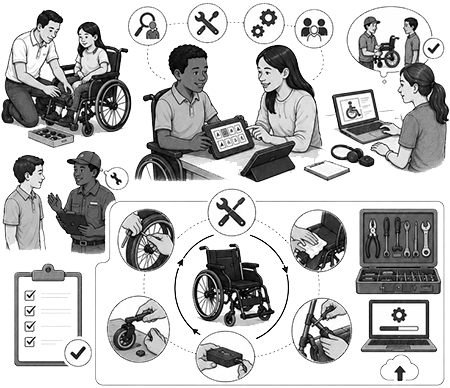
Without proper maintenance and follow-up services, assistive technologies may become unusable, abandoned, or unsafe. This can significantly affect participation, independence, learning, and daily life.
Repair and maintenance are often overlooked parts of assistive technology provision, especially in low-resource settings. Community-based repair, local initiatives, and user-led solutions frequently become essential for maintaining continued access to AT.
Why maintenance and repair matter?
Assistive technologies may require:
- Regular maintenance
- Software updates
- Battery replacement
- Spare parts
- Repairs after wear or damage
- Technical support and troubleshooting
Preventive maintenance is especially important. Regular checks, updates, backups, and monitoring can help prevent failures and extend the useful life of assistive technologies.
Users should contact the supplier, assessor, service provider, or support team if an assistive technology:
- Does not function properly
- Does not meet the learner’s needs
- Is unsafe or poor quality
- Stops working shortly after delivery
Repair and support in low-resource settings
In many low-resource settings, formal repair services are limited or unavailable. Research from Kenya, Uganda, Sierra Leone, and Indonesia highlights that many assistive technology users rely on:
- Community-based repair
- Local tradespeople
- Informal repair networks
- Disability organizations (DPOs)
- Self-repair and adaptation
These approaches often help extend the lifespan of devices and maintain participation in education and daily life. The research also emphasizes that community-based repair should be better supported and integrated into formal assistive technology systems.
Integrating ATs in education
Successful integration of assistive technology requires collaboration, planning, and continuous support.
Educational institutions should:
- Conduct needs assessments
- Allow students to trial different AT solutions
- Collaborate with teachers, families, technicians, and service providers
- Provide ongoing training and technical support
- Monitor progress and effectiveness
- Plan for sustainability and long-term access
It is especially important to involve students in decisions about their assistive technologies and listen to their experiences and preferences.
The AT lifecycle
AT lifecycle management considers the full journey of a device or service from creation to disposal.
The lifecycle includes:
- Design and development
- Manufacturing
- Distribution
- Use and training
- Maintenance and repair
- Reuse and refurbishment
- Recycling or disposal
Lifecycle thinking helps reduce environmental impact while improving long-term sustainability and accessibility. In this, the importance of repair-friendly design, modular systems, and availability of spare parts to improve long-term usability can be highlighted.
Sustainability and long-term access
Sustainable AT implementation requires planning beyond initial device delivery.
Important considerations include:
- Budgeting for maintenance and replacement
- Spare parts and consumables
- Technical support availability
- Device compatibility and durability
- Reuse and refurbishment possibilities
- Data protection and safe disposal at end-of-life
Long-term planning helps ensure that assistive technologies remain useful, accessible, and reliable over time.
Monitoring and evaluation
Monitoring and evaluation help determine whether assistive technologies are effectively supporting participation and learning.
Examples of useful indicators include:
- Usage Metrics
- Time in use
- Subjects or activities supported
- Number of repairs or support requests
- Device reliability
- Impact Metrics
- Participation and task completion
- Access to assessments
- Learner and teacher satisfaction
- Learning outcomes
- Reduction of barriers
Regular review meetings and feedback collection can help improve planning and identify areas needing additional support.
Checklist and practices
Maintenance and repair:
- Schedule regular maintenance and device checks
- Keep software updated and maintain backups
- Ensure access to repair services and spare parts
- Report faults and problems early
- Plan for preventive maintenance
Integration and support:
- Conduct learner needs assessments
- Allow learners to trial different technologies
- Collaborate with teachers, families, technicians, and service providers
- Provide ongoing training and technical support
- Involve students in AT decision-making
Sustainability and lifecycle planning:
- Consider long-term costs and sustainability
- Plan for replacements and consumables
- Support reuse and refurbishment when possible
- Ensure safe recycling and disposal
- Use repair-friendly and durable technologies when possible
Monitoring and evaluation:
- Monitor device use and effectiveness
- Collect learner and teacher feedback
- Review progress regularly
- Track repairs and maintenance needs
- Adjust support strategies when needed
Remember:
- Providing AT is only the beginning of the process
- Maintenance and support are essential for long-term success
- Community-based repair can play an important role
- Sustainability and accessibility should be considered throughout the full AT lifecycle
- Ongoing collaboration and training improve successful AT implementation
Links and references
- Global Disability Innovation Hub | AT2030 programme (GDI website)
- Oldfrey, B., Holloway, C., Walker, J., McCormack, S., Deere, B., Kenney, L., Ssekitoleko, R., Ackers, H., & Miodownik, M. (2024). Repair strategies for assistive technology in low resource settings. Disability and Rehabilitation: Assistive Technology, 19(5), 1945–1955.
- UNICEF (2022). The use of Assistive Technology in Education: A Guide for Teachers and Schools
- WHO & UNICEF (2022). Global report on assistive technology (GReAT).
Next page: Training and competency