


AT categorization is traditionally based on technological complexity, ranging from low-tech to mid-tech to high-tech. The current literature reveals a diverse range of ATs used in educational settings, from low-tech tools such as Braille machines to high-tech solutions such as virtual reality and socially assistive robots (SARs). In low-resource settings, availability often varies significantly based on geographic and socio-economic factors.

Based on global mapping in the BERT project, the six main categories for ATs are 1) complexity, 2) functionality, 3) target group, 4) implementation context, 5) socio-economic accessibility, and 6) stakeholder involvement.
Complexity
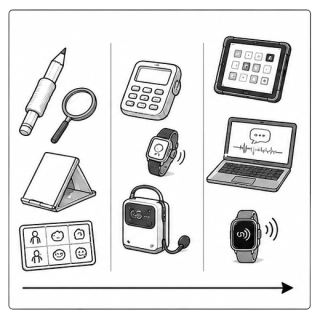
Low‑tech ATs are simple non‑electronic tools, mid‑tech ATs provide basic electronic support, and high‑tech ATs offer advanced digital solutions that deliver greater functionality but often require specialized training.
- Consider whether low-tech, mid-tech, or high-tech solutions are most appropriate
- Start with simple and effective solutions when possible
- Ensure that users receive adequate training for more advanced technologies
- Consider maintenance, electricity, internet access, and technical support needs
- Remember that high-tech solutions are not always the most practical or sustainable
Functionality
ATs in this category are based on specific functionality, such as communication, mobility, learning and educational support, hearing, vision, and cognitive assistance.
- Select ATs based on learner needs and intended functionality
- Consider support for:
- Communication
- Mobility
- Vision
- Hearing
- Learning and cognition
- Ensure technologies support participation in daily learning activities
- Combine multiple ATs when needed
Target group
ATs can be targeted to specific groups, such as students with visual, hearing, mobility, learning disabilities (difficulty), or multiple disabilities.
- Match technologies to individual learner strengths, needs, and preferences
- Avoid assuming that one solution fits all learners
- Consider multiple disabilities and overlapping support needs
- Involve learners in selecting and evaluating technologies whenever possible
Implementation context

The implementation context categorizes ATs by where and how technologies are used, whether in classrooms, homes, or hybrid learning environments.
- Consider where and how ATs will be used:
- Classroom environments
- Home learning
- Hybrid or remote learning
- Ensure compatibility with local infrastructure and learning environments
- Adapt learning spaces to support effective use of ATs
- Consider portability, durability, and usability in different contexts
Socio-economic accessibility
Categorization by socio-economic accessibility is based on affordability and availability across different socio-economic levels, emphasizing the cost of ATs and the ability to access them.
- Prioritize affordable and accessible solutions when resources are limited
- Consider long-term sustainability, maintenance, and replacement costs
- Use locally available technologies and materials when possible
- Reduce barriers related to cost, availability, and connectivity
- Remember that effective low-cost solutions can significantly improve participation and learning
Stakeholder involvement
Stakeholder involvement highlights the roles of different groups in the development, distribution, support, and use of assistive technologies.
- Include teachers, learners, families, technicians, and communities in AT planning and implementation
- Encourage collaboration between schools, governments, NGOs, and service providers
- Provide training and ongoing support for users and educators
- Promote awareness and reduce stigma related to disability and AT use
- Ensure that policies and decision-making processes include the perspectives of persons with disabilities
Checklist and practices
- Start simple, scalable, and context-appropriate
- Focus on real learner needs, not just technology
- Plan for long-term use, support, and costs
- Ensure collaboration and training at all levels
- Effective AT is usable, accessible, and sustainable
Accessibility and inclusion require more than technology alone, where AT selection should always consider the learner, environment, and context together. Sustainable and context-appropriate solutions are often the most effective in the long term. See also this manual’s Procurement and acceptance.
Next page: AT examples