


Monitoring and evaluation help schools, governments, and organizations understand whether assistive technologies (AT) are actually improving learning, participation, and inclusion.
Many assistive technology projects fail not because the devices themselves are poor, but because there is no follow-up to see whether the technologies are being used effectively. Devices may remain unused, break without repair, or fail to support meaningful participation in learning.
Effective monitoring and evaluation help ensure that assistive technologies are:
- Being used regularly
- Supporting teaching and learning
- Meeting learner needs
- Sustainable over time
- Improving participation and outcomes
Monitoring and evaluation should not only focus on counting devices. It should focus on understanding the real impact on learners, teachers, and educational participation.
Remember outcomes, not just outputs
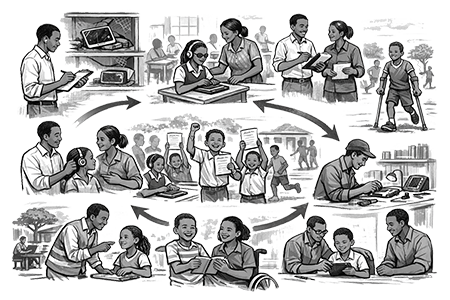
A common mistake in assistive technology projects is focusing only on outputs instead of outcomes.
Outputs
Outputs describe what was purchased or delivered.
Example: “50 tablets with screen readers were delivered to the school.”
Outcomes
Outcomes describe what changed for the learner.
Example: “80% of students with visual disabilities can now complete national examinations independently using school-provided assistive technologies.”
Tracking outcomes helps schools understand whether assistive technologies are truly improving accessibility, participation, and learning.
The three pillars of school-based monitoring and evaluation
1. Technical and logistical
Technical monitoring focuses on whether assistive technologies remain available, functional, and accessible.
Examples include:
- Inventory audits
- Device condition checks
- Maintenance and repair logs
- Tracking spare parts and replacements
- Utilization monitoring
Schools should regularly check whether devices are:
- Still available
- Functional
- Properly maintained
- Actually being used
For example, if devices remain locked in cupboards or repeatedly fail in certain environments, procurement and support strategies may need to change.
2. Pedagogical
Monitoring should also examine how assistive technologies are integrated into teaching and learning.
Important questions include:
- Are teachers confident using the technology?
- Is the AT included in lesson planning?
- Is the technology supporting classroom participation?
- Are educators receiving enough training and support?
Assistive technologies should become part of everyday teaching rather than isolated “special activities.”
3. Learner experience and inclusion
The learner experience is one of the most important parts of monitoring and evaluation.
Schools should examine whether assistive technologies improve:
- Participation
- Communication
- Confidence
- Independence
- Attendance
- Retention
- Academic performance
Monitoring should focus on meaningful participation, not simply device availability.
Monitoring in low-resource settings
Many schools in low-resource environments may have limited internet access or technical infrastructure. Monitoring systems should therefore operate offline and flexibly.
KoboToolbox
A free platform for offline and mobile-friendly data collection commonly used in humanitarian and education projects.
Open Data Kit (ODK)
An open-source mobile data collection platform that can work offline and synchronize later.
Classroom Shadowing
A supervisor or support staff member observes classroom activities and evaluates whether assistive technologies appropriately match:
- The student
- The learning environment
- The learning task
This approach is closely connected to the SETT framework.
Community feedback
Parent-teacher associations (PTAs), families, and local communities can help support accountability, transparency, and sustainability.
Community involvement also strengthens local ownership and long-term support for accessibility initiatives.
The Feedback loop in procurement
One of the most important purposes of monitoring and evaluation is improving future decision-making.
Findings should directly influence:
- Procurement decisions
- Device selection
- Training priorities
- Maintenance planning
- Infrastructure improvements
For example:
- If devices repeatedly fail because of heat or dust, future procurement may require more durable devices.
- If laptops are damaged by unstable electricity, future procurement may include surge protectors or solar charging systems.
- If learners struggle with language barriers, future technologies may require local-language support.
Monitoring only becomes meaningful when the results are actively used to improve future practice.
Sustainability and long-term planning
Monitoring and evaluation also support sustainability by helping schools understand:
- Which technologies are most effective
- Which devices require frequent repairs
- Which solutions are affordable and durable
- What types of training are needed
- How technologies fit local contexts
Continuous review helps ensure that assistive technologies remain useful, accessible, and sustainable over time.
Checklist and practices
Focus on outcomes:
- Track changes in participation and learning
- Measure independence and inclusion
- Avoid focusing only on device numbers
Technical monitoring:
- Conduct regular inventory audits
- Maintain repair and maintenance logs
- Monitor device utilization rates
- Track spare parts and replacements
Teaching and learning:
- Monitor teacher confidence and competency
- Include AT use in lesson planning
- Observe how technologies support classroom participation
- Provide ongoing training and support
Learner participation:
- Monitor attendance and retention
- Compare participation before and after AT use
- Evaluate communication, engagement, and confidence
- Include learner feedback in evaluations
Low-resource monitoring approaches:
- Use offline-friendly tools such as KoboToolbox and ODK
- Conduct classroom observations and shadowing
- Involve PTAs and communities in monitoring
- Use simple and sustainable data collection methods
Procurement feedback loop:
- Use findings to improve future procurement
- Identify recurring technical or environmental problems
- Adapt purchasing decisions based on evidence
- Review reports regularly and apply lessons learned
Remember:
- Devices alone do not guarantee inclusion
- Monitoring should focus on real educational impact
- Monitoring and evaluation is a continuous process, not a one-time activity
- Feedback and evaluation should guide future improvements
- A monitoring and evaluation report has value only if the findings are used in practice
Links and references
- Education management, monitoring, and evaluation (UNESCO website)
- KoboToolbox – free offline data collection for humanitarian and education projects (website)
- Monitoring and evaluation: how we look at impact (UNESCO website)
- Monitoring and evaluation toolkit (UNESCO website)
- Oldfrey, B., Holloway, C., Walker, J., McCormack, S., Deere, B., Kenney, L., Ssekitoleko, R., Ackers, H., & Miodownik, M. (2024). Repair strategies for assistive technology in low resource settings. Disability and Rehabilitation: Assistive Technology, 19(5), 1945–1955.
- Open Data Kit (ODK) – open-source mobile data collection (website)
Next page: Lifecycle and Training