

Assistive technology (AT) plays an important role in supporting independence, participation, communication, learning, and daily life for billions of people worldwide. The Convention on the Rights of Persons with Disabilities (CRPD) recognizes access to assistive technology, education, rehabilitation, independent living, and inclusion as human rights.
Relevant articles include:
- Article 9 – Accessibility
- Article 19 – Living independently and being included in the community
- Article 20 – Personal mobility
- Article 24 – Education
- Article 26 – Habilitation and rehabilitation
Assistive technology helps people participate more fully in education, employment, communication, and community life.
The global need for ATs
More than 2.5 billion people worldwide currently require one or more assistive products. By 2050, this number is expected to exceed 3.5 billion. Despite increasing global demand, access to assistive technology remains highly unequal. Nearly one billion people, especially in low- and middle-income countries (LMICs), still face major barriers to obtaining essential assistive products. In some regions, product availability may be as low as 3%.
Common barriers include:
- High costs
- Limited product availability
- Lack of support services
- Insufficient training
- Limited awareness and policy support
Many individuals obtain assistive products through private funding, family support, or personal finances rather than public systems. Improving access to AT is essential for promoting equity, inclusion, independence, and participation in society.
ATs and independent living
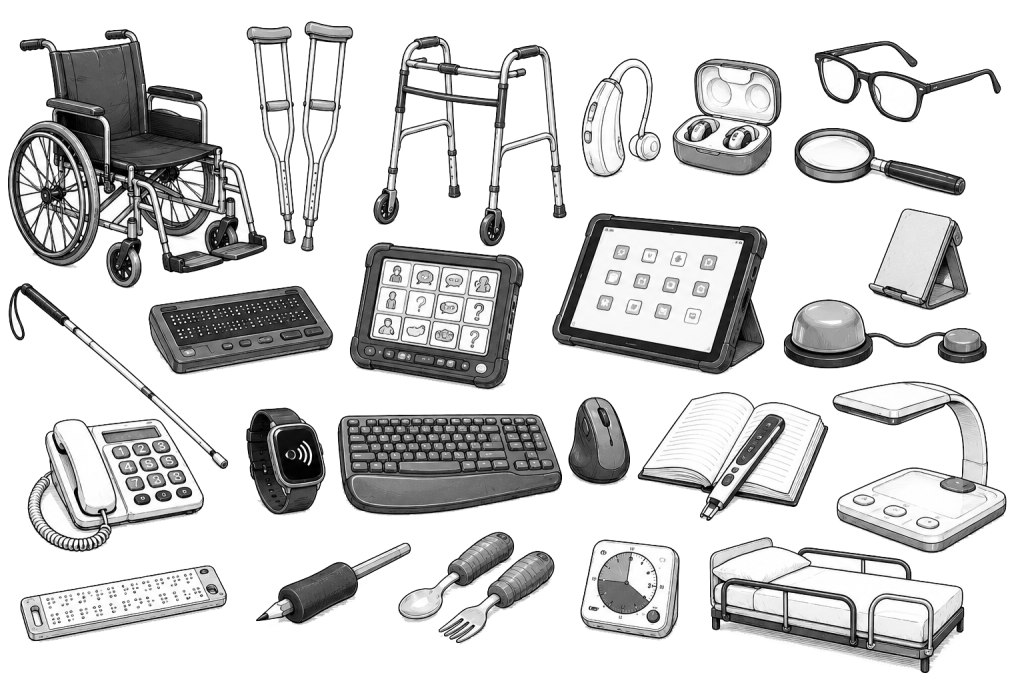
The most commonly needed technologies for independent living often include simple assistive products and home adaptations.
Examples include:
- Walking aids
- Communication boards
- Hearing devices
- Accessible furniture
- Magnifiers
- Wheelchairs
- Daily living tools
Modern Intelligent Assistive Technologies (IAT), including technologies using Artificial Intelligence (AI), are intended to complement rather than replace traditional assistive technologies.
The Committee on the Rights of Persons with Disabilities encourages increased access to modern information and communication technologies, including AI. Discussions around emerging technologies should consider the rights, participation, and inclusion of persons with disabilities.
Definitions
The World Health Organization (WHO) defines assistive technology and assistive products as follows.
- Assistive technology is the application of organized knowledge and skills related to assistive products, including systems and services. AT is a subset of health technology.
- Assistive products: Any external product (including devices, equipment, instruments, or software), especially produced or generally available, whose primary purpose is to maintain or improve an individual’s functioning and independence and thereby promote their well-being. Assistive products are also used to prevent impairments and secondary health conditions.
- Priority assistive products: Those products that are highly needed, an absolute necessity to maintain or improve an individual’s functioning, and which need to be available at a price the community/state can afford.
Assistive technology and UDL
ATs works closely together with Universal Design for Learning (UDL). UDL focuses on designing flexible learning environments and curricula that support diverse learners from the beginning. AT helps address individual learner needs by providing personalized supports and tools.
Assistive technology may include:
- Devices and hardware
- Software and digital tools
- Communication supports
- Cognitive and behavioral supports
- Services that help learners and teachers use AT effectively
Together, UDL and AT help create more inclusive learning experiences without excluding learners from participation.
Successful Implementation of AT
Successful use of assistive technology requires more than simply providing devices.
Teachers and schools should:
- Adapt curriculum flexibly
- Select technologies based on learner needs
- Consider the learning environment and context
- Provide adequate training and support
- Ensure accessibility and participation for all learners
When properly implemented, assistive technology can significantly support inclusion, participation, independence, and meaningful learning.
Checklist and practices
Assistive technology should:
- Support independence and participation
- Address individual learner needs
- Be affordable and accessible
- Work alongside inclusive teaching practices
Schools and teachers should:
- Provide appropriate training and support
- Select technologies based on learner context
- Ensure compatibility with learning environments
- Include AT within broader inclusive education planning
Remember:
- AT complements inclusive pedagogy and UDL
- Technology alone does not guarantee inclusion
- Effective implementation requires planning, training, and support
Links and references
- Assistive Technology (WHO website)
- Global Partnership for Assistive Technology & Clinton Health Access Initiative (2024). Assistive Products Market Report 2024.
- Global Partnership for Assistive Technology & Clinton Health Access Initiative (2024). Product catalogue annex.
- Orkwis, Raymond; McLane, Kathleen (1998). A Curriculum Every Student Can Use: Design Principles for Student Access. ERIC/OSEP Topical Brief. ERIC/OSEP Special Project.
- Quinn, G. (2021). Report of the Special Rapporteur on the rights of persons with disabilities. Human Rights Council, Forty-ninth session, General Assembly, United Nations.
- Rosken, A., Crosby, N., & Fuzes, P. (2021). From institutions to community living. Collection of Models of Good Practice in deinstitutionalisation for people with high support needs/multiple disabilities, including practices on how assistive technology can support inclusive living. European Association of Service providers for Persons with Disabilities.
- The UDL Guidelines (CAST website)
- UNESCO (2023). Global Education Monitoring Report 2023: Technology in education – A tool on whose terms?
- UNESCO (2026). Global Education Monitoring Report 2026: Access and equity Countdown to 2030.
- UNICEF (2022). The use of Assistive Technology in Education: A Guide for Teachers and Schools
- Wangmo, T., Lipps, M., Kressig, R. W., & Ienca, M. (2019). Ethical concerns with the use of intelligent assistive technology: Findings from a qualitative study with professional stakeholders. BMC Medical Ethics, 20(1), 98.
- WHO & UNICEF (2022). Global report on assistive technology (GReAT).
- WHO (2016). Priority Assistive Products List.
- World Intellectual Property Organization. (2021). WIPO Technology Trends 2021- Assistive Technology.