
 There are an estimated 240 million children with disabilities worldwide, and millions of children also face barriers that limit access to education and participation in society. These barriers are often caused not by individual impairments but by systems that fail to provide accessible environments, inclusive teaching practices, and equal learning opportunities.
Exclusion is often linked to:
- Limited accessibility
- Lack of inclusive policies
- Insufficient funding
- Inadequate teacher training
- Missing support services and learning materials
- Poor disability data collection and planning
Because children with disabilities are most likely to be excluded from school and broader social and economic participation, it should be highlighted that education is a fundamental human right for every child. Inclusive pedagogy is a key part of creating equitable education systems where every child has the opportunity to learn, participate, and succeed.
Digital rehabilitation and inclusive education
Rehabilitation helps children with disabilities improve or maintain their physical, cognitive, communication, and social abilities so they can participate in education and society as fully as possible. The rapid development of the internet and digital technologies, even in low- and middle-income countries, has significantly influenced healthcare, including rehabilitation practices. In the context of inclusive pedagogy, digital rehabilitation efforts can remove barriers and support equal participation.
- Digital rehabilitation uses digital tools (apps, AI, devices) to support functioning and reduce disability.
- Digital rehabilitation is a distinct concept, though related to broader digital health.
- Focuses on a holistic, digitally supported rehabilitation process, not just individual tools.
- Supports monitoring, evaluation, and management of health and rehabilitation pathways.
- In inclusive pedagogy, it supports accessible learning and equal participation for diverse learners.
What is inclusive education?
Many approaches still reflect integration or traditional special education models, in which general teaching strategies are supplemented by separate or additional support for certain learners. However, educators are encouraged to adapt their teaching practices to address the diversity present in classrooms.
Inclusive education means that all learners study together in the same schools and classrooms, regardless of disability, language, culture, background, or support needs. At its core, it values diversity as a strength and supports different ways of learning and participation, and is based on principles such as flexibility, adaptability, respect for individual differences, and the provision of meaningful choices for all learners.
Inclusive education benefits:
- Children with disabilities
- Learners from linguistic or cultural minorities
- Students with different learning needs
- Entire school communities
Inclusive pedagogy in practice
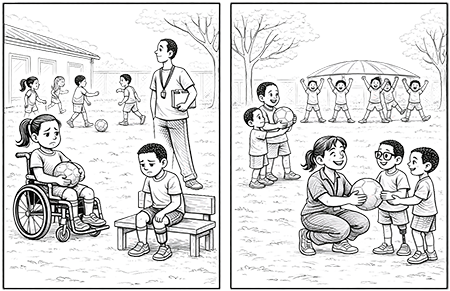 When disability is not properly included in education systems and decision-making, inequality continues. As an example, especially in the context of physical education, it is easy to separate students with physical disabilities from their peers and assign activities with little educational value.
Practices easily reflect a performance-focused curriculum that prioritizes traditional sports and treats disability as an individual limitation rather than a need for adaptation. As a result, students may experience marginalization, limited participation, and reduced confidence.
Inclusive pedagogy suggests redesigning activities, environments, and teaching methods to ensure all students can engage meaningfully in shared learning. Inclusive education is a continuous process aimed at increasing the participation of all learners across all aspects of education, including school culture, community life, and curriculum design.
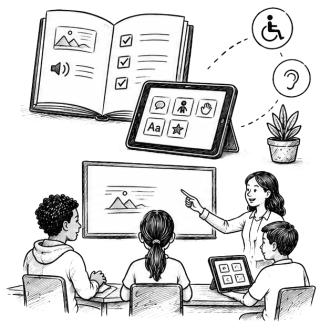
In practice, inclusive pedagogy means designing teaching and learning so that all students can participate meaningfully.
This may include:
- Flexible teaching methods
- Accessible learning materials
- Assistive technologies
- Multiple ways to communicate and participate
- Collaborative and student-centered learning
- Supportive classroom environments
Teachers play an important role in creating classrooms where all learners feel valued, respected, and supported. Support is designed to be available to anyone when needed, without stigma or exclusion.
Universal Design for Learning (UDL)
One important framework supporting inclusive pedagogy is Universal Design for Learning (UDL), which integrates flexible learning design and technology to provide multiple ways to access content, engage in learning, and demonstrate understanding. By adopting such approaches, educators can reduce inequality and create more inclusive and equitable learning environments.
The CAST UDL Guidelines are a tool that can be applied in any discipline or domain to help ensure that all learners can access and participate in meaningful and challenging learning opportunities.
UDL encourages educators to provide:
- Multiple means of engagement
- Multiple means of representation
- Multiple means of action and expression
This means offering different ways for learners to access information, participate in learning activities, and demonstrate their knowledge and skills. By reducing barriers in curriculum design from the beginning, UDL supports learner diversity and helps create more flexible and inclusive learning environments for everyone.
Building inclusive education systems
Delivering inclusive education requires coordinated action across many levels of society.
Policymakers and governments
Governments should:
- Align legislation with international human rights frameworks
- Ensure sustainable funding for inclusive education
- Include disability in education planning and data systems
- Support teacher education and curriculum development
Schools and teachers
Schools need:
- Accessible buildings and learning environments
- Trained teachers and support staff
- Appropriate learning materials and assistive technologies
- Inclusive teaching practices
Communities and families
Communities help support inclusion by:
- Reducing stigma and discrimination
- Encouraging participation
- Supporting learners and families
- Promoting positive attitudes toward diversity
Why inclusive education matters?
Inclusive education improves:
- Equity and equal opportunities
- Learning outcomes
- Social cohesion
- Participation in society
- Employment and future opportunities
When education systems include everyone, societies become more inclusive, sustainable, and resilient.
Checklist and practices
Inclusive pedagogy
- Support participation for all students
- Use flexible teaching approaches
- Encourage collaboration and active participation
- Create supportive and respectful learning environments
Universal Design for Learning (UDL)
- Provide multiple means of engagement
- Provide multiple means of representation
- Provide multiple means of action and expression
- Design learning experiences that reduce barriers from the beginning
- Offer different ways for students to access and demonstrate learning
Accessibility and learning materials
- Ensure physical and digital accessibility
- Use accessible learning materials and platforms
- Support compatibility with assistive technologies
- Provide alternative formats when needed
- Use clear structure, language, and navigation
Schools and education systems
- Train teachers and support staff
- Promote inclusive policies and planning
- Ensure access to appropriate support services
- Engage families and communities
- Reduce stigma and discrimination
Inclusive education is not only about access to school — it is about meaningful participation, belonging, and learning for every child.
Links and references
- Florian, L. (2015). Inclusive Pedagogy: A transformative approach to individual differences but can it help reduce educational inequalities? Scottish Educational Review, 47(1), 5–14.
- Florian, L., & Black‐Hawkins, K. (2011). Exploring inclusive pedagogy. British Educational Research Journal, 37(5), 813–828.
- Florian, L., & Spratt, J. (2013). Enacting inclusion: A framework for interrogating inclusive practice. European Journal of Special Needs Education, 28(2), 119–135.
- Handbook of Digital Rehabilitation in Health Care for East African countries (JAMK, RADIC project website)
- Educational Handbook of Digital Rehabilitation in Health Care for East African Countries (JAMK, RADIC project website)
- Inclusive education (UNICEF website)
- Inclusive education is a reality in Rwanda (UNICEF website)
- SKATE ICT/AT Competency Framework
- SKATE Guidelines: Inclusive classrooms for ECEC teachers
- The UDL Guidelines (CAST website)
- What you need to know about inclusion in education (UNESCO website)
See also this manual’s Online resource library and related research articles.